
It was Labor Day in Boston and the bronze ducklings in the city’s Public Garden were each wearing a fluffy autumnal scarf. Nobody seems quite sure who dresses them, but at various points they have worn party hats, festive knitwear and hot pink. When the Tartan Army arrived for the World Cup earlier this year, Mrs. Mallard and her ducklings – Jack, Kack, Lack, Mack, Nack, Ouack, Pack and Quack – were forced to endure miniature traffic cones and saltires.
The sculpture was created by Nancy Schön in 1987 to celebrate Robert McCloskey’s 1941 children’s book, Make Way for Ducklings. In 1990, former Soviet first lady Raisa Gorbachev visited Boston and admired the statue. So a separate set, commissioned in the name of diplomacy by Barbara Bush in 1991, sits in Novodevichy Park in Moscow.
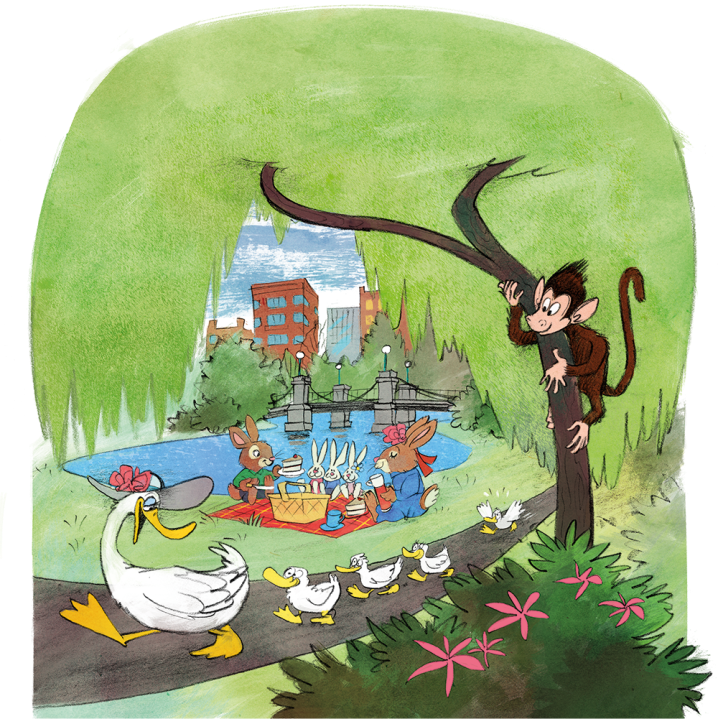
The book tells the story of a pair of mallards searching for a safe place to raise their family, faithfully mapping the geography of Boston Public Garden: the island, the swan boats and the cobblestones of Beacon Hill. And while the ducks are cute, it sure makes Boston look wonderful, too. “It’s quite a story,” an elderly Bostonian woman told me, as we watched children clamber over the ducklings.
Planes landing at Logan, ferries crossing the river, fire engines and cars zooming back and forth
I had never visited Boston but felt I already knew it a little through reading this story, among others, when I was younger. McCloskey’s classic is hardly unique in its setting; Boston’s cityscape helped inspire several iconic works, including H.A. and Margret Rey’s Curious George and Richard Scarry’s Busytown series.
I arrived wanting to understand what it was about the city that made the children’s literary scene so vibrant. It quickly became obvious, because walking through the beautiful brownstone streets is like walking through a charming children’s book.
My adventure began at the Newbury, the hotel adjacent to the Public Garden, which serves an afternoon tea in honor of Make Way for Ducklings. Everything from the teapot to the plates came decorated with illustrations from the book.
Fortified, I headed off to Charles Street, passing the duckling statue and the park’s swan boats, which were making their Labor Day swansong before disappearing until spring.
Beacon Hill Books & Cafe is a narrow townhouse turned literary haven. Its upper-floor children’s room is divine: pale blue, with a secret entrance and miniature furniture for young readers. While all the classics sit alongside contemporary releases, a staff member and several parents confirmed that there is still much affection for the iconic Boston books.
On one shelf sat a collection of Wedgwood Beatrix Potter figurines with a sign reading, “Please don’t take us, we live here!” It made me reflect on how different American children’s books felt from their English counterparts. When my father traveled to the US, he would bring back books. Where our English stories felt lovely and nostalgic – from The Wind in the Willows to Winnie-the-Pooh, Beatrix Potter to Brambly Hedge – the American tales seemed more buccaneering. The themes differed, too, often focusing more on the urban and the industrial. In Virginia Lee Burton’s The Little House (Burton studied at Boston’s School of the Museum of Fine Arts), the house is gradually engulfed by a growing city. In Mike Mulligan and His Steam Shovel, a machine eclipsed by diesel engines finds new life digging the town hall in Popperville.
If English fairy tales offered magical forests, faraway castles and quaint domesticity, American books celebrated the realism of everyday life. What Do People Do All Day? remains a great question.
Scarry was born in Boston in 1919, and he too studied at the School of the Museum of Fine Arts. While Busytown – populated by animals in overalls and bowler hats – is not a direct portrait of Boston, the city’s energy animates every page. From the top of the Prudential Center, I could see it all in full view: planes landing at Logan, ferries crossing the river, fire engines careering along and cars zooming back and forth. I half expected to see Rudolf Von Flugel fly by in his bratwurst balloon.
Across the Charles River in Cambridge, I reached Curious George-Town. When the Reys escaped wartime Paris with their Curious George manuscript hidden in their luggage, they eventually settled near Harvard Square in 1961.
Though the famous Curious George Store has long since closed, the red-brick buildings of the area are clearly the backdrop for the books. The couple even collaborated with Boston Children’s Hospital on Curious George Goes to the Hospital, helping make the experience less frightening for generations of young patients.
On a tour led by a brilliant guide named Sam from the Boston History Company, I learned more about why the city became the cradle of American children’s literature. The legacy traces back to the Puritans’ requirement that everyone learn to read to study the Bible, which spurred the creation of America’s first public schools. As the city’s literary and publishing ecosystem blossomed in the 19th century, books for young readers came to be valued as serious artistic endeavors. In 1868, Louisa May Alcott, who later lived on Beacon Hill, established a new template for storytelling with Little Women.
Police officers are important characters, the ducklings are stars, buildings are places of wonder
Credit also goes to librarian Alice M. Jordan, who developed the dedicated children’s space at the Boston Public Library from 1902. I popped in to see it: the room was humming with children reading – not all that quietly – while in the main reading room, adults slumped silently over their laptops.
Hoping to return home with more American titles for my children, I had arrived with a fairly empty suitcase. At the Brattle Book Shop, one of the country’s oldest used bookstores, posters display notable first editions sold in recent years: The Tale of the Pie and the Patty-Pan by Beatrix Potter ($5,000), Make Way for Ducklings ($20,000) and Ferdinand the Bull ($7,500).
Not able to spend quite as much as that, I browsed Boston’s shops – including Trident, Posman Books and the Harvard Book Store – picking up additional classics such as McCloskey’s Blueberries for Sal and One Morning in Maine, alongside new discoveries such as Miss Nelson Is Missing!. From Paul Revere’s house in the North End, I bought a copy of Henry Wadsworth Longfellow’s famous poem, illustrated by Ted Rand. Sam had earlier recited part of it to me: “Listen, my children, and you shall hear / Of the midnight ride of Paul Revere.”
Then at the Isabella Stewart Gardner Museum, I was delighted to find What Isabella Wanted, a book introducing younger readers to her Renaissance-inspired palazzo, with its fine collection of works by Botticelli, Giotto and Raphael.
Boston’s authors wrote (and still write, judging by the number of children’s books available) great stories. But they also taught children how to look at and appreciate a city. The police officers are important characters, the ducklings are local stars and ordinary buildings are places of wonder. The magic is right here, on the sidewalk.



Comments