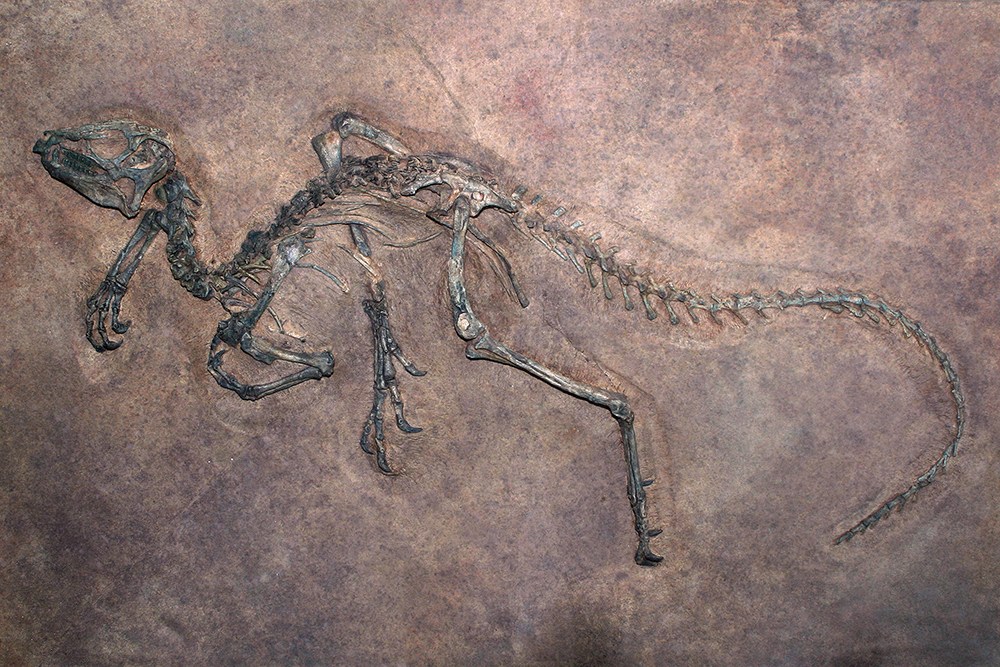


The best fossils, our guide explained as my fiancé and I trudged along a Yorkshire beach in the pouring rain, often look like nothing at all. He pointed out a grey-rust lump the size of a good jacket potato, handed me a hammer and showed me exactly where to smack it. The stone (a nodule, to give it its proper name) split open to reveal a ridged, coiled ammonite, flecked with golden pyrite, which had lain unseen for around 180 million years.
The rain that soaked us to the bone turned out to be a good thing, setting off lots of little landslides that dislodged fresh nodules to crack open – by the afternoon I had a dozen ammonites and the beginnings of an obsession.
People were collecting old bones long before they became my latest hobby. The Emperor Augustus kept a collection known as the ‘bones of the giants’. In Whitby the ammonites were thought to be snakes turned to stone by St Hilda, and enterprising locals carved snake heads on them to help the myth along. It was the discoveries of Mary Anning, the Lyme Regis fossil hunter, that transformed Britain’s Jurassic coast – she found the first complete plesiosaur among the Dorset cliffs in 1823. Within a generation the word ‘dinosaur’ had been coined, even if Anning herself had by the end of her life become ‘sick of fossils’.
One entrepreneur keeps the skull of a T. rex in the lobby of his firm’s HQ – the rest is too big to bring indoors
Our guide says the trade has since started to attract a rougher crowd, out to strip areas – including the British coast – of their oldest, most complete and most valuable specimens. Some are prepared to sell on the black market without disclosing what they have found, while others are simply drawn by the prices coming out of the auction rooms. Anning would have been startled by the sums involved. In July a Tyrannosaurus rex called Gus, who walked the Earth about 67 million years ago, sold at Sotheby’s in New York for $50.1 million to an anonymous buyer. For that the new owner gets parts of 183 bones out of the 300 or so a T. rex ought to have.
Gus took the record from Apex, a 27ft-long stegosaurus bought for $44.6 million by Ken Griffin, a hedge-fund billionaire whose favourite childhood toy was a stuffed dinosaur. Another billionaire, Dan O’Dowd, keeps the head of his T. rex in the lobby of his company headquarters, the rest being too large to bring indoors. A mystery buyer paid $12.4 million at auction a few years ago for the skeleton of a Deinonychus antirrhopus, the inspiration for the velociraptors in Jurassic Park.
For the anonymous billionaires, tech bros and even Hollywood stars, dinosaurs have become one of the latest status items, overtaking fancy cars and fetching higher prices than many of the Old Masters. Nicolas Cage beat Leonardo DiCaprio to a tyrannosaur skull at auction, only to be forced to return it to Mongolia when it proved to have been smuggled. Cage never got back the $276,000 he had spent. DiCaprio himself once sold a mosasaur skull from his collection to a drunk Russell Crowe for $35,000.

But it is worrying for the world of palaeontology. ‘A lot of the time fossils are going up for auction and being purchased by someone with financial means and that’s it – the fossil disappears,’ says Steve Brusatte, professor of palaeontology at the University of Edinburgh and a consultant on Jurassic World. ‘They might put it in a mansion or in a vault to gain value.’ He sees a ‘looming crisis’ as auctions and anonymous sales especially become more and more common.
In these exchanges, museums are often nowhere to be seen. Palaeontologists complain that a trophy skeleton in a private home or vault might as well still be underground, and that the extortionate prices encourage diggers who are more reckless – recording little, disturbing the surrounding rock and, in the worst cases, tidying up their finds with resin. But as Salomon Aaron, director of the David Aaron gallery in London, says: ‘Many dinosaur fossils wouldn’t be discovered if it weren’t for the private trade.’
Nothing dug out of a British cliff has fetched $50 million yet – Aaron says ‘there are amazing dinosaur fossils being found in the UK, just not on the same scale as the US’ – but even so our finds are not immune to foreign snipers. During the summer it emerged that one of the finest Jurassic collections assembled – 318 specimens gathered around Lyme Regis by a collector called Chris Moore – had been sold to the Natural History Museum Abu Dhabi for an eight-figure sum.
Moore had done the proper thing and offered them first to British museums. The Natural History Museum in London, which reportedly has ‘no money at all’ for acquisitions, had to decline, as did Museum Wales.
The potential relatives of those ichthyosaurs discovered by Anning 200 years ago now belong to the emirate that also picked up Stan, a T. rex, for $31.8 million. ‘It is a shame if a world-class collection of fossils is sold somewhere so far from where they’re from,’ Brusatte says, though he concedes that at least these ones will be on show. With an anonymous sale, he says, it ‘doesn’t really matter if the buyer is from Dubai or China’, since the fossil vanishes either way.
This latest sale was entirely above board. China, Mongolia, Brazil and Argentina all forbid the export of their fossils, whereas in Britain and the US they can be sold legally to private buyers. Natural history museums seldom have the purchasing budgets of the big galleries and would likely still be outbid by billionaires if they did. ‘Dinosaurs get such high prices that any public museum or university couldn’t afford them,’ says Brusatte. And Aaron expects ‘prices for the best dinosaur fossils will continue to climb’.
Had the gold flecks of my fossil instead been from the gold of a Viking ring, I would have been obliged to report it within 14 days so that a museum could have the chance to buy it, whereas a fossil hunter who digs up a new species of marine reptile is bound by nothing stricter than a voluntary code.
Our ammonites, I should say, are staying in Britain. They are lined up on the windowsill, worth no more than a couple of hundred quid – and so far nobody from Abu Dhabi has been in touch.



Comments