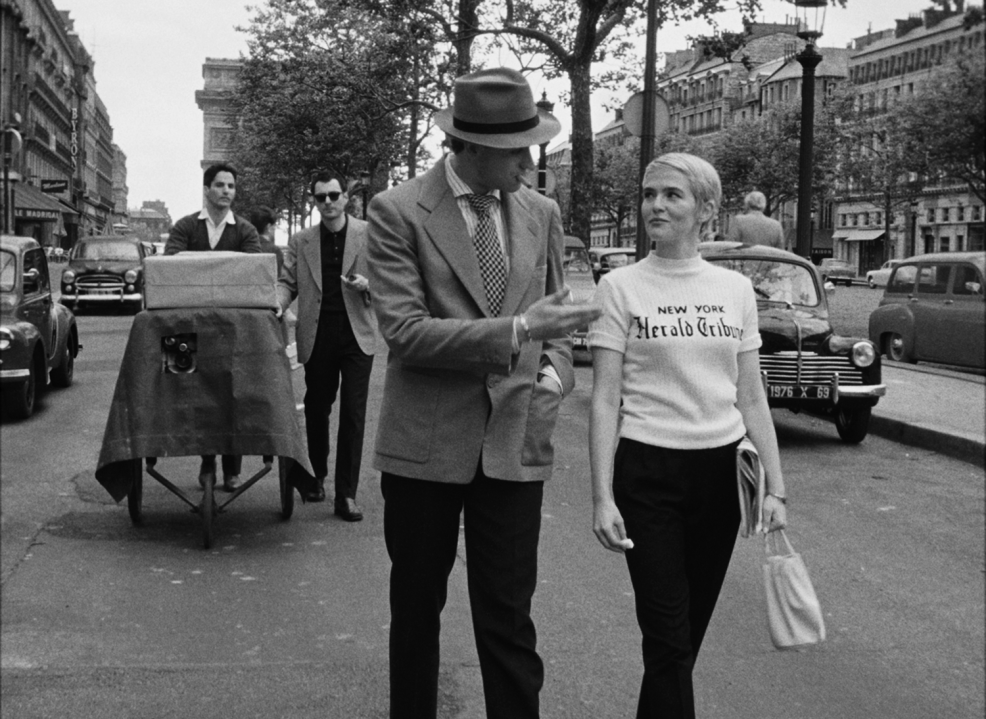
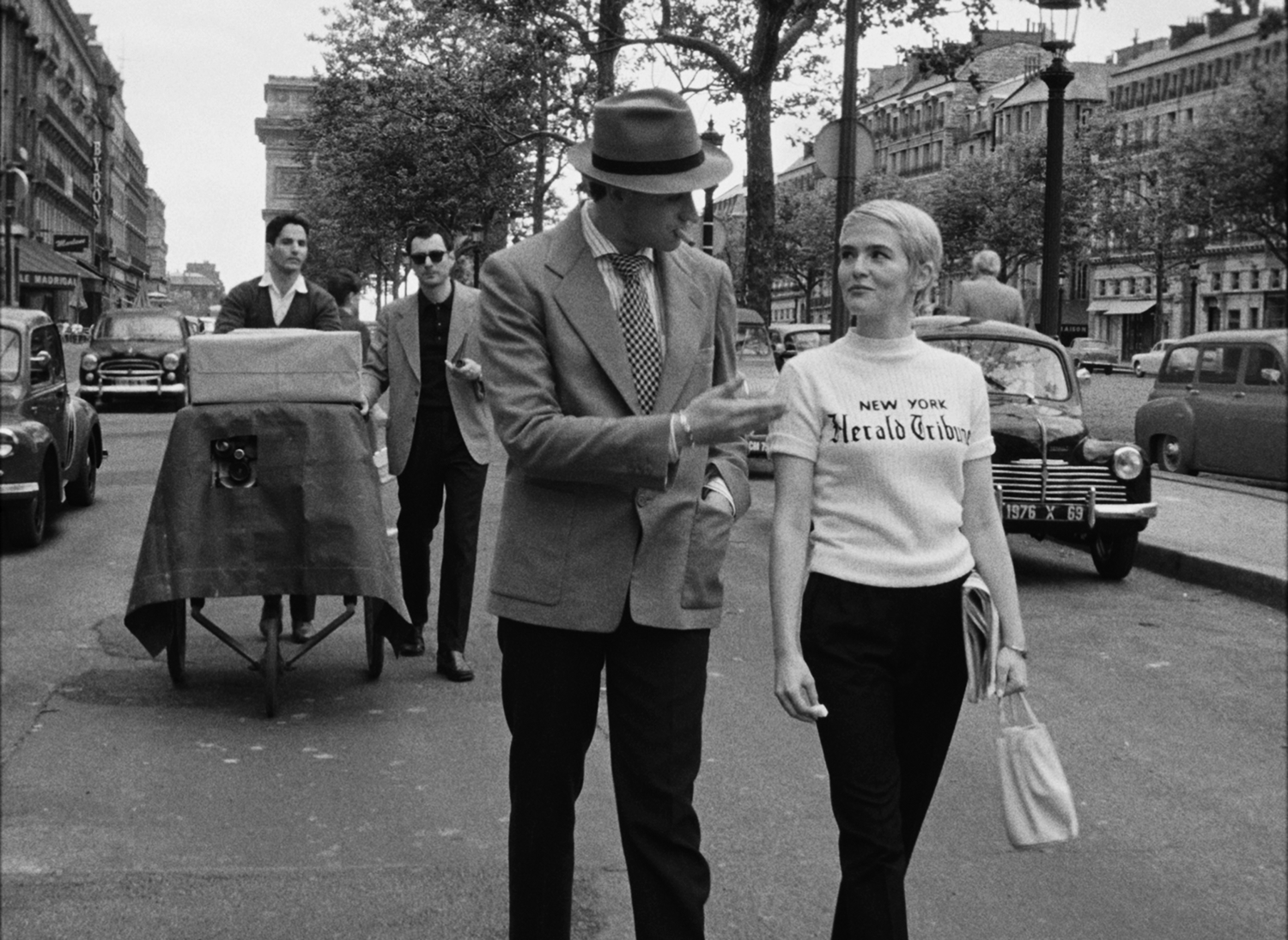
Richard Linklater’s Nouvelle Vague dramatises the (chaotic) making of Breathless (1960), Jean-Luc Godard’s French New Wave classic. It’s a film about a film, told mostly in the manner of that film, with the same kind of liveliness.
Godard is as impossible to comprehend by the end as he was at the beginning
It isn’t necessary to watch Breathless first by the way, although why not? It’s widely available on streaming platforms and, while it remains one of the most influential movies of all time, it’s just 90 minutes long. Christopher Nolan take note. You too, James Cameron. (His latest Avatar is three hours and 20 minutes, for heaven’s sake.)
Linklater certainly recreates the look, feel and sound. It is beautifully filmed in black and white, the language is French, and it deploys many of the New Wave innovations: natural light, handheld cameras, choppy cutting, a disdain for continuity. (This even, cheekily, has the ‘cigarette burns’ in the corner of the screen which signal to a projectionist when it’s time to change a reel.) It opens with Godard (Guillaume Marbeck) as a film critic working for Cahiers du Cinéma (and stealing from the petty-cash box). This is where both François Truffaut (Adrien Rouyard) and Claude Chabrol (Antonie Besson) started out but unlike them Godard has yet to direct and is desperate to do so. A producer, George de Beauregard (Bernard Dreyfürst), is willing to give him a chance but only if he shoots from a treatment already written by Truffaut about a sociopathic car thief wanted for murder and his American girlfriend living in Paris. Beauregard begs Godard: ‘I don’t want anything obscure… just a story that makes sense.’ Some hope.
Breathless starred Jean-Paul Belmondo and Jean Seberg, played here by Aubry Dullin and Zoey Deutch, who are both terrific. The film was anti-Hollywood – a living, daily creation. There were no sets. Instead, they worked in real cafés and bars and on the streets, with Godard’s cameraman hidden in a postal cart with a spy hole so they didn’t have to pay for extras or special filming permits. (For tracking shots, the long-suffering cameraman was pushed around in a wheelchair.)
Godard, who never removes his sunglasses, is capricious. On the first day of the shoot he leaves after one scene because he does not feel inspired. (He will often pack up when he’s not feeling inspired.) On the second day Seberg wants to quit. The script editor rarely sees a script, hence the film’s lack of any formal dialogue and all those non sequiturs. Godard is just as gnomic, quoting from the likes of Leonardo da Vinci: ‘Art is never finished, only abandoned.’ Beauregard tears his hair out. Godard made me want to tear my hair out.
There’s plenty here to fascinate. And it’s intelligent and funny. But the film is far too celebratory to be revelatory. Godard is as impossible to comprehend by the end as he was at the beginning. It also doesn’t go anywhere near the misogyny. Godard and the other directors might have invented a new cinematic language but they remained depressingly non-revolutionary otherwise. The camera treated Seberg solely as an object of desire. Scenes that wouldn’t land well today – Belmondo’s character is, for example, partial to creeping up behind women on the street and lifting their skirts – aren’t among those recreated here. You wouldn’t know any such scenes even existed from watching this. But it is a fun ride, and it does have a running time of 106 minutes, which isn’t too bad. Can our campaign to bring back the 90-minute film start here?
Comments