
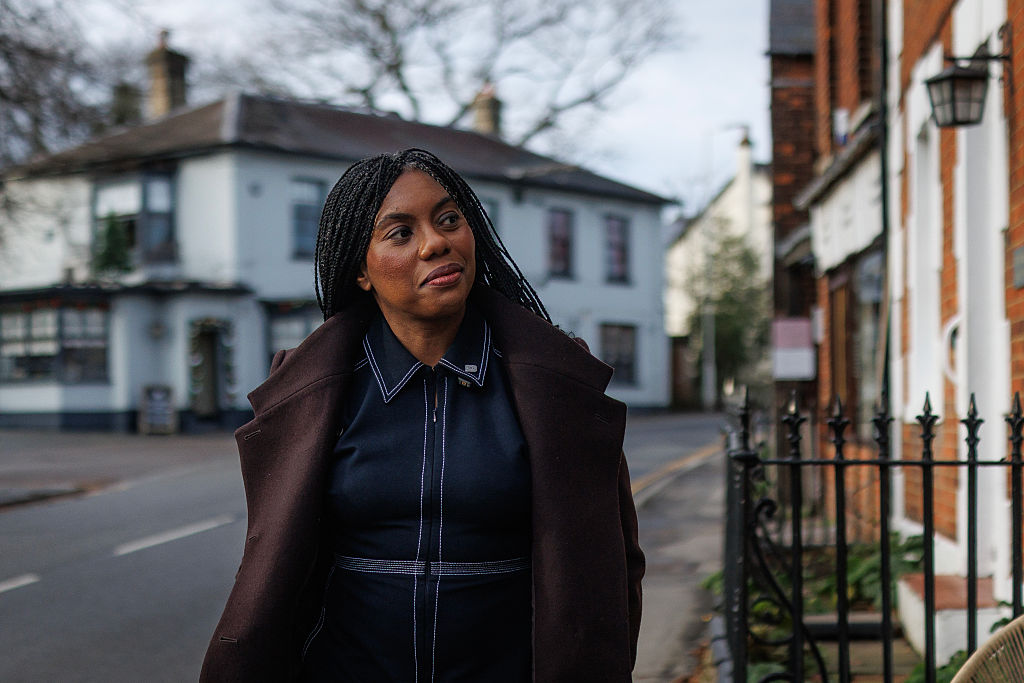
If Kemi Badenoch makes a speech during a war with Iran, does anyone hear it? Following the Gorton and Denton by-election – but seemingly before President Trump had decided to set fire to the Middle East – the Conservative leader had intuited that it was time to outline her party’s new approach to our fraught multi-racial democracy.
For now it is all buzzwords and no bite
Emphasis on multi-racial, not multicultural. Badenoch said she had seen what a true multicultural society looked like while growing up in Nigeria: a country divided, despite a shared skin colour, by religion, culture and priorities. A country that she had left to come to a Britain defined by fairness, the rule of law and a tolerance for minorities, especially Jews. Any past references to her ‘ethnic enemies’ suddenly seemed strangely far away.
Badenoch framed her speech in contrast to Keir Starmer’s ‘weak’ response to the Iran crisis, especially in hesitating before allowing the US to use British airbases to attack Iran. Starmer’s problem, she argued, was that he was hamstrung by Labour voters whose beliefs about Middle Eastern affairs ‘do not align’ with Britain’s best interests. International law is but ‘a fig leaf’; Labour are hobbled by ‘pure political calculation’ and ‘decades of failed integration policy’.
Handwringing about ‘family voting’ is a distraction. It’s unlikely that the Muslim wives of Gorton and Denton were raving Matt Goodwin fans, forced into voting for the Greens by their husbands. The bigger problem, she suggested, is a communalism driving wedges between different ethnic and religious groups. What is needed is to bring Britain together around a common identity and culture – a project that she hopes the Tories can lead.

Accordingly, Badenoch wanted to draw a line between sectarianism and ‘separatism’, which she defined as groups living parallel lives, being in Britain but not belonging, treating it as a country to use and not one to love. ‘Sectarianism’, she argued, is ultimately a product of this, whether it is religious extremists, or the diaspora politics that, as we saw in Gorton and Denton, puts foreign conflicts ahead of domestic priorities.
The losers of this are numerous. There are those who find themselves on the wrong sides of these separate communities, whether it is the girls brutalised by the rape gangs and then ignored, or British Jews who have been increasingly targeted. And there are victims within these communities, especially women and girls, who are deprived of their freedoms by men with backwards and coercive attitudes.
‘For too long’, Badenoch warned, ‘Britain has been complacent about out culture and too tolerant of those weaponising identity politics for their own gain’. Culture is not ‘just the food you eat, or the clothes you wear for a festival’. It is behaviours, norms and expectations, about everything from women’s rights to freedom of speech. For ‘integration to work, people have to know what they’re integrating into’ – a culture that ‘is strong and self-confident’.
But while a government can control that by restricting the flow of immigration, it cannot force people to integrate by banning burkas or handwringing over other particular practices. Platitudes about ‘muscular liberalism’ are inadequate when freedoms are exploited. Instead, we need freedom with boundaries – ‘muscular conservatism’. We want the courage, Badenoch suggests, to decide what we want to preserve in our society and then enforce it.
Punchy stuff. But what ‘muscular conservatism’ means in practice is still being decided. Badenoch announced a new ‘Cultural and Integration Commission’ which she has tasked with preparing a report in time for this year’s Conservative party conference. It will seek to outline the culture that she wants people to assimilate into. There will be ‘no more state-sponsored division’, an end to identity politics, and standardisation across public bodies.
Robert Tombs and Amanda Spielman will oversee a review of the curriculum to ensure it teaches a ‘coherent national story’ rather than cultural relativism, while The Spectator’s own Toby Young will review ‘institutional self-censorship’. Finally, Clare Coutinho, the shadow equalities secretary, will review the Equality Act in line with a ‘Meritocracy Test’ to ensure that it strengthens integration – central to her plan to ‘get Britain working again’.
All fine stuff. But it all seems a little too late. A series of reviews and consultations will not, by themselves, reverse the ongoing process of ethnic Ulsterisation that Gorton and Denton highlighted. It will not reassure those British Jews who see hate marches on their streets or wonder if our changing country is safe for them. Badenoch promises that hers will be more effective than previous integration strategies. But for now it is all buzzwords, and no bite.
A ‘Meritocracy Test’ or a patriotic national curriculum will not integrate a divided constituency like Gorton and Denton. Effective integration, in a multiracial society, requires some sort of force, a state-backed indoctrination. Look at the social housing projects of Singapore, with their racial quotas, or Wembley’s Michaela School, a successful model of integration based on the authoritarian but effective teaching methods of Katharine Birbalsingh.
Badenoch’s proposals are easily outflanked by those to her right. She seems oddly keen to keep the Equality Act in some form; Reform have pledged to scrap it. She is an eloquent enough exponent of a multi-racial Britain. But online, across the Atlantic and across Europe, the discourse is being dominated by advocates of remigration – who suggest that the integration of recently-arrived minorities is impossible.
By comparison, there is a nobility to Badenoch’s approach: a romantic, if outdated, attempt to preserve a Britain of multi-racial harmony that once seemed in reach but is now rapidly receding out of view. But just as the Conservatives have been outflanked on the right, you suspect her working groups will swiftly be overtaken by events, and those willing to give harsher but straighter answers to the public. In so many ways, Badenoch is yesterday’s woman.





Comments