
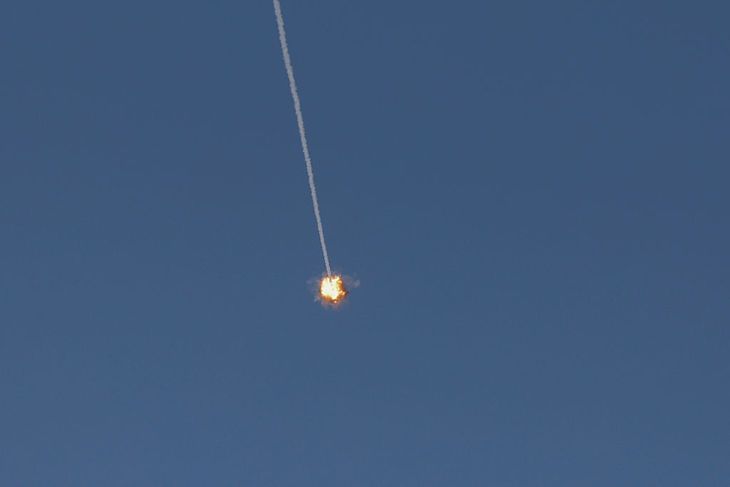
In March 1983, Ronald Reagan announced on television that the era of mutually assured destruction could come to an end thanks to developments in science which would make nuclear missiles ‘impotent and obsolete’. The US president’s aim of developing sophisticated interception systems was quickly nicknamed ‘Star Wars’ and would later become formalised as the ‘Strategic Defence Initiative’ or SDI. For a population which had been terrified to its wits’ end since the Soviet Union first developed nuclear weapons in 1949 the response was broadly positive, but in practical terms the building of a foolproof interception relied on untested technologies like particle beams and space-based lasers which were found to be impractical. For leftist historians and writers, ‘Star Wars’ became a symbol of Reagan’s emphasis on style over substance, the epitome of politics by television – though there is some evidence that it spooked the Soviet Union into coming to the negotiating table.
Britain’s real vulnerability against Russia is that we lack a robust conventional strike arsenal
With the ‘Britannia Shield’, Kemi Badenoch seems to be having her own Star Wars moment – albeit out of government. The press release had all of the marks of a policy stunt: the £10 billion costing, which is conveniently the cheapest way you can get to double-digit billions, and the tell-tale use of ‘Iron Dome’, borrowing the resonant Israeli metaphor also lifted by Donald Trump for his ‘Golden Dome’. Badenoch denies that the Tories want to call it the ‘Iron Dome’ and says this was made up by the media – leading ‘the media’ to refer the Tories to their own press release, in which the words ‘iron dome’ appear.
It is perhaps unsurprising that the Tories are now rowing back on the ‘Iron Dome’ comparison as it is wholly inappropriate for Britain. Israel is a small country with enemies in every direction who threaten it with cheap unguided rockets fired en masse. The other comparison used – Greece’s ‘Achilles Shield’ – is also a different context to Britain. Greece is positioning against Turkey; a part contiguous neighbour which could launch an attack with drones, aircraft and ballistic missiles like Tayfun.

‘Britannia shield’ would be designed to protect the country from Russian attacks. Iran barely has the means of striking mainland Britain, and if China is launching missiles at us, it will not be an exercise in ‘testing Nato’ but all-out war. Moscow is around 1,500 miles away from London while the edge of the Kaliningrad Oblast on the Baltic is around 750 miles from mainland Britain. Russia has access to long-range weapons like cruise and ballistic missiles. This includes weapons like the Oreshnik missile, which deploys warheads travelling at ten times the speed of sound. It’s a different world to what Hamas can deploy. Countering it requires extremely expensive exo-atmospheric interceptors like Israel’s Arrow 3, which Germany has committed to paying over $6 billion (£4.5 billion) for – and it is not even certain that it will work to block Oreshnik. That is before we consider other capabilities that Russia has such as hypersonic glide vehicles (Avangard) for which no country has developed a reliable interceptor.
It is true that Britain is poorly equipped for an aerial exchange with Russia. We have only six Type 45 destroyers capable of intercepting missiles, not all of which are at sea at any one time, a few Sky Sabre batteries which spend much of their time on deployment and a handful of Typhoon jets on alert for attacks. But given the intense expenditure demands that every branch of the British military is making for equipment, it does not logically follow that constructing a ‘Britannia shield’ is the wisest use of £10 billion. That is money which could be spent, as an example, on protecting and monitoring undersea cables. Or improving the dire condition of our barracks.
Perhaps the best way it could be spent is increasing our own offensive capabilities against Russia. It is almost always more expensive to intercept missiles than it is to launch them at targets, as interceptors are more sophisticated than the weapons they are destroying, which means investing in offensive missiles is almost always better value for money. Britain’s real vulnerability against Russia is that we lack a robust conventional strike arsenal, meaning that we would have to resort to either inaction or a nuclear exchange in a protracted back and forth.
This would not mean abandoning any defensive capabilities – launch sites and command centres need to be protected to make retaliation possible – but with ten billion pounds it would be possible to buy tens of thousands of cheap short-range missiles like Rusty Dagger – coming into service at the end of this year at a unit cost of $246,000 (£185,000) and can be fired from RAF jets or allied airfields. Or Britain could focus on cheap long-range missiles such as Flamingo and drones such as the Fire Point FP-1. The 2025 Strategic Defence Review pledged 7,000 long-range weapons and new munitions factories but the government is yet to fund this properly.
If Badenoch wants to deter Russia she should take inspiration from Margaret Thatcher rather than Ronald Reagan, and aim to improve deterrence by improving our offensive capabilities. In 1983, the same year that Reagan introduced Star Wars (which Thatcher was sceptical of), Thatcher faced down protestors at RAF Greenham Common and agreed to host 96 nuclear-tipped Tomahawk missiles to counter the Soviet Union’s SS-20s (those were a forerunner of the Oreshnik). The Labour party under Michael Foot had run on a campaign of unilateral disarmament and hundreds of thousands of people were marching in London under the banner of the CND. Her resolve was ultimately vindicated when, four years later, Reagan and Gorbachev signed the INF treaty abolishing intermediate-range missiles on either side – talks which ‘Star Wars’ almost collapsed at Reykjavik. Lasers and particle beams didn’t keep Britain safe from the Soviet Union. Missiles did.






Comments