
The longest postscript in sport is finally over. On the eve of the first Ashes test, which began on 21 November, English pundits were talking up their team’s best chance of winning down under in 30 years. Australia were old, slow and injured. Mark Wood, Jofra Archer and Josh Tongue would rough up the hosts with genuinely quick bowling. And Bazball, the only-good-vibes philosophy that had underpinned the team’s singular focus on the Ashes for the past two and a half years, would prevail. Such predictions proved as wild as Brydon Carse’s new-ball bowling. Australia mathematically retained the urn before Christmas. But in reality the Ashes were won on 22 November, the day after the series began. Two days was all it took for Australia to eviscerate an undercooked England team in the first test in Perth.
This is a puzzling Ashes to pull apart. The current Australia team is clearly not a patch on the vintage sides of 2001, 2006 or 2013. And England can be a devastating team when they click into gear. But for the first three matches they were a shadow of themselves. The captain, Ben Stokes, will have played through this series in his mind hundreds of times, but never did it turn out as badly as this. England have spent far longer trudging around Australia as defeated tourists than they have as a competitive sports team. Their final flogging in Sydney felt occasionally cruel.
But English introspection does Australia a disservice. This series was undoubtedly won by Australia, rather than conceded by England. And Australia won under unusually challenging circumstances. Their metronomic opening bowler, Josh Hazelwood, missed the entire series. Their captain and talisman, Pat Cummins, was half-fit for a single game. Their spinner, Nathan Lyon, played two games before tearing a hamstring. Opening batsman Usman Khawaja ricked his back in Perth, was shunted down the order and then announced his retirement. Steve Smith, their stand-in captain, got vertigo. Their debutant opening batsman, Jake Weatherald, only passed 35 once all series. In spite of this adversity, they administered a thrashing, needing only three matches and three players to do it.
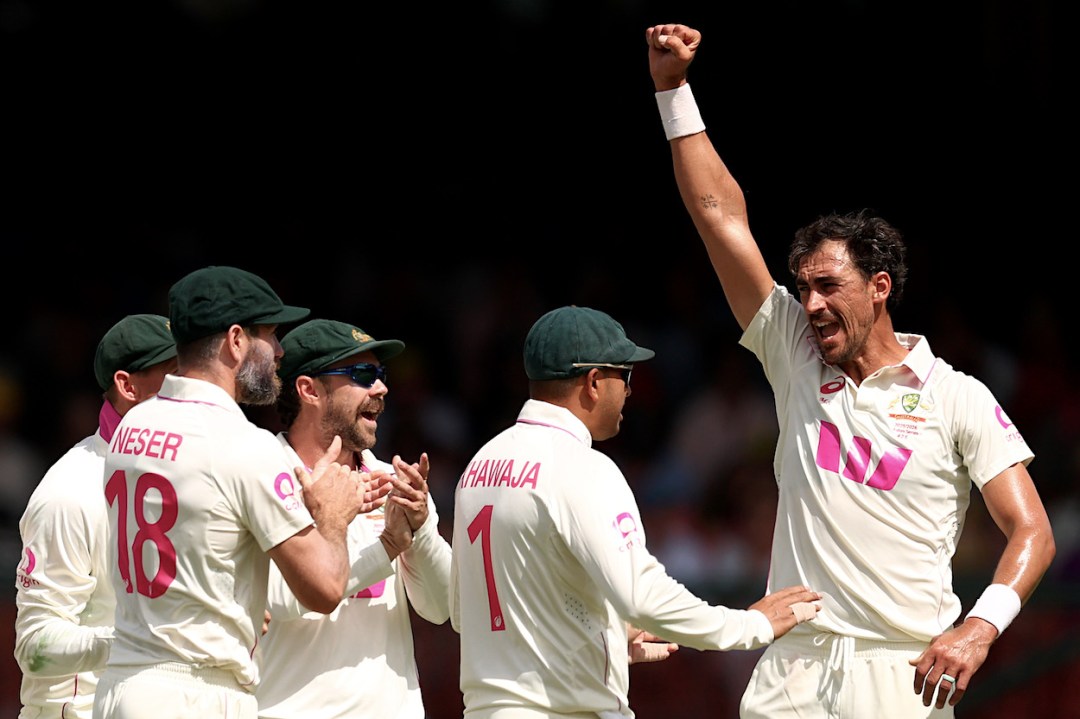
Mitchell Starc set the tone for the series in Perth. The veteran left-armer took his first England wicket before the English batsmen had scored a run. He added another nine in the match. Starc has been bowling on Australian pitches for almost 20 years; an England team full of batsmen playing a test match in Australia for the first time were woefully underprepared. Nevertheless, Starc accounted for England’s two most experienced batsmen, Joe Root and Ben Stokes, through clever plans perfectly executed. Root was fed a series of wide balls and then couldn’t help but nick a tighter one to slip. Starc gave Stokes an over of out-swingers and then a fuller ball that moved in and splattered his stumps. By the second innings Starc was in the zone; his other-worldly one-handed return catch from Zak Crawley evidence of a man operating at a higher level. Starc went on to take another eight wickets in Brisbane and then top-scored with the bat.
England actually kept pace with Starc in Perth, setting the hosts a target of 205, which required the biggest innings of the match. Then stand-in captain Steve Smith opted to promote moustachioed middle-order thumper Travis Head to open the batting. The reasoning was clear. If Head struck out quickly, then never mind. But in a low-scoring game, his ability to score quickly could put the pressure back on England. It proved a masterstroke. Head laid waste to England’s pace bowlers, smiting 123 runs from 83 balls. Australia reached their target in less than two and a half hours, leaving England punch-drunk. Head, now permanently promoted to opener, added another second-innings hundred in Adelaide and a third century in Sydney. He finished the series with 629 runs. No-one else managed more than 400.
They ended the Ashes with a bits-and-pieces team that will change considerably
And then there was Alex Carey, Australia’s understated wicketkeeper. England have regularly suffered at the hands of Australian glovemen. Even in the T20 era, Adam Gilchrist still holds the record for the fastest Ashes century with his 57-ball effort in Perth in 2006. Brad Haddin set new records for the most catches (29) and most runs (493) scored by a wicket-keeper in 2013. Carey is a less dominating figure than these predecessors, but his contribution was no less important. At Brisbane he stood up to the stumps to Australia’s fast-medium bowlers. This denied England the opportunity to attack them and eventually bought the crucial wicket of Stokes. At Adelaide he steadied a wobbly Australian first innings with a century, before adding 72 in the second. His immaculate keeping outshone his young English counterpart, Jamie Smith, whose series was dogged by dropped catches and reckless batting. That he hit the winning runs in Sydney was fitting.
This is not the start of a new era for Australian cricket. They ended the Ashes with a bits-and-pieces team that will change considerably ahead of their matches against Bangladesh, South Africa and New Zealand. Selectors need to find long-term successors for Khawaja, Hazelwood and Lyon, and then for Smith and Starc. However, the ability of team to blow away their oldest rivals, even in a time of transition, suggests a depth of talent and an appetite for the hard yakka that will have their counterparts at Lord’s looking on with envy.


Comments