

I have recently begun training for holy orders in the Church of England. I know, they’re getting desperate. My motivation for wanting to be a priest is selfish. I want more joy in my life. You might feel that joy is to be found in extreme sports, or pop concerts, or snorting coke from the midriffs of hookers. But I think you mean pleasure. Joy is deeper, linked to a sense of the goodness of existence.
It seems to me that joy is to be found in doing cultural things. I don’t mean going to plays or art galleries; I mean cultural things that are very participatory and democratic. Things like this: getting to know people who are different from me, through putting on a little play, making stuff for a festival and seeing some local children enjoying it, singing a rousing song. This stuff feels, sometimes, like authentic culture. In fact, as I see it, the secret to human fulfilment is participation in festivity – communal meaning-making fun.
Within the dirgey and naff music you notice that there is a spirit that holds this disparate bunch together
You may say you get this from Glastonbury or the Eton-Harrow match (or both), but to my mind these things are not sufficiently open to the wellsprings of meaning and purpose. There is a unique wideness and depth to religion, and those who have tasted it can be satisfied by nothing smaller. Other subcultures are likely to attract a certain sort of person – religion doesn’t settle for that, it seeks to be cross-class, cross-cultural. And it earnestly addresses the meaning of life.
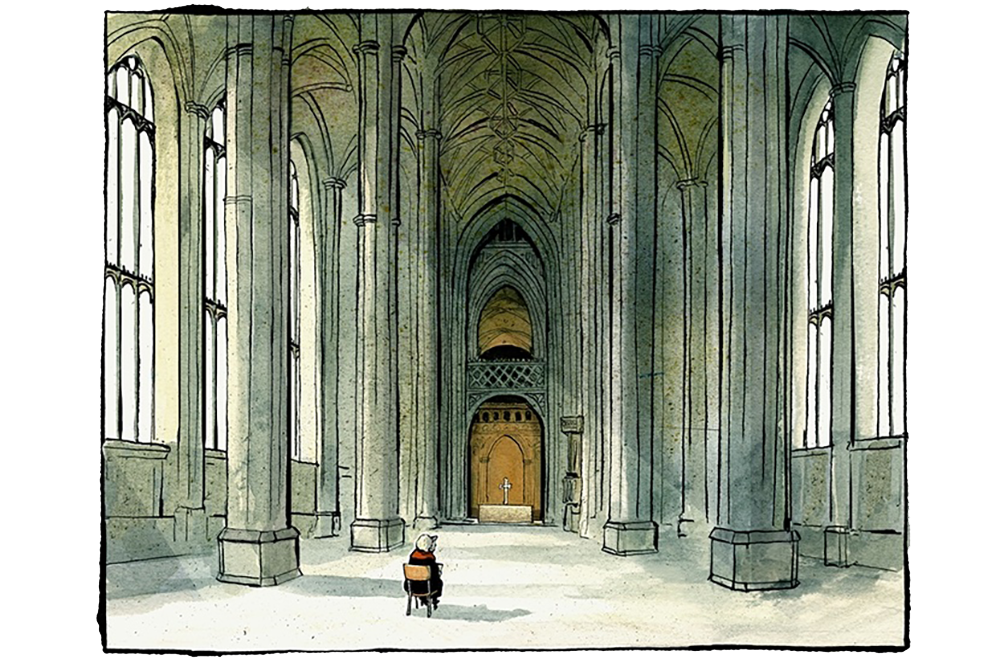
This all sounds good, you may be thinking, but in practice my local church is an uninspiring place, with a bunch of old ladies and assorted other oddballs, and music that alternates between dirgey and naff. It doesn’t look like the pinnacle of authentic culture and true community. Fair point. I’ve wrestled with it for decades, this gap between how church ought to feel and how it does feel. All I can say is that if you stick with it, it starts to feel a bit more like it ought to feel. Within the dirgey and naff music you notice that there is a spirit that holds this disparate bunch together – when they sing the prayers, they mean it, and in a way no other bit of culture is quite as real.

For years I felt like this: I half-like church, or feel the need for it, but I can’t really be myself there, because there’s a slightly fake pious atmosphere. But it gradually grew on me: secular social life is also a bit fake, everyone’s showing how laid-back and unjudgey they are, treating everything as material for repartee, and keeping their sincerity half-hidden. I’m someone who wants a bit more earnest shared culture as a ground for ‘being myself’. Social life has never felt quite enough, much as I like some of my friends.
So church has grown on me. One way of putting it is that in every other group or public meeting, whether a book talk or a PTA, there is something I don’t like the smell of. I always sniff something cliquey or snobby or chippy or self-righteous, or ideologically dodgy. But Anglican worship (unless it’s one of the sectarian fringes) feels miraculously inoffensive. It’s just some local people trying to worship God in an open-minded way, trying to keep the rumour of Jesus alive. It feels like a miracle that in a world full of dodgy creeds, the one creed I fully approve of has a weekly meeting in my local high street. Some weeks I don’t feel that keen on turning up. Then I think: imagine if it shut down, this 150-year-old church, and became flats or a carpet shop. (Some weeks, I imagine this and still don’t turn up, to be honest.)
But why go the whole hog? Why not just be a layman? I suppose I feel the need to nail myself to the mast. Maybe it’s because I have a strong secular side and feel that my life gravitates that way unless explicitly redirected. Or that I don’t feel I have a very clear role in the world, and this might help.
It has taken a long time, my calling (I’m 53). For many years I kept my distance from church, despite being keenly Christian. One aspect of this was finding church rather dull, as I have said. But I also wondered whether organised religion was defensible – didn’t it always have a dubious authoritarian side? For some years I felt that the C of E was intolerable; it seemed to entrench this tradition in nostalgia. I have come to see that the Church’s establishment ties it, very benignly, to political and cultural liberalism.
Another reason for delaying is that priests are meant to exemplify Christian goodness. I felt that I had a good side but a prickly, proud, neurotic, angry side too. And even my good side was a bit muted compared with those energetic do-gooder types (including, annoyingly, lots of agnostics). I guess I needed a bit more time than some to trust that my good-ish side might be good enough.

In the weeks leading up to my final interviews, I tried to get it clear in my mind what a priest is. One thought was sparked by an article in the New Statesman, a dialogue between Gordon Brown and the actor David Tennant, both sons of ministers. Tennant said that his father was a talented performer who could have become an actor if certain opportunities had been open to him. This struck me as an enormous misunderstanding, to imply that being an actor is a bigger deal than being a minister. It struck me that a priest is a sort of anti-actor, a performer who understands that one role is worthy of being inhabited for real, for life.
A related thought was that a priest’s uniform is more substantial than other professional uniforms. He or she brings narrative stability to the world. So does every other type, you could say, but maybe there is an ambiguity to every other type. A politician might make moral speeches but have a dodgy personal life. A priest might have a dodgy personal life too, but it would be more jarring – he or she has signed up to a consistency of narrative function that is unique.
Does this mean a priest has to be predictable and so a bit boring? I suppose that was my assumption for a long time. But in reality no form of human life is boringly stable, free of edge and angst and creative possibility. In fact, Jesus told us to be an interesting mix of good and edgy (cunning as serpents as well as innocent as doves). For a while this thought held me back. Me, a priest? Nah, I’ll lose my edge. I fretted on, repeating the phrase ‘I’ll lose my edge’, until methought I heard one saying: ‘You’ll lose your edge? You’ll use your edge.’



Comments