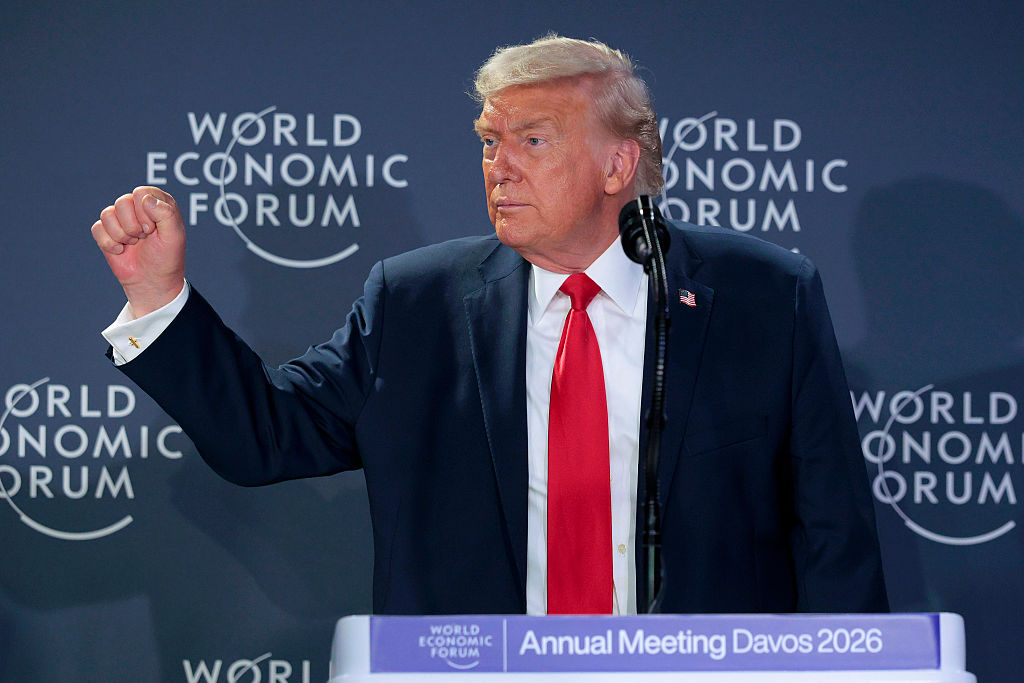

Donald Trump has completed the first year of his second presidency – and remains a truly divisive figure. He may have pulled back, after an absurd escalation, from his apparent threat to annex Greenland by force. But European leaders continue to berate him for his turbulent behavior in international affairs, and a growing number of Republicans are turning against his erratic foreign policy.
Last week, the cry on global markets was “Sell America,” after the President ratcheted up trade hostilities with long-standing US allies by announcing yet another round of punitive tariffs on several European countries for refusing to agree that America should own Greenland outright.
The US is a gathering economic success story which continues to pull away from the rest of the world
But then Trump abruptly withdrew his new tariffs against Europe over Greenland, the markets recovered and those selling their US stocks were left wondering if it wouldn’t be better to take investment advice from the President himself. He told his audience at Davos that the indices are going to double. That may be a little fanciful – although Trump didn’t provide a time frame for his prediction.
But the latest report from the Bureau of Economic Analysis found that in the third quarter of 2025, US GDP grew at an annualized rate of 4.3 percent. That is a level which has only briefly been exceeded in the past half century, on a couple of occasions in the 1980s and 1990s, along with the artificial boom which followed the equally artificial slump of Covid.
It must be dawning on Trump’s critics that his disruptive economic and trade policies are in danger of becoming a success. Experts insist that his mercantilist approach ought to be a miserable failure, curtailing the free-trade policies which have enriched the world in recent decades, for the US especially. Yet, as Trump enjoyed pointing out to the denizens of the World Economic Forum, his Liberation Day tariffs have not sunk America or the global financial system.

The evidence does not lead entirely in one direction. For instance, the manufacturing sector, around whose interests the President’s tariff wars are based more than any other, has shed 68,000 jobs in the past year.
Nevertheless, when Trump boasts that he has rebalanced US trade without causing the inflation that many people feared, he is essentially correct. The real value of exports has risen by 8.8 percent in the past 12 months, while the value of imports has fallen by 4.7 percent. Inflation is steady at 2.7 percent.
Trump is right, too, to contrast the “economic engine” that is the US economy with a stagnant Europe. It is possible to see an element of sour grapes in Europe’s renewed attempts to stifle the success of IT giants such as X, Google and Meta through regulation.
It is now America and Southeast Asia which are shaping the world, while Europe’s principal role descends into one of genteel vacation destination. There is little prospect of changing in the short term, not least because of the self-denial that is European energy policy.
Trump is right to be scathing of the UK, of which he said at Davos: “They’re sitting on top of the North Sea, one of the greatest reserves anywhere in the world. But they don’t use it, and that’s one reason why their energy has reached catastrophically low levels with equally high prices.”
Trump is also right to raise the ongoing problem of public debt in developed nations, though he hasn’t made all that much progress balancing the books at home.
There is a risk that the growth in national wealth is not being felt among his natural blue-collar supporters. While economic growth motors ahead, real wages are bumping along at a rate of 1 percent growth. Stagnant living standards among low-income groups – one of the main reasons for Trump’s victory over the Democrats in 2024 – must be on the President’s mind as the midterm elections heave into view. Trump has committed to rebalancing the market for domestic real estate against corporate investors and in favor of ordinary people – in the hope of making housing more affordable.
The surprising success of Trump’s first term was his foreign policy. Talked of as a warmonger at the beginning of his term, he calmed tensions in North Korea, achieved recognition of Israel among some Arab states and stifled Iran’s ambitions for a while. Since negotiating a peace deal in Gaza, however, Trump’s second term is threatening to descend into disaster on the international front. His efforts to persuade Vladimir Putin to end his war in Ukraine have so far failed and suddenly he is riling US allies without much cause.
As the Europeans are at pains to point out, the US can have many more military bases in Greenland if it wants them. Yet, like a boorish loudmouth in a golf club, Trump insists on insulting allies for their historic weakness in the face of hostile actors.
On the domestic front, it could be argued that things have turned the other way. After an indifferent first term, which saw him failing to fulfill his promise to stop illegal migration, he has made significant strides in his second term. The southern border has now effectively closed to illegals. And Trump has not merely barked at the DEI officials who are trying to creep left-wing ideals into universities and government institutions; he has fired them.
On the home front, then, Trump’s America is no declining superpower. On the contrary, notwithstanding various ongoing problems in the real economy, the US is a gathering economic success story which continues to pull away from the rest of the developed world. Those who sell America may find themselves regretting it.
This article was originally published in The Spectator’s February 2, 2026 World edition.

Comments