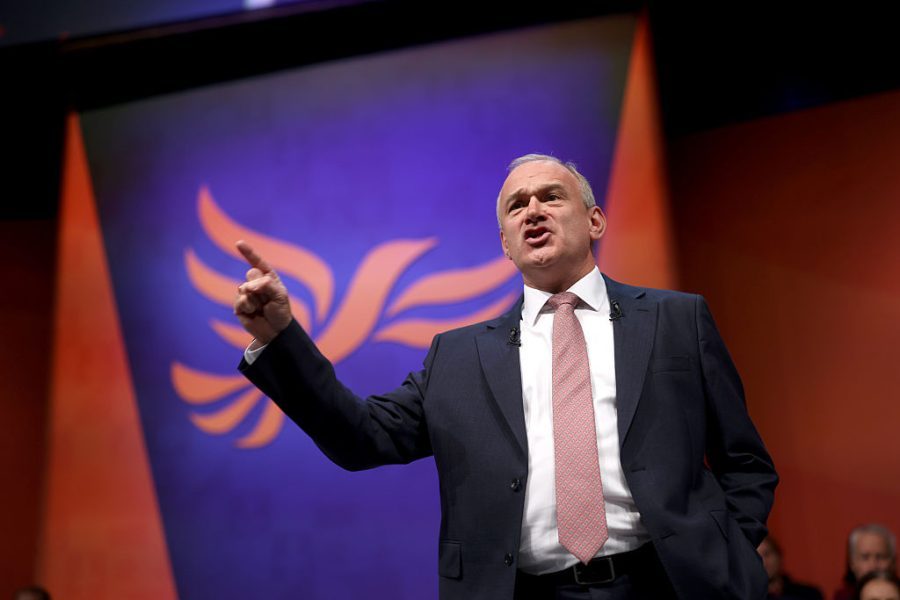
Ninety years after Liberal leader Archibald Sinclair made the case that military weakness invited aggression, a new generation of liberals is talking about rearmament. At this year’s Liberal Democrat conference in Brighton, on the same day that leader Sir Ed Davey delivered his viral ‘We care! We fight!’ moment, the party approved a new defence and security policy which, it hopes, demonstrates how far the party has come over the last decade.
The party argues the plan provides ambitious targets for defence spending, while reframing existing policies about the need for greater cooperation with allies through the lens of collective security. For a party best known for its stance on an issue of foreign policy – being anti-Brexit – the Lib Dems hope a stronger line on defence and security will help shore up the middle class vote, alongside its bolder economic policies, particularly in the south east.
Foreign affairs spokesperson Calum Miller has said that ‘the global security landscape has reached a dangerous tipping point’ with the party identifying Russia, China and Donald Trump as the biggest destabilising forces. While Putin presents the most obvious challenge and the most unifying for the party, the Lib Dems argue that ‘China’s ambition to become the dominant global power’ creates ‘systemic vulnerabilities’, particularly around critical minerals and technology. US president Donald Trump, meanwhile, is presented as an unreliable partner who undermines international institutions.
For now, the Liberal Democrats are more bullish about their electoral prospects
These threats led to Lib Dem members approving the policy paper, which commits the party to the 3.5 per cent defence target by 2035 of Nato (including 1.5 per cent for additional security spending). While this matches Labour and Conservative policies, the party has an interim target of 3 percent by 2030 – which is more ambitious. The policy also pledges £20 billion in defence bonds, ‘smarter’ defence security and ‘unwavering’ support for Ukraine, as well as a new civil defence force.
In pledging to use defence to deepen relationships with European partners – including creating a new defence council – the party has moved away from a debate on Europe that was reduced to Remain vs Leave to argue that the UK should rejoin the single market. This allows the party to argue that Europe makes Britain safer, as well as richer, rather than saying simply that Brexit was a mistake.
The old adage is that foreign affairs doesn’t win elections but, in an era of fragmented politics, the Lib Dem think they have spotted an opportunity. The party’s conference in Brighton was optimistic in part because it is confident it can hold on to the new seats it won in 2024, and a sensible and robust defence policy is one way it feels it can do this. The party won 72 seats at the last election; huge swathes of these were seats that had previously always voted Conservative while also voting Remain in 2016. The calculation is that these seats are full of voters who may never vote Labour but are not yet ready to trust the Tories again and are internationally-minded enough to understand how foreign policy impacts the domestic.
Within the context of rising external threats, Ipsos polling suggests that defence is now the third-highest government investment priority for the public, above housing. While the Tories remain the most trusted party nationally on the issue, the polling is close: they lead on 33 per cent, while the Lib Dems are on 24 percent. Confidence in Labour has been trending down, especially coupled with criticism from military figures about the speed with which the government is pursuing rearmament. It is no surprise that Burnham is talking up the threat of Russia at the UN to try to demonstrate Labour are taking it seriously. Thus, rearmament is an issue which suits the new Lib Dem electorate and could help the party solidify its hold in these seats.
Speaking to Lib Dem activists in Brighton, they painted this as less about the party changing and more about reacting to a changing world. Following Putin’s full-scale invasion of Ukraine, the party – which previously had a strong pro-nuclear disarmament arm – shed its scepticism of the Trident nuclear deterrent, a policy which previously undermined the party’s ability to appear serious on defence and security. It still argues for a more financially efficient and sustainable nuclear deterrent, but it accepts the need for one.
While Russia’s war with Ukraine provided the biggest external shock, the Lib Dems being reduced to a rump of MPs in 2015 provided the opportunity for the party to be reborn, attracting new figures and working out where it stood on defence policy. The party also benefited from the Tory chaos following Brexit, attracting serious figures including former civil servants like Bicester MP Calum Miller and ex-military servicemen like Tunbridge Wells MP Mike Martin. It is hard for opponents to argue that the Lib Dems are irresponsible on defence and security when they have attracted so many establishment figures.
In a new era of political fragmentation, the Lib Dems have also benefited from a rising Green party, which may have attracted their more fringe left-wing members. While Ukraine features heavily in Lib Dem thinking, the party has been insulated from the more toxic debate over Israel and Gaza.
There is a strong liberal tradition of arguing that military strength is necessary to uphold collective security, and their new policy should be seen within this context. That’s not to say there aren’t challenges. While Ed Davey has modelled himself in opposition to Trump, it is not enough to be anti-Trump; the Lib Dems need to explain what Britain’s relationship with the US should look like.
With talk of a special relationship with the EU and the importance of new relationships with ‘middle’ world powers, Mark Carney and Canada’s example – as the Lib Dems see it – very much hung over this conference. This was especially the case after the announcement last week that Canada was being considered for ‘associate membership’ of the European Union (and Britain would not be). It’s easy to say Britain should be closer to countries like Canada, but what should its relationship be with middle powers which are more contentious for liberals, like Saudi Arabia or Modi’s India?
For now, the Liberal Democrats are more bullish about their electoral prospects, despite the polls. Their growing overlap with Labour on defence, Europe and the broad architecture of foreign policy could also make negotiations easier were they ever to hold the balance of power – particularly if the current speculation about an early election under Andy Burnham proves well-founded.
There is a warning in the party’s own history however. Sinclair spent the late 1930s urging Britain to rearm as the European security order deteriorated – yet there was little electoral reward. In 1945, the Liberals lost seats, and Sinclair himself lost his own (extraordinarily finishing third with only 61 votes behind the winner). He was the last liberal leader to serve in government before the 2010 coalition. While this is not the 1930s and Davey is no Sinclair, his predecessor’s fate is a reminder that identifying a threat and devising a serious response is no guarantee that voters will notice. If, as the Liberal Democrats now claim, ‘liberalism faces its gravest challenge since 1945’, their challenge is hoping that enough of the electorate agree with them.






Comments