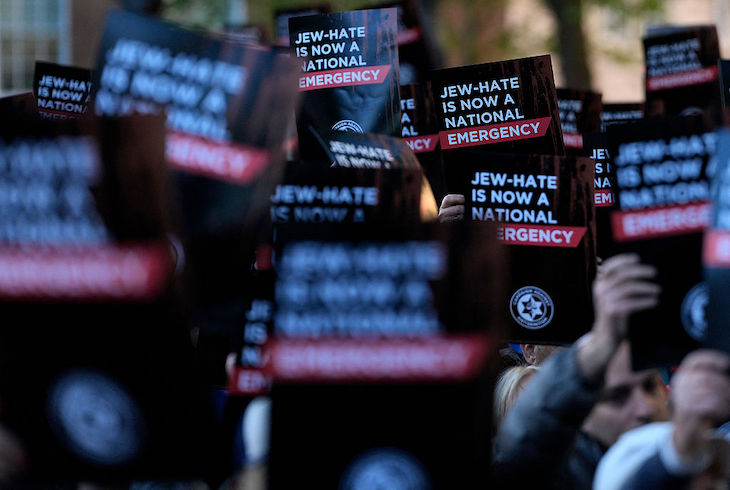
It’s a toss-up as to which is the least surprising: today’s new Community Security Trust figures showing another surge in antisemitic incidents, or the inane (to put it charitably) government response to those figures.
Antisemitism is no longer something that rears its head and then falls in a repeating pattern. It is now part of life in the UK
In the first six months of this year, CST recorded 1,926 antisemitic incidents: the second-highest six-month total ever reported and a 21 per cent increase on the same period last year. Indeed, there were more incidents in the first six months of 2026 than in all of 2022 (the last year before the October 7, 2023 massacre). No month so far in 2026 has had fewer than 200 incidents, with over 350 in March, April and May.
But it’s not the rise in itself that is so chilling. It’s the fact that no one will be in the least surprised. The real shock would be if there was a significant fall in antisemitic incidents. Which is, of course, the real point to take from all of CST’s figures since 2023. A fall would not be merely a shock; it is unimaginable. Antisemitism is no longer something that rears its head and then falls in a repeating pattern. It is now part of life in the UK.
When the first real surge in antisemitism occurred during Jeremy Corbyn’s Labour leadership, many of us – I include myself – naively thought that the poison he allowed to be injected into politics and public life was some sort of ceiling. It turns out that this was, rather, the floor. Corbyn’s time as Labour leader let the genie out of the bottle and it will never be put back. But even those levels of Jew hate were trifling compared to where we now are.

I’ve written here before about my view that the low level of antisemitism seen for several decades after 1945 was a historical aberration. Many of us thought that something had changed after the Shoah – that open Jew hate had become socially unacceptable. In many ways that was correct. But as we can now see, that was a temporary phenomenon in response to the obvious evil of the Holocaust. In recent years we have reverted, as it were, to the mean. History shows that antisemitism is the norm; the periods and places where Jews have been able to live free of it are the aberration.
CST’s latest figures confirm the existence of a new floor for Jew hate. That has many causes, but the seeping of openly antisemitic attitudes into the mainstream, often via social media, has been one of the most powerful drivers of Jew hate. Likewise, the take-over of institutions such as NGOs, the arts, quangos, broadcasters, the church and even the police by graduates taught to think in universities dominated by post-modern lecturers and departments has provided a fertile foundation for Jew hate to grow.
A survey conducted last month found that 28 per cent of all Brits believe Jews hold most of the world’s wealth and power. Forty per cent believe a secret group controls major world decisions – a classic antisemitic conspiracy. More than a quarter of undergraduates believe the October 7 attacks were “defensible”.
And that’s without even focusing on Muslim attitudes. Policy Exchange’s JL Partners poll of Muslims in high-density English areas in April found that 45 per cent say Jews have too much power over the media, 42 per cent over banking, 39 per cent over Parliament (as opposed to the general population’s 17–19 per cent); and 25 per cent hold a favourable view of Hamas.
No wonder 82 per cent of British Jews say antisemitism is a very or fairly big problem and 35 per cent rate their safety in the UK at 0–4 out of 10. In the LSE’s recent “Listening to British Jews” report, British Jews describe abandonment by the police, the education system, the media and the legal system, and a “climate of fear” centred on everyday harassment rather than spectacular attack. The novelist Howard Jacobson spoke recently of how he and his wife now ask the question they have never before asked: had they been in Berlin in the 1930s, when would they have left? This is a question asked routinely in Jewish households – only more so, since the question asked is now usually a more immediate version: ‘When might we have to leave here?”
The government’s response to today’s figures came from the Minister for Policing and Crime, Sarah Jones, who described them as “appalling” and pledged to “never stop fighting to rid society of this evil”, citing the government’s recent pledge to spend £250 million boosting policing in Jewish neighbourhoods. That is, of course, welcome. Better to have police tackling antisemitic attacks than not. But even better to have a government which doesn’t fuel Jew hate by turning on Israel, one of our country’s most important and reliable allies, and treating it as an enemy state. The list of calumnies and smears pushed by ministers could fill a longer column than this. Within two days of becoming defence secretary, for example, Wes Streeting, said that the IDF has “fallen short” of British soldiers’ standards – without producing a shred of evidence. As Andrew Fox has written: “I spent sixteen years serving under British military standards. Having seen both wars [Gaza and Afghanistan] up close, the only standards I can say with confidence have fallen short are those of Britain’s Defence Secretary.”
The government is scared witless of the threat posed to its vote by the development of sectarian Muslim candidates. Its response has been to turn on an ally defending itself from Islamist terror. This, and its passivity in the face of the regular hate marches through London and elsewhere, have both had a devastating influence on the rise of Jew hate, making a bad situation far worse. Spending money to tackle the hate which it has helped fuel is no answer.






Comments