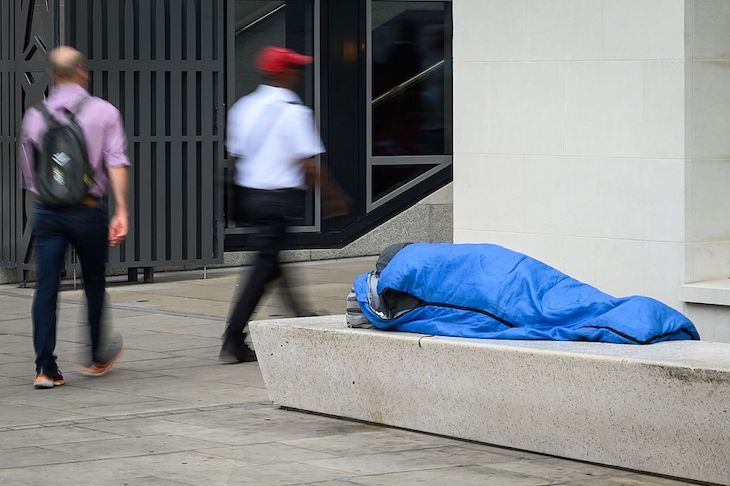
Andy Burnham has gone further than any of his predecessors have in years in attempting to address rough sleeping in Britain. A large sum of money and a focus not just on housing but also some of the underlying causes of homelessness is as good as this kind of policy usually gets. Alas, even this attempt by the Prime Minister is doomed to fail, as it misses a critical ingredient: what to do about those rough sleepers who refuse help.
Some rough sleepers are fairly well-organised, some are coerced into crime by gangs, some are able criminals in their own right
Though only a small proportion of those classed by the government as ‘homeless,’ rough sleepers are still fairly numerous, and visible beyond their numbers. Almost eight thousand people slept rough at some point over the month of March, according to the Ministry of Housing, Communities and Local Government (MHCLG). That number has been rising year-on-year since 2021, when the Tories’ drive to end rough sleeping – something they promised in the run-up to the 2018 election – seemingly lost momentum.
Worse, the true number of rough sleepers is likely far higher due to the government’s inadequate data collection methods. In fact, over the course of 2025/26, there were probably around 13,000 rough sleepers in London alone. The England-wide number is plausibly three to four times that.
This is why, two years ago, I criticised Mayor of London Sadiq Khan over his boast about investing an extra £10 million to “eliminate” rough sleeping in London: a tiny amount relative to the problem at hand. Burnham’s commitment is much more serious: £442 million, and intended not just to provide accommodation but also medical and addiction care.
This is the right focus, as accommodation is largely a one-time fix. The popular perception of the homeless as a largely fixed population which, once accommodated, would only begin to grow again slowly, is false. At least sixty per cent of rough sleepers are new to rough sleeping – either because they never slept rough in the first place, or because they had been in accommodation for years before re-lapsing into homelessness. Consequently, even if you housed every rough sleeper this very moment, in just one year the homeless population would be around two-thirds of what it is now. Addressing the underlying causes of homelessness – addiction and poor health amongst them – is the only way to solve the problem properly.

Unfortunately, addiction and health support is not enough. Some rough sleepers will refuse such help even when offered; or may indeed be sleeping rough for different reasons altogether.
I once spent several years regularly volunteering for a charity providing the homeless with soup, sandwiches, showers and so on. Much of it involved walking around and approaching rough sleepers, then asking them if they wanted anything.
There was a particular group which always occupied the same road. Initially wary, they eventually warmed up and even became happy to see us. They operated a system where, normally, only one of them was ever begging, and the others were lying around, with one gentleman also serving as a sort of group spokesman.
But one late autumn night, the group disappeared. It took a couple of months for them to re-appear. When I approached the spokesman as usual, I asked him where they had gone while handing him the sandwiches. He was happy to inform me he had gone back to his home country to see his family, where they live! And was even so kind as to show me he was currently video calling them on his phone. I did not dare to ask why he had gone back to rough sleeping given he evidently had a place to stay abroad and resources to travel.
Some readers on the right might imagine that most, if not all, rough sleepers are like this. But the truth is that, for the average homeless person, the situation is dire. They die at 44 and the help they are offered is often terrible. Rough sleepers would tell me that, during the winter, they would rather brave the cold than go to the local homeless shelter because they are then forced to be in proximity with less-than-sympathetic people who can be loud, violent or steal from them. Indeed, mortality in homeless shelters is just as bad as when sleeping rough.
Some others would be restricted from entering on account of their untoward, often intoxicated, behaviour, but this does not mean they do not deserve help: I am reminded of an anecdote where, supposedly, C.S. Lewis and a friend were walking to a pub when somebody asked Lewis for change. He acquiesced, and his friend confronted him: “You know he will just spend it on alcohol?” to which he replied, “What do you think I would do?” One can hardly be surprised somebody in such a bad place might want to take their mind off things.
But the left errs too far the other way. They deprive rough sleepers of almost any agency. Some rough sleepers are fairly well-organised, some are coerced into crime by gangs, some are able criminals in their own right. Indeed, what incentive is there not to commit crime if the punishment is being provided with a roof?
Perversely, good measures to tackle rough sleeping can in fact worsen the numbers. Berlin spends more than 13 times as much per person (!) on help for rough sleepers than Burnham plans to spend in Britain, yet the city still hosts around 4,000 of them: roughly the same ratio of rough sleepers per person as London. Some of this may be due to inefficiency, but the likeliest explanation is that many would-be or current rough sleepers travel across Europe to get to Berlin, precisely because they can and want to travel to the place where they know they can get help. Burnham himself even recently acknowledged this.
So long as petty crime pays, so long as our borders are poorly controlled, and so long as we do not cooperate with countries where the would-be homeless are coming from, the problem will never be fully solved. A comprehensive rough sleeping strategy needs to go deeper – even deeper than addiction and health treatment do.






Comments