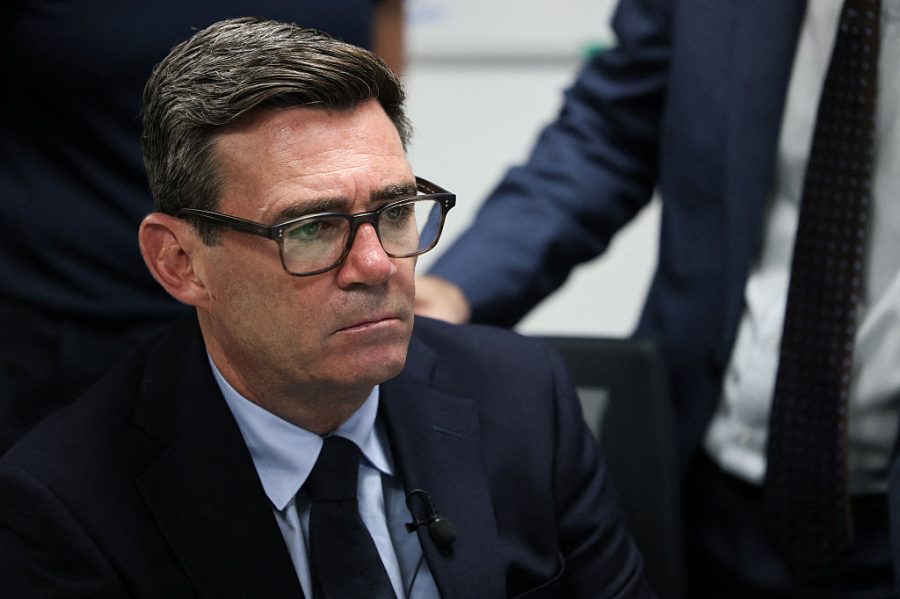
Since becoming prime minister just three weeks ago, Andy Burnham has focused on two key words: ‘hope’ and ‘justice’. And yet, in a world riven by conflict, persecution and repression, he has so far had little to say on how those aspirations will translate into action in foreign policy.
The fact that the first foreign leader Burnham invited to Britain since becoming prime minister is Ukraine’s wartime president Volodymyr Zelensky is a very welcome sign. It builds on the leadership the United Kingdom has offered in support of Ukraine under all four previous prime ministers who have held office since Vladimir Putin’s illegal invasion in 2022. But if Britain is to play a leading role in defence of freedom and democracy under Burnham, he must do much more to signal how he will pursue hope and justice in the world.
Of course, there are the immediate priorities: Ukraine, Iran, Gaza. In domestic policy, however, Burnham has championed advocacy for the forgotten corners of the world. To translate this into foreign policy, he must look beyond the headlines. China deserves Burnham’s attention – as well as two other forgotten human rights crises where Beijing sides with the oppressors: Myanmar and North Korea. In addition, he should explore the question of the crime of crimes: genocide determination.
These challenges represent an axis of tyranny that poses a fundamental challenge to our freedoms and democracy
Burnham’s new foreign secretary, Ed Miliband, has baggage when it comes to China. He is under growing pressure to fulfil the Labour party’s commitment, made while the party was in opposition, to recognise the genocide of the Uyghurs. One of his first priorities ought to be to root out and ban imports from China made by slave or prison labour, a widespread and well-documented practice in the country. But if the new prime minister’s broad vision is to be lived out, then a fundamental review of key foreign policy priorities – and how we advance our values within that – is needed.
The former Conservative party leader and co-founder of the Inter-Parliamentary Alliance on China (IPAC), Sir Iain Duncan Smith, responded to the High Court’s decision last month to approve the Chinese mega-embassy in London by seeking a meeting with the new prime minister on China policy as a whole. He is right to do so – I hope higher courts will hear the appeal against the decision to approve China’s mega spy base.

But even if they don’t, Burnham must start by tackling China’s transnational repression of its critics and exiled diaspora communities across Britain. He must insist on the immediate and unconditional release of British citizen Jimmy Lai from jail in Hong Kong, demand the release of Chinese student Tara Zhang Yadi, due to begin her studies in London last year until she was arrested in China simply for promoting understanding of Tibetan culture, and advocate for the release of prisoners throughout China – whether human rights defenders, religious leaders, or civil society organisers.
Burnham should urge Xi Jinping to free eight detained pastors and leaders of Zion Church, following the release last month of its founder, Pastor Ezra Jin Mingri – the result of a direct appeal from President Trump during his China visit. He should roll back Keir Starmer’s kowtow to Beijing and insist on a robust defence of our values and security.
Britain also has a responsibility to lead the global effort to end the dire and desperate human rights and humanitarian crisis in Myanmar. The government must demand the immediate and unconditional release of democracy leader Aung San Suu Kyi and the more than 14,000 political prisoners held in Myanmar’s jails. They must ensure accountability for ongoing and unmitigated mass atrocity crimes in the country.
The news last week that Suu Kyi met with officials from the International Committee of the Red Cross is a welcome response to her son Kim Aris’s request for proof of life. But Britain must press the regime for more. Miliband should meet with Aris, a British citizen, at the earliest opportunity. He should also meet with representatives of Myanmar’s pro-democracy and ethnic nationality resistance forces to discuss how to force an end to the junta’s almost daily bombardment of civilians.
Even more importantly, Miliband must review our sanctions apparatus, impose new targeted sanctions against the Myanmar junta, and do everything possible to cut channels of funding, fuel, and weapons to Myanmar’s illegal regime. He should continue to reject the sham elections in Myanmar and the legitimacy of the new ‘civilian’ government: changing from a military uniform into presidential dress has not changed the nature or illegality of the murderous Myanmar junta.
At the UN General Assembly next month, Miliband should spearhead a diplomatic effort to discuss, coordinate and implement action in response to Myanmar’s crisis, mobilise international aid and intensify efforts to pursue accountability for mass atrocity crimes. He would do well to heed one of his predecessors, Jeremy Hunt, on the issue.
Meanwhile, North Korea too often gets put in the ‘too difficult’ box, but its atrocity crimes place the country in a category of its own. Its horrific human rights record should not be ignored. With North Korea potentially providing as many as another 50,000 troops to support Russia’s war in Ukraine, it is not some far-off country of which we know nothing: in partnership with Russia, it is a totalitarian threat on Europe’s borders.
While these challenges are just three among many, they represent an axis of tyranny that, together with Russia and Iran, pose a fundamental challenge to our freedoms and democracy. But they also represent a challenge that a new piece of legislation is designed to help address.
The Genocide Determination Bill, which passed its second reading in the House of Lords just before the summer recess, is pioneered by Lord Alton of Liverpool, with cross-party support. It is designed to help the government answer a difficult question: what constitutes genocide, how can it be prevented, and when can it be prosecuted and punished?
My colleague Peter Bouckaert, who worked for twenty years as Human Rights Watch’s emergencies director, documenting atrocity crimes around the world, has argued that if we are to prevent genocide, we must first identify it, which this Bill will do. For years, successive governments have used a circular argument along the following lines: genocide is a legal term and as such should be determined by the courts, not by politicians. Yet no court in Britain is empowered to make such a determination.
This Bill will change that – taking the decision out of the hands of governments and enabling our courts to receive supplications and make determinations of the crime of crimes. The Bill will depoliticise ‘genocide’, yet also offer a course of justice that has not hitherto existed.
What is being asked of Andy Burnham on genocide, then? It’s very easy. It’s simply to give this bill parliamentary time. Ideally, the government should support it. If it won’t do that, at least it should not seek to block it or whip its benches against it. Not if it is really a government of hope and justice – what greater cause is there than to ensure the world ‘never again’ experiences a holocaust or genocide?
Burnham and Miliband have an opportunity to reset foreign policy, as they have to reset domestic policy. In so doing, they must remember that our freedom and security are crucial to both. We must diversify economic relationships, reduce strategic dependencies, de-risk key investments, and defend our values. Rebooting, rewiring and reviving our economy is crucial, but it must never be at the expense of genocide, crimes against humanity, war crimes or other brutal and egregious human rights violations around the world. If hope and justice are the watchwords of a Burnham government, they must apply to our relations with the rest of the world just as much as they do at home.






Comments