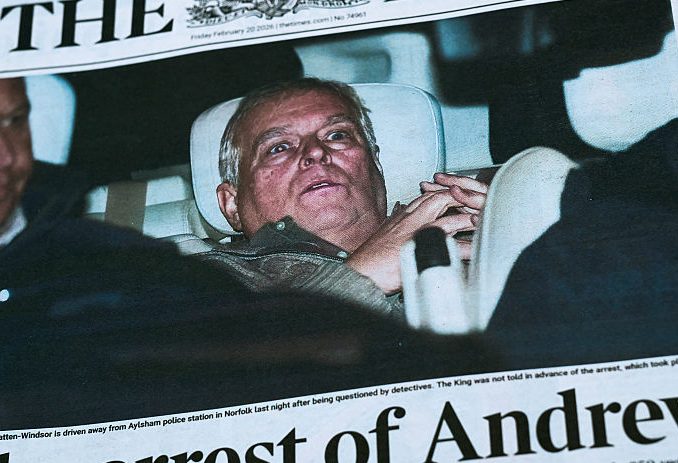
For future royal historians, the date 19 February may take on the same totemic significance as the abdication of Edward VIII on 10 December. It was the date that Andrew Mountbatten-Windsor, eighth in line to the throne, was arrested on the day of his 66th birthday – it is fair to surmise this wasn’t a coincidence – and taken to Aylsham police station. Before yesterday, Aylsham was an unexceptional North Norfolk market town, perhaps best known for the presence of a firm of fine art auctioneers. Now, it will forever go down in history as the place where the former Duke of York was taken, put in the cells, and interrogated.
A few weeks before, a rather different image was dispersed from the Epstein files, showing Andrew smirking as he was poised over a spreadeagled and anonymous woman. The picture that was released to the media yesterday told its own story. Now, there was a ghastly, even disturbing image of a frightened man, devoid of the privilege and protection that his rank had previously offered him. He looked like most of us would if we’d spent the day being grilled by senior detectives about precisely what he’d done during the most examined period in recent history. Andrew has consistently denied any wrongdoing.
Well, it is now clear that worse was yet to come in the form of a criminal investigation
He didn’t know it was coming. The fact that neither Andrew nor Buckingham Palace was briefed about his arrest says an awful lot about both the speed with which this story has gone from being a source of prurient speculation to an active criminal investigation. It also shows the way in which King Charles has chosen to step back from offering any kind of support to a member of his intimate family in unknown circumstances.
Melanie McDonagh rightly observed yesterday that the King’s statement omitted the words ‘my brother’. It was not a warm or personal offering, but it was very necessary. Yet Andrew, when he was finally released from Aylsham’s cells, would have read the words that his brother sent out into the media with terror. They were uncompromising and offered him no succour whatsoever. They are, incidentally, without any kind of precedent:
I have learned with the deepest concern the news about Andrew Mountbatten-Windsor and suspicion of misconduct in public office. What now follows is the full, fair and proper process by which this issue is investigated in the appropriate manner and by the appropriate authorities. In this, as I have said before, they have our full and wholehearted support and co-operation. Let me state clearly: the law must take its course. As this process continues, it would not be right for me to comment further on this matter.
Andrew would have realised, if ever there was any doubt, that he is now on his own. The royals have been distancing themselves from him with alacrity for months now, but they have always hoped that this will not become the nuclear issue that it has become. No member of the royal family has been arrested since Charles I, and any armchair historian will know how that panned out. If the former Duke of York does not fear judicial decapitation, he at least is aware that his reputation has long since sunk into the mire and that recent events have made matters immeasurably worse.
The Firm will be holding crisis talks today with a mixture of sorrow and panic. Andrew was not cast asunder until more recently than the average subject might have assumed – remember those photos of him at the Duchess of Kent’s funeral last September – because it was hoped that, even after the publication of Andrew Lownie’s reputation-shredding biography Entitled, the worst was past. Well, it is now clear that worse was yet to come in the form of a criminal investigation, and the question is what anyone can do about it. That image of him in the car – wracked, wretched and ruined – might make the average observer feel pity. But the situation has moved a long way beyond such normal emotions. Who knows where we will end up.



Comments