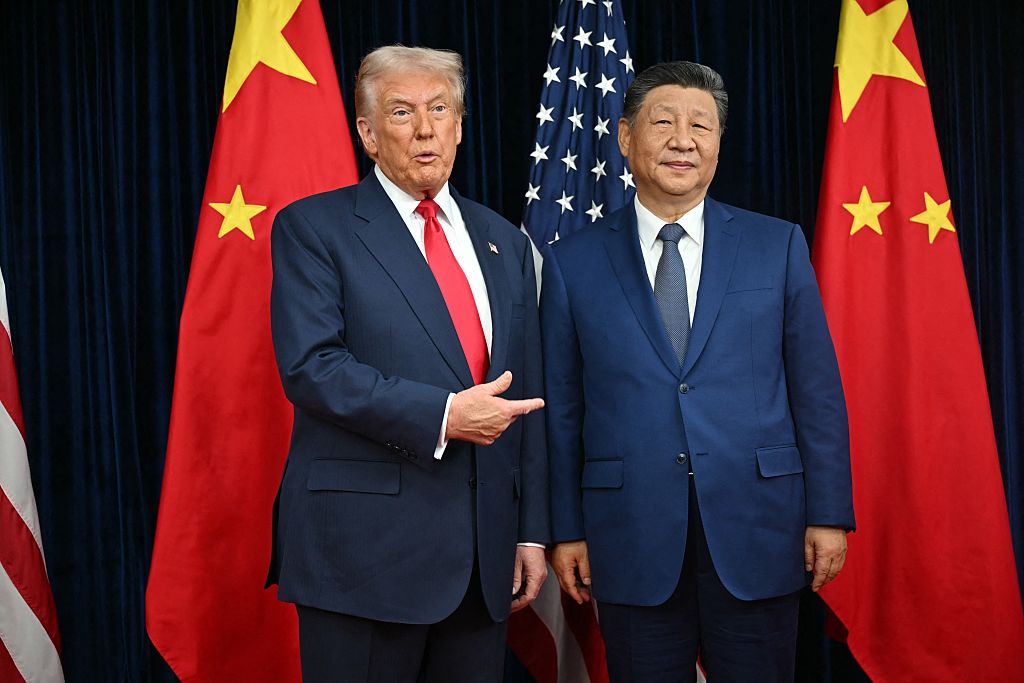
The Trump administration has released a list of CEOs who will be accompanying the president to his meeting in China with Xi Jinping. Foremost among the delegation is Elon Musk, traveling in his capacity as CEO of Tesla and SpaceX. Another notable inclusion is Tim Cook, in what may be his swan song international trip as Apple CEO.
All told, 17 executives will accompany President Trump to the People’s Republic of China (PRC). Their companies represent sectors ranging from banking and investment to automobiles and AI. Their asks of Xi will likely range from market access (Coherent) and advertising (Meta) to component orders (Boeing) and soybean purchases (Cargill).
On paper, President Trump should take business leaders with him to China. It’s the world’s second largest economy, and, for better or worse, countless American companies rely on the Middle Kingdom for their revenue projections.
In reality, Trump should temper his expectations. Xi has worked to decouple China’s reliance on foreign markets for years. The strain that these companies are experiencing is a custom-designed feature of Xi’s economic policies, not a bug.
As Trump calibrates his diplomatic outreach in Beijing, he should pursue two objectives: avoid transferring valuable technology to CCP-controlled competitors, and target his negotiations leverage where it will matter most – namely, human rights.
Of the executives traveling with the President, three of them are enmeshed in artificial intelligence. Micron produces memory chips and has lost significant revenue from Beijing export controls, imposed in response to US export controls.
Coherent produces optical transceivers, which integrate advanced graphics processor units in AI data centers. But Chinese export controls have restricted Coherent’s access to critical minerals, which has particularly harmed the company because it holds over 3 million square feet of manufacturing and R&D facilities in China.
Illumina is a biotechnology company that makes DNA sequencing machines. As such, it competes with the Chinese champion BGI. In March 2025, Xi restricted Illumina’s access to China in response to US tariffs.
Negotiating over AI policy with the CCP is wrought with pitfalls. In exchange for Micron concessions, Xi could well ask Trump to rescind export controls on Chinese memory chip companies.
In Coherent’s case, the President should consider whether the US government should allow tech sales of optical transceivers to Chinese companies at all, given their crucial role in AI data centers.
Finally, fighting for market access in China for Illumina will be difficult after Trump last year signed the BIOSECURE Act, which restricted the use of CCP-controlled genomics sequencing in the US.
Notably absent from the delegation is Nvidia CEO Jensen Huang, a proponent of relaxing export controls on advanced AI chips for China. That may signal the administration has tempered expectations for what it can accomplish.
Trump should park his summit capital where it can reap maximum returns: human rights
The wild card in the CEO deck, though, is Elon Musk. He is one of the most influential business executives in the Trump White House, and has a complicated history with China. In March 2025, Musk reportedly requested a Pentagon briefing on America’s war plans with China, much to Trump’s public concern. In early 2022, Tesla announced the opening of a showroom in Xinjiang, the location of Beijing’s ongoing genocide of Uyghur Muslims, an atrocity which Musk has reportedly downplayed. He has also parroted CCP propaganda about Taiwan, dismissing the island-democracy as “an integral part of China that is arbitrarily not part of China.”
Instead of listening to interlocutors like Musk or getting sucked into policy negotiations that Beijing will likely violate in due course, Trump should park his summit capital where it can reap maximum returns: human rights. To his credit, the president has already committed to raising the cases of Hong Kong media tycoon Jimmy Lai and Christian Pastor Ezra Jin Mingri. There are other political prisoners worthy of Trump’s attention: Gulshan Abbas, a Uighur physician, and Pastor Gao Quanfu and his wife Pang Yu. On Tuesday the House of Representatives is poised to pass a resolution calling on President Trump “to prioritize securing the humanitarian release” of these individuals in his meeting with Xi later this week.
Why focus on political prisoners? It’s the right thing to do, yes – but it’s also Trump’s strongest leverage over Xi. The CCP lives in fear of its own people daily, which is why the party routinely imprisons them. Raising these cases isn’t box-checking diplomacy; it’s putting pressure on Beijing’s most acute vulnerability.
If Trump gets bogged down in questionable market access requests, he will be playing on Beijing’s turf and asking for concessions, thus empowering Xi. When he shines a spotlight on Xi’s draconian policies, however, Trump will reverse the power dynamic and gain the upper hand. If the president is in search of leverage on his way to Beijing, he need look no further than the brave businessmen, pastors and mothers in Chinese prisons.


Comments