
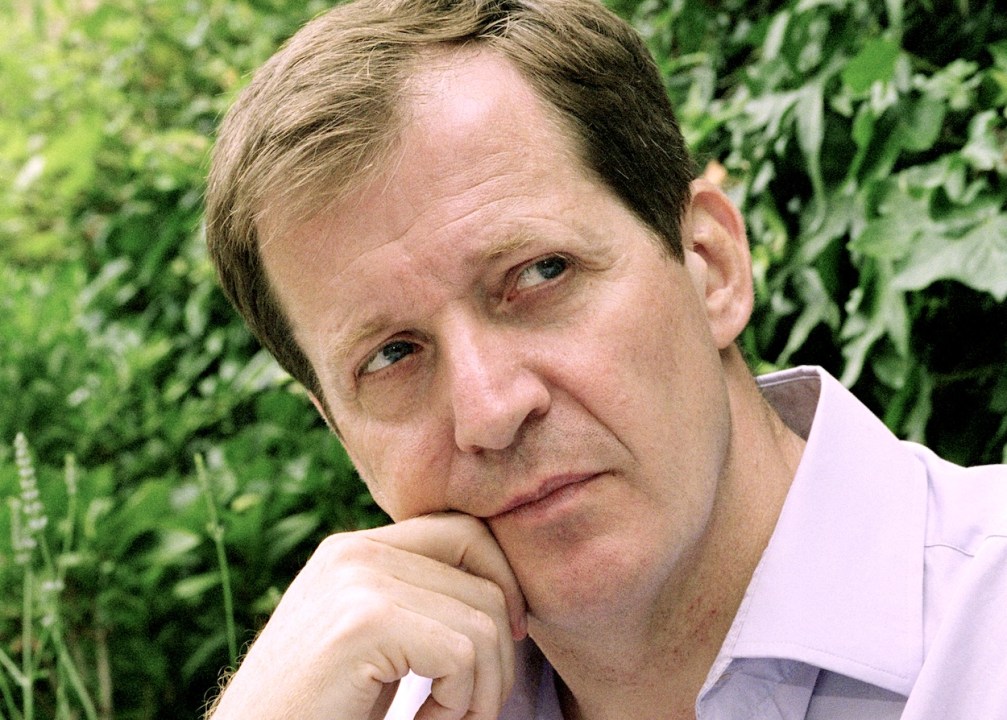
Please, one last indulgence, implored Alastair Campbell. The previous two hours had been bad enough, sitting through Campbell being ‘interviewed’ by former Today host Mishal Husain about his godawful new self-help book. And the hours before had also been painful, trying to read that book, Persevilience, which is somehow both superficial and incomprehensible. Yet, as the launch event inched to a close, Tony Blair’s old spin doctor wanted still more attention. In fact, no, he wanted more than still more attention. He wanted to masturbate. Would you mind, he asked, standing in front of a giant projection of his own face, if I played ‘Ode to Joy’ on the bagpipes?
It was precisely 9:34 p.m. on a Thursday night in Cadogan Hall off Sloane Square in West London when Campbell blew the first skirl of the anthem of Europe. Funnily enough, it was also at exactly 9:34 p.m. on a night in March 2003 that George W. Bush ordered the start of Operation Iraqi Freedom, beginning an eight-year war which Campbell helped design and propagate and then abandoned, a war which killed 400,000 people and wrecked the politics of Britain, America and the Middle East. A silly coincidence, 9:34 p.m., but it made you wonder: how is Campbell not only still kicking, but thriving?
Campbell piped, and the audience – including luminaries such as Delia Smith, Neil Kinnock and (I’m pretty sure) The Apprentice’s Baroness Brady – looked giddy. No one at the Cadogan wanted to cry over spilt blood. In the two decades since he stopped spinning for the government and started spinning for himself, Campbell has successfully recast his image in many British heads. The appeal of late-Campbell actually seems to originate from his infamous wickedness. At one point, Husain mentioned his ‘combative’ reputation. ‘I honestly think it’s overdone,’ Campbell said. ‘I was robust!’ The crowd laughed. ‘I only hit one of them once!’ (Michael White from the Guardian.) Chortling and knee slaps all round. Unrelatedly: Persevilience is Campbell’s, what, fifth book about mental health and how we need to consider each other’s feelings?
Campbell introduced himself to the public on 27 June 2003. Back then, Britain knew relatively little about him. He was the Downing Street director of communications, an apparatchik with a patina of alcoholism, depression and hostility. In his diaries we read that Campbell had been getting increasingly angry with the BBC, who were defending their journalist Andrew Gilligan and his story about the ‘sexed-up’ Iraq War dossier. ‘I was going to nail Gilligan completely,’ Campbell wrote on 26 June. The next day, he rejected an invitation to go on Channel 4’s evening news and respond to the BBC. Then he changed his mind.
‘Well, now we are joined by Alastair Campbell. Uh, uh, a rare moment, um…’ said Jon Snow, the host. He sounded flustered because he was. Campbell had turned up at the Channel 4 studios unannounced. He was there against the counsel of his wife Fiona and the cautions of Blair. He looked like he was wearing black eye make-up. He smiled while Snow flailed: ‘Thank you, for, for, for coming in. Uh, this, um, row between you and the BBC, um, many will see it as a diversionary tactic to prevent people actually seeing the real issue here…’ For the next ten minutes, Campbell swiped, stabbed, jabbed and grabbed the air in front him as he went after the BBC. Did anyone really believe that he wanted to work in the shadows?
When Campbell’s raddled groping stops, it is usually for banal asides about subjects such as ‘my choice of the greatest person who ever lived’
Campbell left No. 10 two months after the Channel 4 interview. We saw even more of him after that. He published ten volumes of diaries, was perpetuated in The Thick of It, did magazine shoots for GQ, played in Soccer Aid and appeared on Have I Got News for You and Who Wants to Be a Millionaire? and Question Time and The One Show and Top Gear and The Last Leg and Lorraine. He didn’t soften outside of politics. He probably got harsher. A few days after the 2010 general election he went for poor Adam Boulton on Sky News. ‘Adam, Adam, calm down,’ he said, almost cooing, having just wound Boulton into a cataclysm. He flashed the same smile he flashed on Channel 4. The tumescent Boulton rocked foot to foot. ‘This is live on television,’ Campbell kindly reminded him. ‘Dignity. Dignity.’
Why is Campbell still hanging around? ‘I think I probably do have a bit of a relevance issue,’ he said on The Rest is Politics recently. ‘I have to be relevant in some way. To what and to who, I don’t really know.’ That period in Downing Street where he was unknown to the public was an aberration: Campbell loves to be known. He always has. It’s sometimes forgotten that in 1979, after graduating from Cambridge University, Campbell moved to France and pretended to be a gigolo. For a while he wrote for Forum, an old porno mag, about adventures with older women. The Sun even sent a reporter to meet him. ‘During this time he became a fabled figure,’ wrote Peter Oborne and Simon Walters in a 2004 biography. ‘Campbell was never again to be at the centre of so much concentrated attention until he addressed lobby briefings in the seclusion of Downing Street two decades on.’
Persevilience only makes sense as part of this drive for attention. The book is one long attempt to get ‘persevilience’ – a portmanteau of ‘perseverance’ and ‘resilience’ – into the dictionary. He defines it as ‘the ability of an individual, group or organisation to turn any situation, setback or meaningful experience into a positive opportunity to grow, to advance, to secure their core interests and beliefs.’ Campbell is clearly happy with this wording. He puts it on the back cover and the front flap and on pages nine and 16 and 68 and probably in a couple of other places too. But how is persevilience different from fortitude, tenacity, grit, resolution or positivity?
Shunning clarity, Campbell packs Persevilience with long-winded case studies which make the concept even more otiose. Early on, Campbell tries to explain it using Labour’s 1997 election campaign. ‘Set sights high – we wanted a landslide. Be clear about what it is you are trying to achieve – modernization [sic] of the party, and then the country. Learn from the past, (success and failure) and adapt accordingly. Make sure everyone knows what you are trying to achieve, and how, and where they fit. Make sure everyone understands why you are making the changes you make. Pay special attention to big moments and always pay attention to detail. Turn every setback into an opportunity. Always try to be positive. Positivity is ce–’ Sorry, Alastair, but I’m trying to read a book. When Campbell’s raddled groping stops, it is usually for banal asides about subjects such as ‘my choice of the greatest person who ever lived’ (‘I usually teeter between William Shakespeare (unparalleled word-inventor) and Abraham Lincoln’), or to tell us about the time he showered with Diego Maradona at Old Trafford (‘It was just him and me’).
Whatever, Alastair will reply. I’m not the target audience. And neither are you. At Cadogan Hall, everyone seemed happy. Paul, 90, who had travelled up to London from Brighton to see him, and the woman sitting next to me, who worked for the United Nations in Afghanistan when the war in Iraq began. She hated the ‘war on terror’. She’d lost friends in it. Still she subscribed to the Rest is Politics ‘Club’. She wanted to hear what Campbell had to say, without the bother of advertisements. Alastair, uninterrupted.






Comments