
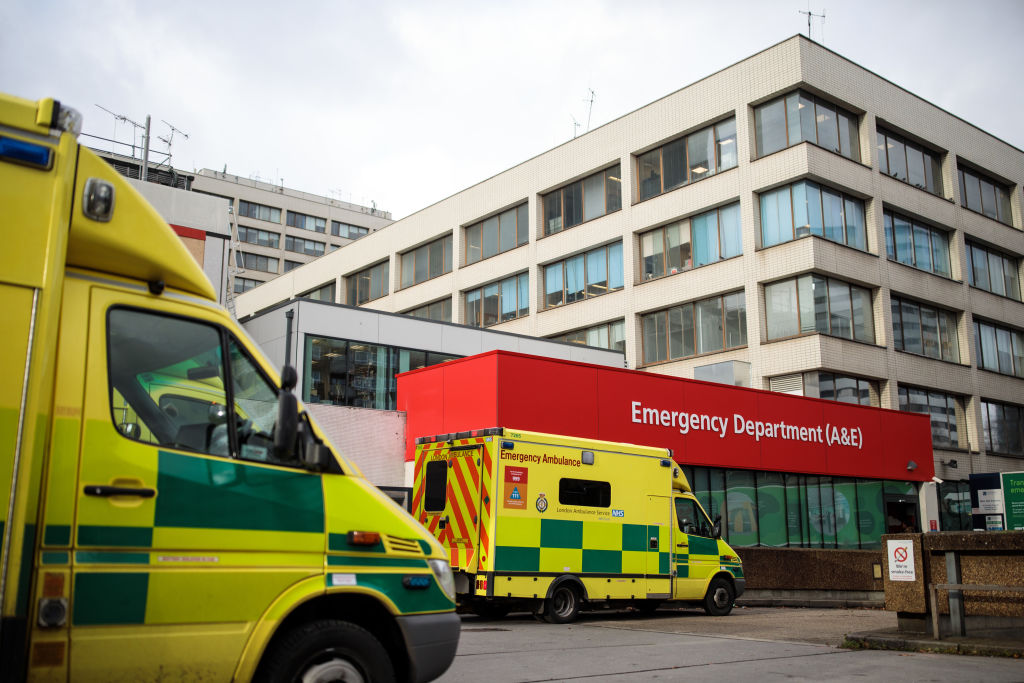
Mental health provision is totally inadequate in this country: we already know that. But you can only really understand quite how badly broken it is by looking at how much other public services are creaking as a result. Take the report today from patient safety watchdog the Health Services Safety Investigations Body (HSSIB), which warns that mental health patients stuck in emergency departments in England are at risk of significant harm because they can currently leave of their own accord, even when staff deem them too sick to be on their own.
Coppers are not supposed to be spending eight hours sitting in A&E, and neither is A&E supposed to be a mental health ward
A&E staff do not have the power to stop a patient leaving before assessment or admission, meaning that either they have to allow a deeply unwell patient to leave or, the report warns, find themselves ‘faced with choosing “the least harmful way to break the law” in order to try and keep patients safe.’ The HSSIB has asked the government to look again at the law for emergency care for people in mental health crisis so that there is an ‘extension of legal powers for health professionals to hold someone in the emergency department.’
This is all very well and good, but the HSSIB wouldn’t need to compile the report or ask for changes to legislation were there sufficient mental health beds for these patients, who are twice as likely as other patients to remain in emergency departments for more than 12 hours. Its report also points out that nearly a quarter of people waiting more than 72 hours in A&E are there for mental health reasons. Accident and Emergency is in no way a therapeutic environment for someone in mental health crisis, and yet it is having to pick up the pieces from a broken system elsewhere on a daily basis.

The creaking system goes far beyond the precincts of a hospital: just last month the chief constable of Police Scotland Jo Farrell warned that frontline officers were spending more time dealing with mental health issues than they were on primary issues of crime and justice. She added: ‘We cannot continue to operate in this way, and our responsibilities lie elsewhere, and threat, risk and harm directs us into other areas.’ The latest figures suggest that police in Scotland are being called out to almost 700 mental health-related incidents every day, and some of those incidents can take up an entire shift, often with the officers sitting in the admissions unit of A&E with a sick person waiting for the NHS to take over – or not, as the HSSIB report shows.
Coppers are not supposed to be spending eight hours sitting in A&E, and neither is A&E supposed to be a mental health ward. The impact of a broken service is that other functions of the state struggle to perform their primary duties. Fewer police officers are available for the response and community work they are supposed to be carrying out. A&E staff are occupied for days by patients they cannot treat – at the expense of those who they might be able to see and discharge within a much shorter period of time. And so if you really want to know how bad things are in mental health, or indeed in any public service, you can’t do so purely by looking at the specific service itself: you need to see how many other systems are having to pick up the slack too.




Comments