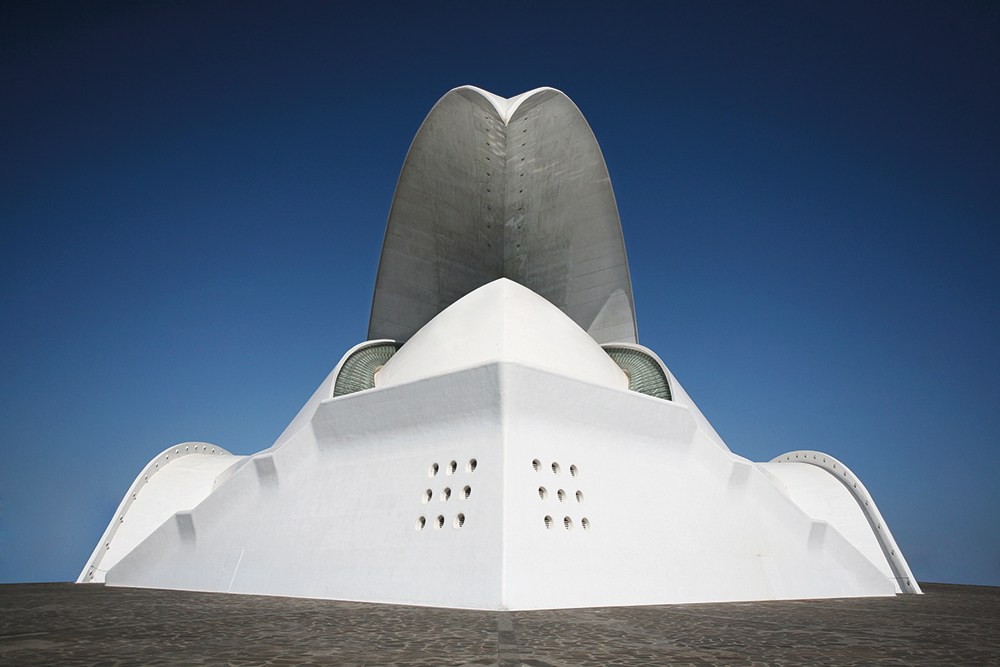
The Iron Curtain, or at least its most visible symbol, was not metal. Berlin’s Antifaschistischer Schutzwall (Anti-Fascist Protection Wall) was concrete. Its ugliness of form and function seemed to many proof of the evils inherent in this ancient building material. But for every hideous Berliner Mauer, you have a glorious Roman Pantheon. The dome of Hadrian’s incomparable temple is, after nearly two millennia, the largest unreinforced concrete structure in the world.
In our own era, concrete has allowed the best architects to do their best work. Witness Le Corbusier’s Ronchamp chapel. And who would argue against Denys Lasdun’s National Theatre as the best late-20th-century British building? The shuttering used to contain the poured concrete has acquired the grain of its wooden construction – proof of concrete’s ability to absorb textures and colours to emotional effect. So much care was taken, the architect said, that it would have been cheaper to clad the theatre in Carrara marble – and he confessed to finding the smell of concrete an aphrodisiac.
The cases both for and against concrete are nuanced, as Stephen Parnell, the editor of the RIBA Journal, explains in a very clever book which is neither an apologia nor an attack, but a well-balanced appraisal of this most familiar yet misunderstood composite. One indisputable thing about concrete is its superabundance. According to the US Geological Survey, global annual concrete production is the equivalent of two metric tonnes for every person on the planet.
The Guardian has called concrete ‘the most destructive material on Earth’. But this is a misunderstanding. True, the manufacture of concrete creates nearly 10 per cent of yearly carbon emissions, which comes from the burning of limestone to produce cement, one of concrete’s constituents along with water, sand and aggregates. But concrete itself is blameless – at least until someone decides to do something stupid and ugly with it.
Miracles of construction technology apart, it’s the metaphors of concrete that fascinate. Building materials lend themselves to imagery: steely resolve, a heart of glass, a wooden expression and a few bricks short of a load. John Betjeman thought of concrete as ‘creeping grey’. And concrete poetry? It’s the very opposite of lyrical.
The case for concrete is simple and clear. It is strong and adaptable. Almost indestructible in compression, its weakness in tension can be relieved by inserting metal rods as reinforcement, known as ‘rebar’. It may be dirty to produce, but you cannot use bamboo or flax to create flood walls, dams, bridges, foundations, tunnels and bomb shelters.
The word ‘concrete’ has a 1553 citation in the OED as ‘a cohesion of particles’. A British patent of 1824 for ‘artificial stone’ defined the modern material. But the French were the energetic pioneers of concrete in contemporary architecture and it became the defining medium of Modernism. However, Le Corbusier’s beton brut (‘raw concrete’) is ironically sourced from Ruskin’s High Victorian moralistic truth-to-materials trope. And this is just one of the complexities in coming to terms with a substance both ancient and modern, as well as enabling and disturbing.
Referring to Le Corbusier, the term ‘Brutalism’ was coined by Reyner Banham in 1955. Never meant to be derogatory, it was intended to describe the Modernists’ preference for expressive raw materials. But Brutalism and concrete became conflated, the one term being used to condemn the other.
It is routine for traditionalists to detest concrete in any form, even streetlights: ‘When all our roads are lighted/ By concrete monsters sited,’ Betjeman wrote. But concrete is a supremely malleable material and can be coloured, polished, textured and moulded to achieve delightful effects. Stained underpasses are caused by bad design and municipal neglect, not by concrete itself.
Donald Trump reveals the ambiguities of the material. In his early fever dream about containing Mexican narcos and rapists, he spoke of a ‘beautiful’ concrete wall, suggesting the rhetoric of power. In fact the wall is composed of steel panels filled with concrete. Then, in a 2020 Executive Order, the President, intent on beautifying federal buildings, condemned the use of ‘exposed poured concrete’.
Concrete may be dirty to produce,but you can’t use bamboo or flax to create dams, tunnels and bomb shelters
Although Brutalism has now been accepted into the canon of architectural history as a good thing, concrete buildings still attract spiteful responses. In 2016, John Madin’s superb Birmingham Library was demolished. It was only 42 years old. Last year, Stephen Hodder’s excellent Centenary Building in Salford, the winner of the very first Stirling Prize in 1996, was pointlessly razed. These were notably stupid destructive acts. One answer to the environmental problems concrete causes is to restrict production and intelligently re-use what already exists, but that demands more vision and creativity than the Salford and Birmingham authorities possess.
Of course, concrete enthusiasts sometimes get it wrong. In New York, Rafael Vinoly wanted his super-tall 432 Park Avenue to be more white, but the pigment he added to the mix degraded its structural integrity and billionaires are now running scared from terrifying cracks on the 96th floor. Just a few years earlier, rusting rebar in Riccardo Morandi’s poorly maintained Genoa bridge caused a catastrophic collapse. Concrete in itself is neither good nor bad: it’s artificial and morally neutral. It can cause delight or horror depending on the design.
Parnell’s father was a concrete professional, and the expertise has been inherited. But this is not a dogmatic book, rather an instructive and amusing one. Concrete prose is more entertaining than concrete poetry.






Comments