Before the 1989 revolution, Romania had seen nearly a century of polarisation – a fascist regime swiftly replaced by a communist one. In Blinding, Mircea Cartarescu’s first instalment of an ambitious, surrealist trilogy, that duality, along with other antagonisms central to existence, is represented by the motif of a butterfly. The novel was originally published in Romanian in 1996, and the title refers to the epiphany which, it’s suggested, can be achieved if life’s opposites are reconciled.
We first meet the narrator, twentysomething Mircea, languishing in a squalid studio flat in Bucharest, his rapidly industrialising home city. He is writing his own ‘endless book’, his aim being absolute self-knowledge. Nostalgia, he tells us, contains the ‘seeds of our existence’, yet memory is unreliable, a ‘metamorphosis’ of the truth. What follows is a kind of invented memoir, lacing together autobiographical elements from Cartarescu’s life and the fantastical, straddling the dream world and reality – and questioning the separation between them.

Bucharest is transformed into a phantasmic playground. Statues installed by the Gheorghiu-Dej government conceal secret passages lined with snail flesh. Catacombs swell, Tardis-like, into colossal palaces, impossible to escape from. Elevators that should not have survived the bombs of the second world war stand dormant, housing oracles. The floors of newly built Soviet-style apartment blocks, each ‘a different colour of desolation’, defy temporal and spatial laws. The city becomes an extension of Mircea’s body, one neighbourhood recollected from his past as resembling ‘a crust of dried blood on a child’s knee’.
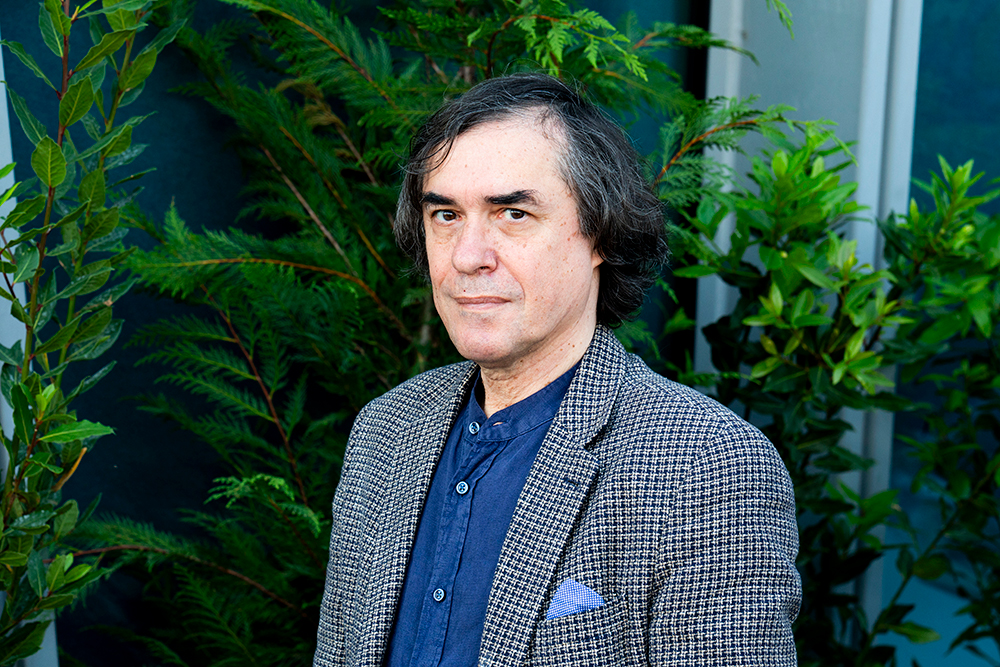
Born in Bucharest in 1956, Cartarescu is an acclaimed writer and a rumoured contender for the Nobel Prize; yet publishers in Britain have been slow to translate his work. Sean Cotter renders the robust but lyrical prose crisply and dauntlessly, despite the epic scale. While there is thematic overlap with Cartarescu’s short story collection Nostalgia, written and published under Ceausescu’s dictatorship, and Solenoid, a fractal portrait of a failed writer, Blinding is undoubtedly the author’s boldest work. At 432 pages, it strives to encompass all under its wing.
That takes the narrative beyond the confines of Bucharest. The butterfly as mythic being is introduced in Mircea’s mother’s strand of the story. This section of the trilogy is the ‘feminine wing’, almost solely about Maria, while the final instalment is about Mircea’s father. As the Badislavs, Maria’s ancestors, migrate across the ice between Bulgaria and Romania, they are tempted to taste the flesh of an enormous butterfly frozen in the Danube. This serves as an omen: the butterfly soon becomes a symbol of monstrous metamorphosis, the terrifying divine and mental torment. Later we learn that Maria has a birthmark in the shape of a butterfly.
Though the storyline is unwieldy, roughly separable into six interlocking subplots, it follows only a small cast of characters. Evoking the era of the Securitate, these minor players are planted throughout the book like robots, ‘built to deliver’ prophecies and lines to Mircea or his mother. One particular episode brings this to the fore, concerning a Securitate officer ordered to spy, ‘Fellini-like’, on a travelling circus. What is it like, Mircea asks, to forget who you are, ‘not to belong to yourself, to be the glove into which, from time to time, an iron hand slides?’.
The result can inevitably sound pretentious at times. Blinding’s pages are filled with grand revelations, some more convincing than others. But the book’s audacity is also its greatest quality. Cartarescu masterfully charts the horrific, incomprehensible evolution of Romania’s history. It’s a monumental work.



Comments