
Philip Hensher has narrated this article for you to listen to.
It is a curious literary form, the published diary. A surprising number of the classic diarists did write for eventual, usually posthumous, publication – Chips Channon under a 60-year embargo, A.C. Benson, Samuel Butler, in his wonderful notebooks, and surely the possibility was in the minds of Samuel Pepys and the Duc de Saint-Simon. More recently, great diaries have been published within the author’s lifetime. James Lees-Milne’s first instalment came out 30 years after the period it described. Alan Clark’s initial offering, covering 1983-92, appeared in 1993. Tony Benn’s hilariously tedious volumes emerged on a rolling programme which slowly caught up with the events they described.
They promise intimacy but too often deliver considered reflection, with one eye on what the readership will think. This is especially true of the rash of hopeless political diaries which the genius of Clark inspired into hard covers. The truly honest private diary, meant only for intimate reflection, is a rarity. Some, such as Philip Larkin’s or the final volume of Sylvia Plath’s, were destroyed by the executors.

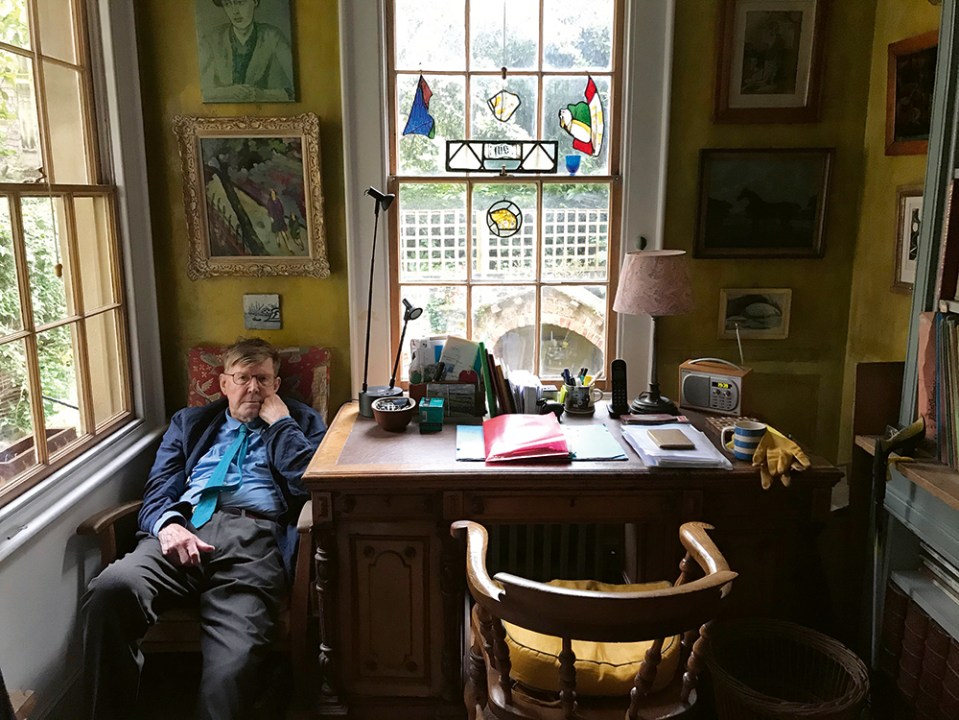
Alan Bennett’s diaries are on the public side of the genre. This is the fourth volume, but they seem to have been more or less available from the start, often appearing in annual instalments in the London Review of Books. Enough Said takes Bennett past his 90th birthday, and its overriding theme is loss. Pleasures and capacities are withdrawn – first cycling, then hearing; memory starts to fail; and finally the right word, or any word at all, disappears from the grasp. Treasured destinations, such as New York, become inconceivable. Friends of decades start to exit, sometimes, like Jonathan Miller, preceded by their mental abilities; sometimes a longtime friend who occupies a place among the great, like Maggie Smith, must be mourned amid a torrent of public sentiment. The world narrows and the diarist becomes more reflective.
More than once Bennett apologises to the reader for saying things he’s said many times before – perhaps justifiably in the case of the ancient crack about finding the question whether he was gay or straight being like asking a man crossing a desert whether he’d prefer still or sparkling water. He certainly often returns here to his most treasured material – family, and his exemplary standing as the grammar school boy who brought off an Oxford first. (‘Does it mean you’ve come top?’ his mother asked when the postcard came.)
A lot of this reflective memory is wonderfully evocative of a lost world. Recollection of the Donalds, Geoffreys and an Arnold (‘who was poor’) of a 1930s class register leads to the insight that Bennett ‘didn’t know how to pronounce Nigel until I was in my teens… If I had to say it, I said “Niggle Bruce.”’ There was a music master called Mr Fletcher who was ‘an early fan of Sibelius and was once invited to Finland to meet him, only the Council wouldn’t give him time off’. It was a childhood seeing legendary and perhaps now quite obscure gods of culture, too:
In Leeds there were four theatres, the Theatre Royal, the Empire, the City Varieties and the one I patronised, the Grand… I saw Laurence Olivier, Eric Portman, Flora Robson, beside James Mason, Ann Todd and umpteen other stars of stage and screen, invariably at the Grand in the upper circle at I think 1/9.
These warm recollections, springing from the narrowing worlds imposed by age and the Covid lockdown (the volume covers 2016-24), are welcome and very charming. Perhaps less so are the highly conventional opinions about political life and personalities, which are precisely the same as those of every other millionaire living between Primrose Hill and Hampstead Garden Suburb, where Bennett goes to a ‘lunchtime discussion group’ to discover his ‘diary entry about Brexit was roundly applauded’. I don’t suppose Bennett’s opinions have much changed since he was ridiculing Harold Macmillan in Beyond the Fringe. Rishi Sunak is ‘odiously pleased with himself’, Margaret Thatcher was ‘pernicious’, Boris Johnson ‘can’t be a normal person’, and so on. But at least Rory Stewart is ‘courageous’; and, weirdly, John Bercow is given ‘full marks’. Keir Starmer is commended for his ‘plainness… a relief’, which perhaps goes to show that one ought to leave diaries a year or two before publishing. All of this is so commonplace as utterances of the lumpenintelligentsia that it can safely be left to one side.
What remains a pleasure is Bennett’s relish of the spoken language, both recalled (‘“He’s batchy,” Dad would say, meaning “He’s barmy”’) and current. Life events are nowadays on the small side, and the loss of his partner’s briefcase and its safe return is a major affair. But such things as the train clerk taking the booking for a wheelchair and saying ‘Awesome’ twice are still of interest. A prospective gardener remarks, with wonderfully downbeat restraint: ‘Yes… I can see what you’re trying to do.’ A woman in a Yorkshire newsagent, seeing news of a lightning strike, admits cheerfully: ‘I love it when they have it nasty down south.’
Bennett is by now so famous that strangers seize his hand to kiss it in the street. But that level of fame produces its own wonderful scenarios of awkwardness. He is an aficionado of the great sociologist Erving Goffman, and one gloriously embarrassing scene would have delighted Goffman. His timing slightly off, Bennett finds himself heading home on a Thursday during lockdown as the ritual of clapping for the NHS starts. He is wheeled down a street, apparently receiving theatrical applause from one household after another, and suitably acknowledges the réclame of the north London claque, raising his hand graciously as he goes.
The latest volume of diaries takes Bennett past his 90th birthday, and its overriding theme is loss
Even better, he finds out that a friend of his publisher’s son called Tom King has had his portrait tattooed on his arm. At first, thrillingly, the man is said to live in Greenwich Village, though later it turns out to be Dartmouth Park, making him presumably a neighbour of Ed Miliband. Has the tattoo been a success? King sends a postcard: ‘The tattoo remains popular, though bizarrely one person thought it was of Henry Kissinger. It also makes for an amusing conversation during intercourse.’ Bennett is quick to draw a discouraging conclusion. ‘This suggests the intercourse might be less than fervent, my name in itself something of a detumescent.’
As readers, we can probably forgive his persistence in maintaining the shy provincial failure schtick, even his deploring figures such as Eddy Sackville-West (‘presumably about the business of Art, but only when socially well-connected’), when it is hard to think of anyone socially better connected than Bennett. The excellent ear for speech and eye for the awkward situation and curious behaviour remain unaffected.
It’s perhaps to be regretted that Bennett’s diaries and occasional pieces are much easier to access than the work on which his reputation should rest. The early stage plays, such as Forty Years On and Habeas Corpus, are less frequently revived than they ought to be. Though the films for cinema are available, including A Private Function and those about George III and Joe Orton, the superb plays for television are mostly lost in some inaccessible archive. They ought to be on the streaming services, as should his unforgettable 1988 documentary about a Harrogate hotel, Dinner at Noon. It seems incredible that the 1990 drama, 102 Boulevard Haussmann, starring Alan Bates as Proust, isn’t, as a matter of priority, on BBC iPlayer, along with similar works of lasting quality.
Until the archive is made available, the diaries will have to do. Good as they often are, however, I think public institutions could do much more to preserve and represent the best of Bennett’s work, which has always been in performance than on the page. It’s the fate of the showman, I know; but the celebration of Bennett as a personality has somehow obscured a genuine degree of neglect.


Comments