You might be forgiven for thinking that a charity sale of particularly kitschy furniture has been set up just past the entrance of the Barbican Art Gallery. There’s a chunky brown dressing table, an ornate table several decades out of fashion and a trio of bedside tables. They are piled haphazardly and on each is a garishly painted picture, invariably a pastiche of a historical painting or a Biblical scene. Raphael’s 1512 ‘Madonna and Child with St John’ rendered slightly sloppily where the mirror of the bureau once was; ‘The Last Supper’ on the table top; three popes in profile staring impassively from the tops of the nightstands.

They are all the work of Colombian artist Beatriz Gonzalez, who, in her early years, often diverted from canvas to bits of junk household fixtures. She died in January this year, aged 93, but leaves behind more than six decades of work, a slightly too generous proportion of which makes up the Barbican’s extensive retrospective.
Rarely had Gonzalez seen the original of the works she recreated: from her first exhibition in 1967 she was interested in how the treasures of Europe circulated in her home country via mass media. The papal portraits she copied from a postcard a friend had sent her; the historical paintings were reproduced from large-circulation magazines or cheaply printed books. These were vestiges of European culture adopted by the striving middle class (of which she herself was a member) as signs of their sophistication.
Gonzalez painted on curtains too: the vast ‘Backdrop of a Moving and Changing Nature’ (1978) hangs floor to ceiling at the Barbican, a take on Édouard Manet’s ‘The Luncheon on the Grass’ (1863), or rather a version of the Frenchman’s painting Gonzalez found as a fading poster in a food-shop window. The picnicking figures are flat and peculiarly lifeless, the detailing is absent, and the colours, which are a bit off, seem to run into each other. It’s all done on purpose of course: ‘This is how one witnesses a work of art in an underdeveloped country,’ she bemoaned.
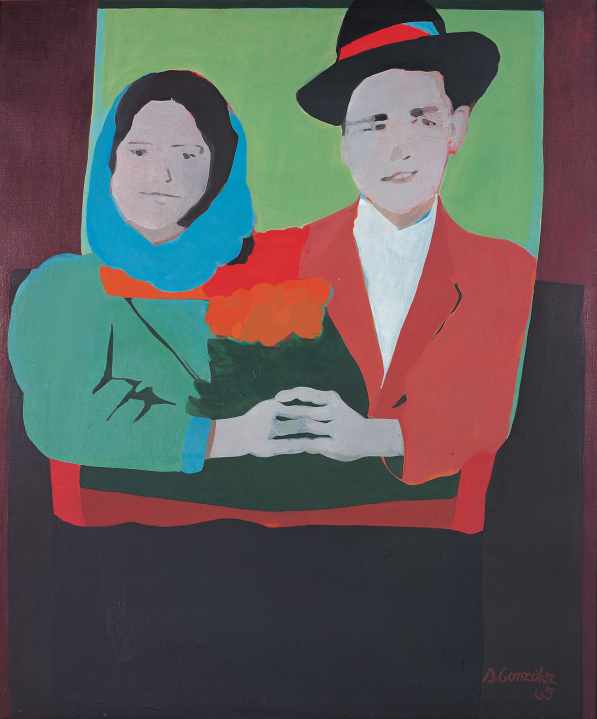
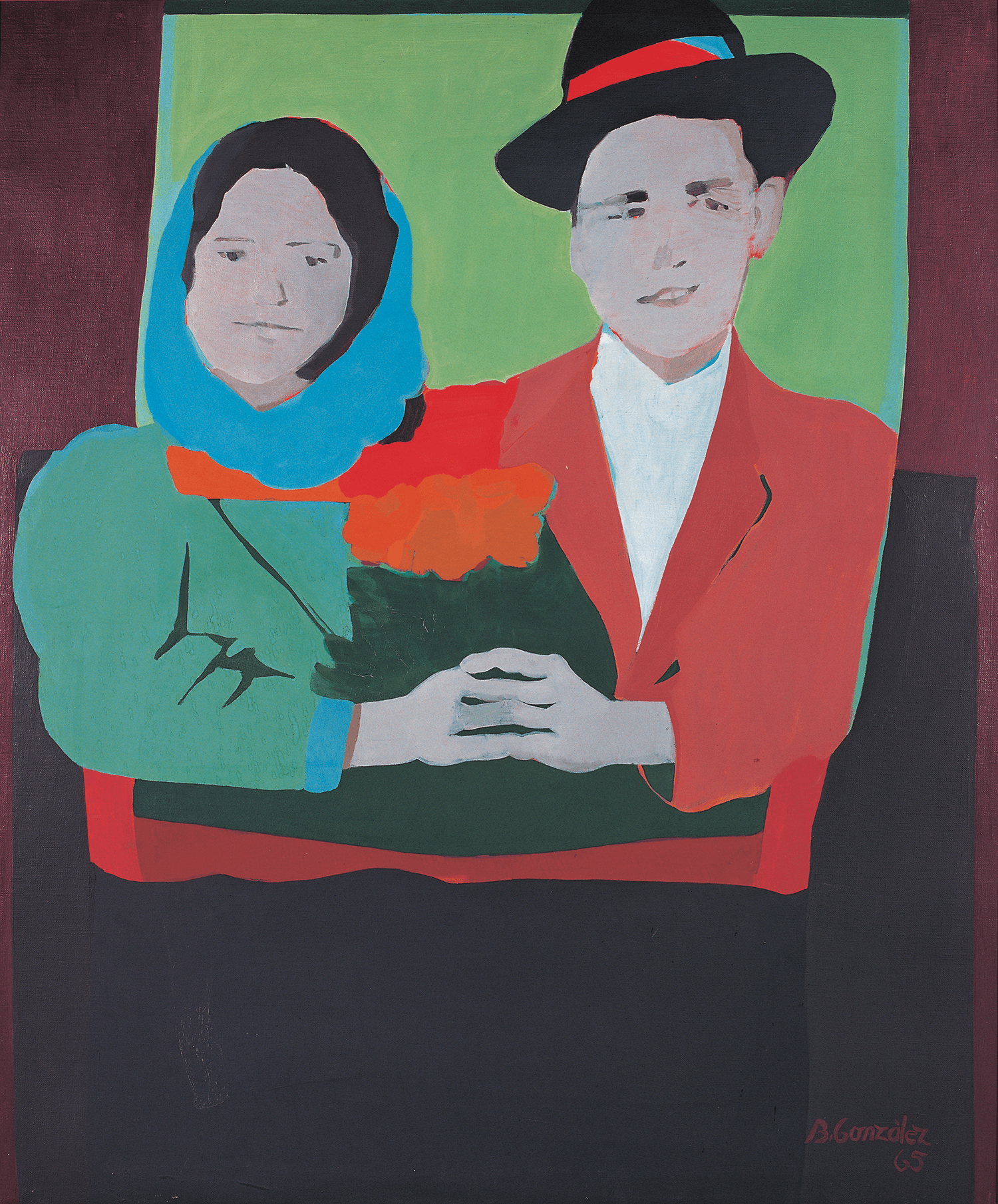
From the outset Gonzalez had turned to newspapers as her source material and she soon found subjects closer to home: three portraits, ‘The Sisga Suicides’ (1965), hang in their own room, each a different imagining of a picture released to the press of a couple who had died by suicide. The artist said she was attracted by the formal composition of the source material, the man and woman embracing as they clutch a bunch of flowers between them, but grief and violence re-emerged as the mainstay theme of her work from the 1980s onwards. No surprise, given Colombia’s turbulent 20th century.
The later works, formed from amalgamations of images chopped from newspapers, have a surreal edge. There’s a discomforting oddity in scale, a whole lot rawer and far more disorientating. Men are invariably depicted dead and women in tears. In ‘Gravediggers’ (2000), several corpses, the faces of each culled from the crime pages of Gonzalez’s local rag, are shown in their open caskets. These in turn rest on the ubiquitous plastic bar chairs of Latin America. It is as if these poor chaps have walked straight from their beer to the after life. Another haunting hang features four long, spotlit, banner-like canvases shown in a gallery alcove, each featuring a woman covering her face in anguish, one of them identified as Gonzalez herself.
It is as if these poor chaps have walked straight from their beer to the after life
In ‘Rivers of Blood’ (1992) two more tearful women, blockily painted in murky purple and blue, clutch what might be a cross, while a river rages behind them. ‘Miraculous Catch’, painted the same year, shows the body of a man floating in water while two women sit impassively looking on. This was painted as Colombia’s narco conflict worsened and it’s as if violence has become so commonplace that the grief no longer registers. ‘Between Wars’ (1992) shows two figures in a boat on a river, but theatre curtains frame the foreground. Perhaps the relative serenity of the scene is just a play-act, before life invariably flows back to war.
If this all sounds heavy-going, then the luridness of Gonzalez’s palettes and the strangeness of the collage approach produce a show that is more delirious than depressing. It’s an aesthetic Gonzalez takes to brilliant extremes whenever she turns her brush to the politicians and generals that laid waste to the country for much of her lifetime. A parade of monstrous and toxic generals are shown with burning red faces in ‘The Parrots’ (1987), while the skin of the assorted politicians in ‘Mr President, What an honour To Be with You at This Historic Moment’ (1987) are variously pigmented jaundice yellow, vomit green or asphyxiating purple. Poisonous visages rendered by a political artist who delivered her barbs with aplomb and wit.





Comments