

David Whitehouse has narrated this article for you to listen to.
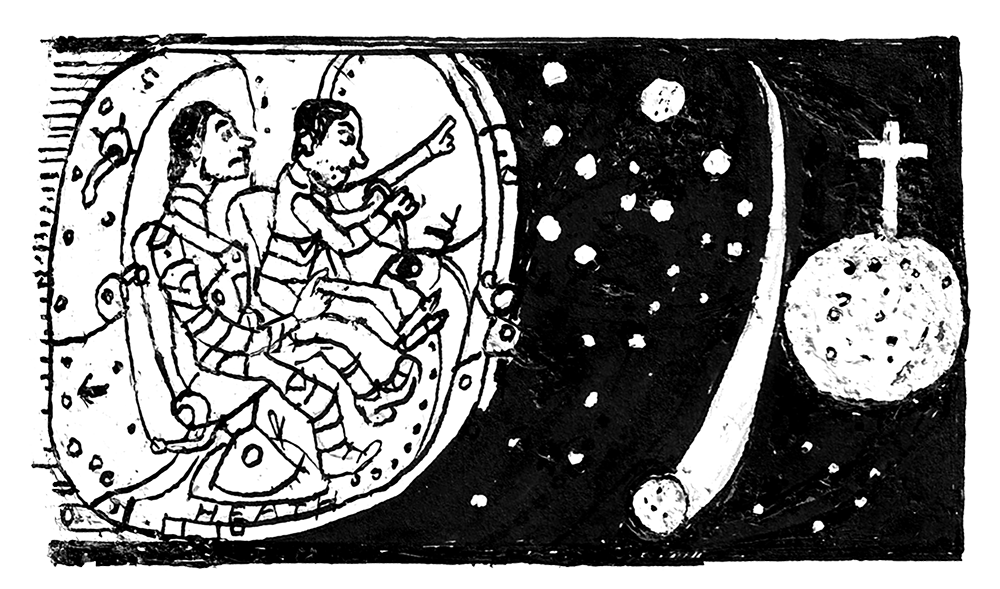
The climax of the Artemis II mission lasted just a few hours. The capsule, named Integrity, rounded the Moon, the crew becoming the most distant humans in history as they moved from its sunward side into its shadow.
The familiar features of the permanently Earth-facing side made way for the more heavily cratered far side. This is not the Moon we know. The far side is different. It has a thicker crust, no major solidified lava plains and is more heavily cratered, like the aftermath of the final war.
Before reaching it, the crew saw two Apollo landing sites: Apollo 12 touched down on Oceanus Procellarum (Ocean of Storms), and Apollo 14 landed on the plains of Fra Mauro, the target for the aborted Apollo 13 mission. There have been travelers here before, but not like this.
The Moon’s brightness illuminated Integrity’s interior. The crew turned out the cabin lights to get a better view. Most of the far side was in darkness, creating something like a hole in the sky, so they concentrated on the sunlit crescent as they sped toward the Moon’s shadow and the end of their outward journey.
One of their earlier studies was of the Mare Orientale, a 200-mile series of concentric craters formed 3.7 billion years ago by an asteroidal impact that almost shattered the Moon. It lies on the limb, so is difficult to see from Earth. Apollo astronauts saw it half a century ago, but only from 150 miles. They were unable to appreciate its true magnificence.
During the encounter, two of the crew of four took a turn at the windows facing the Moon while the others ate lunch. Their timeline determined which lunar features they should be taking pictures of, and when they should just use their eyes to look for subtle color changes. They commented on lines of craters, bright so-called ejecta blankets splashed across the surface by ancient impacts, and the ever-changing shadows of the terminator – the line between day and night. Astronaut Jeremy Hansen said that the crew proposed naming a crater “Carroll,” after Commander Reid Wiseman’s late wife, Carroll Taylor Wiseman, who died of cancer in 2020 at the age of 46.
As well as the Moon, the crew could see the distant Earth, a tiny blue and white crescent moving toward the Moon’s limb. When the Moon obscured it, they would be out of contact for 43 minutes. They call it LOS or “loss of signal.” For the crew it hardly mattered as they were surveying the dark side of the Moon, looking for flashes of light caused by minor impacts and for a hazy glow above the Moon’s limb caused by electrostatically levitating dust. They also tried to see if they could see any planets.
The blackout ended with the crew responding to Mission Control’s “Integrity comms check” message. They were already on their way home and leaving the Moon, whose influence they would shake off in 18 hours. For the crew, having seen the Earth and the Moon like nobody else, things will be forever different. Four people counted apart from the billions on Earth, their lives seemingly obeying different rules. They will leave part of themselves on the Moon.






Comments