For more than a decade, Germany’s mainstream political parties have placed a firewall around the AfD (Alternative for Germany) and refused to work with or vote alongside the right-wing party.
‘We have a clear resolution in the CDU: no cooperation with the AfD or Die Linke,’ as Franziska Hoppermann, the new secretary general of Germany’s leading party, pointed out this week.
The Merkel-era firewall was supposed to deny the insurgent party legitimacy. Instead, the AfD is now regularly leading in the polls
Yet with two weeks to go until the state elections in Saxony-Anhalt, it seems the firewall has been seriously breached.
On Wednesday, it was revealed that a currently serving CDU official will not only vote for the AfD in the state elections, but has donated €10,000 to the party.
The AfD’s lead candidate in Saxony-Anhalt, Ulrich Siegmund, had previously said that a CDU official had donated to his election campaign. This week, Bernd Prange, a CDU politician and mayor, outed himself as the anonymous donor.
More damaging for the CDU was the letter Prange wrote explaining his decision. The 59-year-old said his decision to vote against his own party was born of ‘deep concern for our country’. After 35 years in the CDU, he no longer believes the party is defending conservative principles. Prange listed the party’s failings on the economy and immigration as particular concerns.
He also said he hoped other conservatives in the party would follow his lead, and that the AfD would win an absolute majority in Saxony-Anhalt, forcing the CDU to change course.
The Merkel-era firewall was supposed to deny the insurgent party legitimacy. Instead, the AfD is now regularly leading in the polls. This has forced the CDU to form coalitions with left-wing parties, which neuter its policies and alienate its voters. The open rebellion of a stolid politician like Prange shows how disenchanted some CDU members have become as a result.

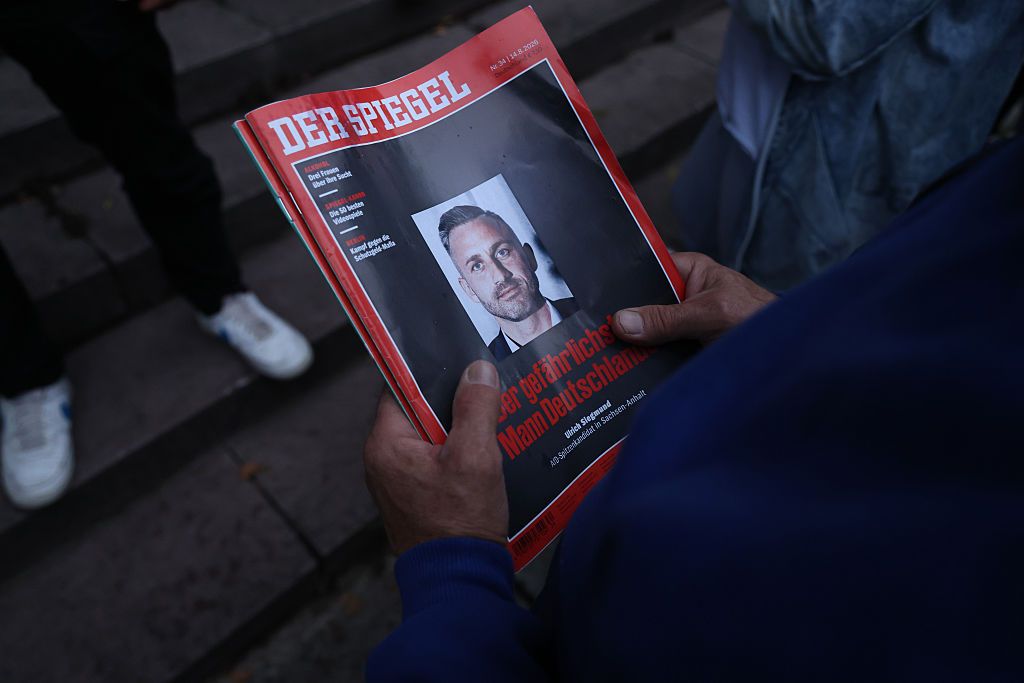
The AfD’s Ulrich Siegmund is exploiting this fissure with considerable skill. Young, cheerful and disarmingly charming, Siegmund is not like the angrier characters traditionally associated with the party. That may prove particularly useful when it comes to winning over female voters, whom the AfD has historically struggled to attract. Siegmund recently went viral after the magazine Der Spiegel put him on its cover with the headline ‘Germany’s most dangerous man’. He treated the attack as a compliment and signed copies of the magazine for fans.
So far, Siegmund’s approach seems to be working. The AfD is polling at around 41 to 43 per cent in Saxony-Anhalt and is aiming for an absolute majority in the state’s Landtag. It could achieve this with less than 50 per cent of the vote if enough smaller parties fail to clear the 5 per cent threshold.
The CDU, meanwhile, is facing the prospect of a sharp decline from its commanding victory five years ago. The party won 37.1 per cent of the vote in Saxony-Anhalt in 2021, but recent polls put it at only around 22 to 24 per cent. If that level of support holds until September, the CDU will have lost a third of its support in five years.
Unsurprisingly, Prange has been threatened with expulsion from the CDU. Mario Karschunke, the CDU’s state secretary general, said it was a serious matter and the local party organisation would investigate.
Yet expelling Prange may only show how much control the CDU has already lost over its grassroots. This is particularly significant in eastern Germany, where local politicians are worried about being kicked out of office as the AfD advances. In this part of the country, the ideological distance between conservative CDU voters and the AfD is considerably smaller than the party leadership in Berlin would like.
It doesn’t help that the CDU is currently facing a leadership crisis. Chancellor Merz has managed to make himself unpopular with both his base and his left-wing coalition allies. Secretary general Jens Spahn had to resign after scandalously buying a surrogate child overseas. His replacement, Franziska Hoppermann, lacks experience. Many see her appointment as an admission that Merz is running out of capable lieutenants to keep his party in line.
A recent attempt by the CDU to reduce taxes ended in farce, with every reduction matched by an increase in taxes elsewhere. To get genuine tax cuts through would require Merz to work with the AfD, which would mean destroying the firewall completely.
Why has the CDU committed to the firewall for so long? Germany’s crumbling media consensus is partly to blame. For years, much of the mainstream press has portrayed the AfD as politically beyond the pale. But in preventing other parties from cooperating with the AfD, they have preserved it as an electoral force. It is now the only major party which can’t be blamed for Germany’s terrible economic and migration policies over the last decade.
Now the CDU has been left with an increasingly uncomfortable choice: it can keep working with left-wing parties that want to sabotage it from the inside – or it can destroy the firewall and face a wave of media and political outrage. Either way, the status quo seems unsustainable as the Saxony-Anhalt election approaches.






Comments