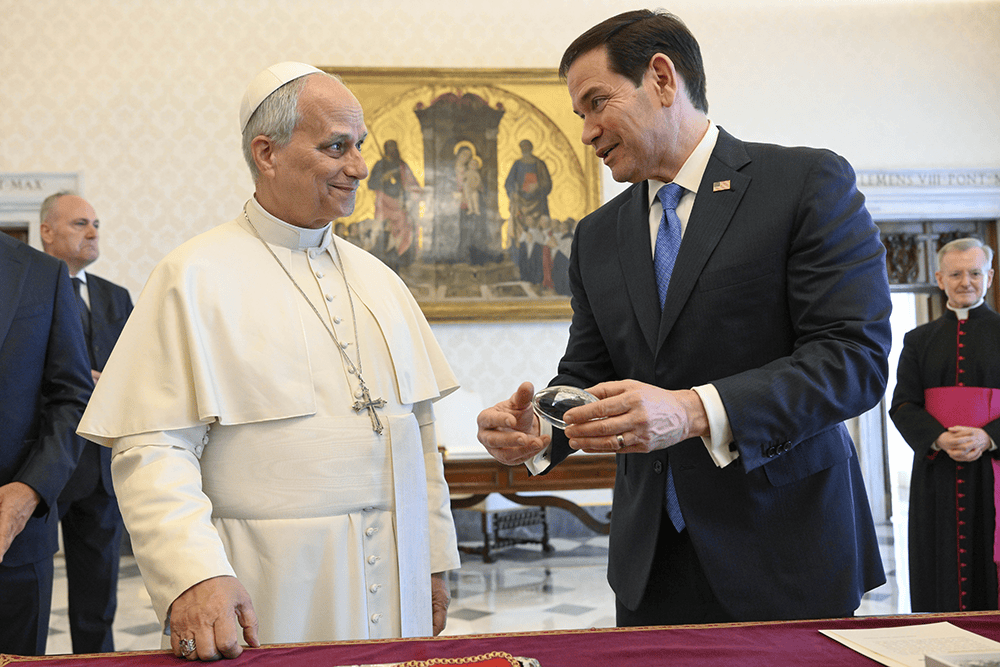
Pope Leo, an American, voted in the US midterms. I am surprised that a foreign head of state can do this, but presumably he is well advised – though not, on such matters, infallible. Paragraph 2240 of The Catechism of the Catholic Church, expounding the 4th Commandment ‘Honour thy Father and thy Mother’, says that ‘Submission to authority and co-responsibility for the common good make it morally obligatory to pay taxes, to exercise the right to vote, and to defend one’s country’. Leo XIV’s age obviously exempts him from defence duties. I imagine that, as head of state, he is also exempt from the attentions of the American Internal Revenue Service. The normal rule is that dual nationals must file full tax returns if they have more than $10,000 in a foreign bank. His vote, however, does trouble me a bit. Even though the Pope rightly does not tell us whom he voted for, we now know for a fact that he has favoured one party over another. As a Catholic myself (though one who, as a peer, is denied a vote in general elections), I hope my duty to exercise the right to vote includes the decision to abstain from voting if I conscientiously believe all the candidates to be unacceptable. For example, would an American voter in 2024 have been committing a sin if he had refused to vote for either Kamala Harris or Donald Trump and instead had got down on his knees to pray for America?
Western media lost interest in the results of the Israeli elections after they failed to humiliate Benjamin Netanyahu (though they may yet lead to his departure). This is a pity because the ensuing negotiations are an interesting example of how a highly representative – some would argue, over-representative – democracy works. They sort oddly with the claim that Israel is an apartheid state, committing genocide. Can you name any other country in the world where the supposed victims of apartheid and of genocidal intent hold the balance of power in the parliament, as do the 19 Arab parties’ members in the Knesset?
The sudden closure, at half-term, of Leweston School in Dorset is disturbing. The government’s imposition of VAT was the straw that broke the camel’s back, but the camel must have been very weak already. There is talk of a huge loan called in. Pupils are distraught. A friend who paid his grandchildren’s fees in advance does not know whether he will ever see the money again. Leweston is owned by Concept Education, whose website proclaims its vision of education as ‘head, hand and heart’. It is a private company with directors well-grounded in independent education, such as Dr Martin Stephen, former High Master of St Paul’s, and his wife Jenny, also a former head. It also owns the Marist School at Ascot. Yet the Leweston exercise has failed, and it was only last year that Concept Education started to run the school. In my boyhood in the increasingly impoverished late 1960s, lots of prep schools, often owned by an individual and containing tiny numbers of pupils, closed, amalgamating with bigger ones. Now hard times are back. There are two differences between then and now. The first is that those little prep schools were run on a shoestring, whereas nowadays many ailing schools undertook vast investments before the financial crash. They sometimes possess assets, chiefly property, which businesses covet for non-educational reasons. Possibly related to this is the fact that foreign ownership has greatly increased. For example, a Qatari-backed company called 35 Education now owns Glenalmond, the great Scottish public school founded by W.E. Gladstone to educate future clergy of the Scottish Episcopal Church. It has put in a Turkish professor, whose PhD from De Montfort University was called ‘Improving Supply Forecasting within the Shipping Industry’, as chairman of the school.
Julia Mount, once a key figure in the life of The Spectator, died last week. I first knew her as the wife of the great Ferdy Mount (then our political columnist) and as, by chance, our neighbour in Islington. When I was the Editor, I asked Julia if she would be my secretary. To my surprise and joy, she accepted. It is now half-forgotten what a secretary was, but Julia was a fine example – the sort of intelligent woman who nowadays would have gone to university but at that time got her education through work, books and a general love of life and friendship. Formerly a secretary at Christie’s before leaving to have her children (including Harry Mount of Oldie fame), she was tremendously well-read, possessed inner confidence without ever showing off, completely understood the paper, and loved its strange cast of characters. Christopher Howse put it well when he said: ‘Julia was very good at liking flawed people and at not putting up with the overbearing.’ The Spectator was chock-full of flawed people, as I like to think it still is. With true kindness, Julia made it a happy home for them. If a few were overbearing, they did not last long.
By the time you read this, I shall have spoken to the Gough Square Club, keepers of the flame of Dr Johnson in his famous house. In preparing, I read an excellent book by Michael Bundock, The Fortunes of Francis Barber, about Johnson’s much-loved black servant. For a couple of years, the then teenage Barber served in the navy, probably drawn by better pay and conditions than those in service and the chance of young company and adventure. Bundock illustrates how Barber would have found a ‘relatively liberal’ attitude towards black sailors: ‘In 1761, two white sailors were court-martialled for sodomy. The principal prosecution witness was a black seaman, and the accused objected that it was unheard of for a black to give evidence against a Christian. The court-martial rejected the objection, convicted the men, and sentenced them to death – on the word of a black man.’ Thus did colour-blind justice assist ‘homophobia’. History contains many ironies.




Comments