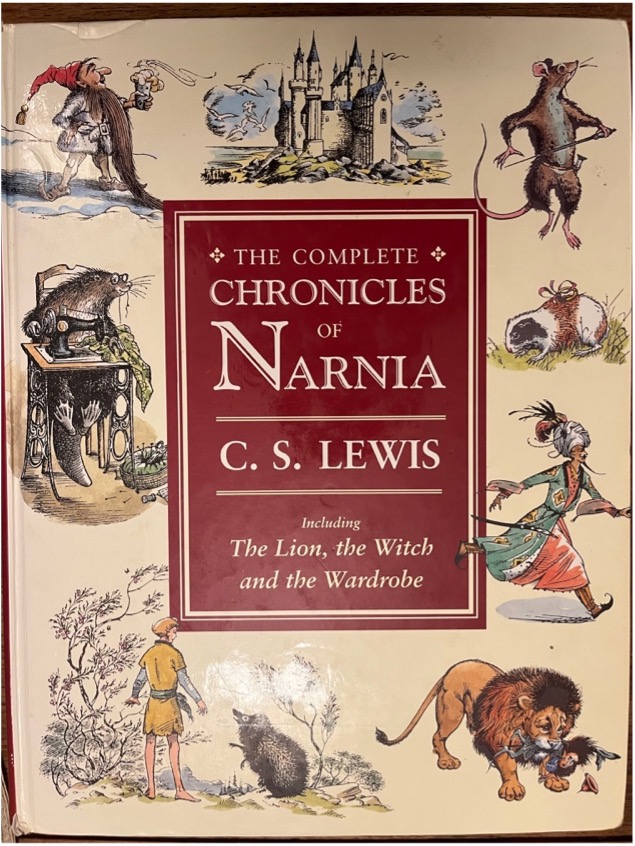
Growing up in an evangelical Christian household, it will hardly surprise you to learn that I was a big fan of C.S. Lewis’s fictional children’s series The Chronicles of Narnia. Pictured below is my own copy; one I pored over as a child, continue to deeply treasure, and look forward to reading to my own daughter in a few years’ time.
When in 2005, Andrew Adamson’s film, The Lion, the Witch and the Wardrobe, arrived in cinemas, I was amazed to see the story come to life. In subsequent years, it became one of my favourite films. As a boy, I wanted, and believed, that one day I could be brave like Peter. As I grew to understand the story as an older child, I perhaps increasingly wanted to believe that I could be redeemed like Edmund.
For a child whose parents limited what he was shown on TV, the Narnia films (three in total) were some of the few action films that I was allowed to watch, and I was inspired by them.
But I saw that the thing C.S. Lewis used to bind the world of Narnia was Aslan. He was bold, fearless, self-sacrificial. He did not flee in the face of the White Witch, but laid down his life for Edmund, a boy whose weakness for Turkish delight, and betrayal of his family, put Narnia in mortal peril in The Lion, the Witch and the Wardrobe.
There is something remarkable about the plain obviousness of Lewis’ characterisation of Aslan as Christ. Whilst Lewis did not regard Aslan as a simple allegory for Jesus, he described the Narnia stories, and Aslan, as a ‘supposal’ for Christ. In essence, an imaginative answer to the question of what Jesus might be like if He became incarnate in another world.

Whilst Lewis did not simply take Christian doctrine and paste it into a children’s fantasy world, Christianity is part of the fabric of Narnia itself. Creation, temptation, sacrifice, resurrection, moral law, providence, judgement, and the hope of new creation are all embedded within the stories.
This is why, when it was announced that Greta Gerwig was going to make a new series of Narnia films, some Christians were elated. A new generation of films would perhaps speak to what is good, true, and beautiful.
I too, was initially hopefully. Whilst Gerwig’s Barbie was criticised by some conservative critics as yet another feminist jibe at men, I did not share that apprehension. I thought Barbiewas considerably more interesting and conservative in its treatment of masculinity, femininity, and motherhood than many right-wing commentators gave it credit for. I therefore approached Gerwig’s Narnia with hope rather than suspicion. Sadly, however, my confidence has been knocked.
On 17 September, Gerwig confirmed to Empire magazine that Aslan would be voiced by Meryl Streep in the upcoming film, The Magician’s Nephew.
Aslan will remain male in Gerwig’s interpretation, and so it is not simply the matter changing the characters’ sex that concerns me. Nor do I always think there is something inherently wrong with a woman playing a traditionally male character in all cases – if there is good reason to do so. But Aslan, simply put, is different – he is the theological centre of the Lewis’sNarnia series.
Jesus is male. As an incarnate person, he was historically male. In Christian theology, He is the Word through whom creation came into being, the Son who dies for the sins of the world, and the Lamb who will come to judge the living and the dead. Lewis gives Aslan an astonishingly similar role in Narnia. He creates the world in The Magician’s Nephew, he sacrifices himself for Edmund in The Lion, the Witch and the Wardrobe, and he stands in judgement over Narnia in The Last Battle.
The problem, then, is not so much Streep being a woman, but that Aslan is a characterisation of Christ, and therefore occupies a uniquely important masculine place in Lewis’s fictional world.
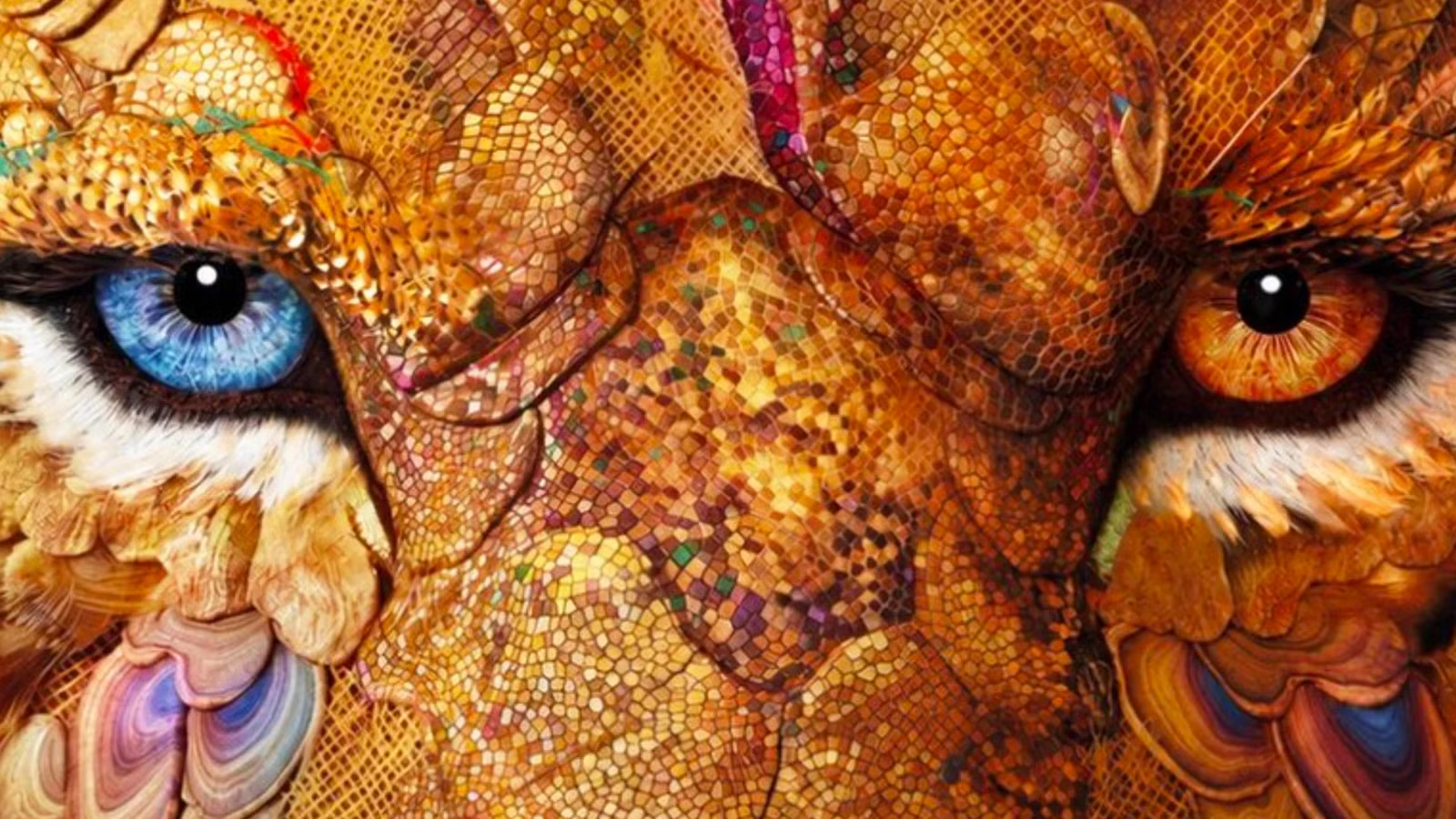
Sadly, the casting comes alongside other signs that Gerwig intends to make Narnia distinctly her own. She describes the film as being informed by ‘rock opera’, drawing its influence from David Bowie’s music and theatricality. Early images of Aslan show a highly stylised, almost iridescent scaled lion with heterochromia, a strikingly different appearance to the Aslan familiar to viewers of the earlier films and BBC series.
None of these things necessarily mean that Gerwig has misunderstood Lewis. She may understand him perfectly well and simply believe that a faithful adaptation requires substantial artistic reinterpretation. But this is precisely what concerns me. The Christ-like nature of Aslan is not a Freudian accident of a Christian fanatic. Lewis crafted Narnia very carefully, specifically, and theologically as a way to teach children the Christian message. It is a way to show children the beauty and importance of self-sacrifice, but more importantly, the ultimate sacrifice of Aslan.
Throughout the stories, virtues are portrayed, tested, and grown, as Lewis teaches children to be brave. That putting their faith in Aslan is more important and successful than relying on their own strength. The Narnia stories teach children that evil can be overcome, and that whilst they, the ordinary, may play a part in that, the Lord of Narnia has a bigger plan through his friendship and mercy.
The saturation of theology in Lewis’s Narnia goes far beyond mere story modelling, and delves deeply (surprisingly so for children’s books) into creation, eschatology, the nature of evil, morality, and relationship with Christ. The choice of Streep therefore raises the question as to how much of Lewis’s theological imagination will survive when his would is reimagined so thoroughly.
I may be being premature. The film has not yet been released, and Gerwig may ultimately surprise me – I hope she does.
But Lewis himself gives a rather good standard by which to judge any Narnia series. At the end of The Voyage of the Dawn Treader, Aslan transfigures from The Lamb, back into a lion, and informs Lucy and Edmund that they will not be returning to Narnia. Through the sobs of grief, Lucy and Edmund ask whether Aslan will be there in their own world.
“Are – are you there too, Sir?” said Edmund.
“I am,” said Aslan. “But there I have another name. You must learn to know me by that name. This was the very reason why you were brought to Narnia, that by knowing me here for a little, you may know me better there.”
I am afraid, at least at this point, that Gerwig’s reimagining of Lewis’s Narnia may forget the very reason Lewis brought us there in the first place.




Comments