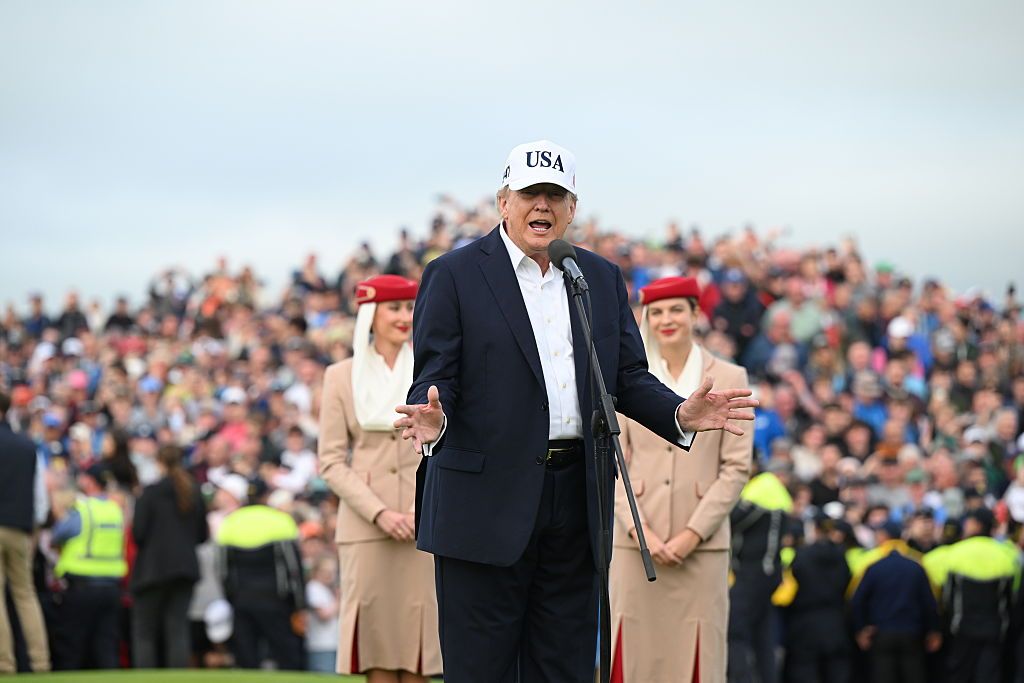
Usually, when an American politician makes some pronouncement about the inevitability of a united Ireland, it is invariably some Democrat backwoodsman with a Boston brogue, not the President of United States.
Yet Donald Trump has ventured where even bona fide Sons of the Sod John F Kennedy and Joe Biden dared not tread when calling Irish unification ‘one of the naturals of all time’, adding that ‘I’d love to see it unified’ on his visit to the Republic over the weekend.
It is yet another addition to the Trump canon of diplomatic faux pas, a MAGA version of De Gaulle declaring ‘Vive le Quebec libre’ when on a visit to Canada in 1967. A penny for the thoughts of King Charles – ‘the greatest king, in my book’ as described by Trump – about a fellow head of state hypothetically portioning off part of his realm, especially after the flummery of recent state visits.
It is highly unlikely that any real affinity towards Irish nationalism or any nationalist movement is nestled within the Trump psyche. Much like his recent comments about revisiting the US stance on Argentina’s coveting of the Falkland Islands, this needs to be rationalised as a form of punishment for the UK’s lack of support for his misadventures in the Middle East.
An unintended yet hilarious consequence of Trump’s stream of consciousness is the contortions it has forced the great and the good of the Irish political establishment to take
With November in mind, it is also conceivable Trump is flashing some leg at the sizeable electoral cohort of Irish Catholics; in 2024, Trump carried white Catholics by a decisive margin and that constituency, of which Irish Catholics are a considerable chunk, is increasingly becoming a reliable wellspring of Republican support.
Away from the machinations of high politics, an unintended yet hilarious consequence of Trump’s stream of consciousness on the margins of a tournament at his County Clare golf course is the contortions it has forced the great and the good of the Irish political establishment to take.
After all, official and political Ireland, with all its self-conceit, does not normally like Donald Trump and has not been shy in saying so.
Sinn Fein’s Michelle O’Neill and Gerry Adams have both previously derided Trump, with O’Neill boycotting the annual White House St Patrick’s Day shindig over the situation in Gaza. Following his comments at the weekend, both O’Neill and Adams have since spoken as if Trump has shown Delphic wisdom about Ireland’s constitutional destiny.
Claire Hanna, leader of the SDLP and tribune of self-satisfied South Belfast types who view US politics through the antiquated prism of The West Wing, greeted Trump’s White House return in 2024 by saying it was ‘very disheartening that his divisive brand of politics has been so widely endorsed’. Now she intones that his comments should ‘concentrate minds in Dublin, London and closer to home’.
The current Taoiseach, Michael Martin, who has previously said Trump’s trade and tariffs policy is a ‘moment of real threat’ to the Republic’s status as a tax haven moored to the sidings of the EU, told RTE radio that the President clearly viewed unification as a ‘logical imperative’.
Quite the volte face for a man who, only a few months ago, when speaking about the Iran conflict, said ‘we could be forever trying to interpret President Trump in terms of what he said and what actually gets done, and that’s always been the feature’.
While it may be a stretch to expect Trump’s quotes and grinning visage to appear on Sinn Fein or SDLP literature any time soon, those who claim there is momentum behind the conversation about unification will make hay. Concerns about ICE rounding up undocumented Irishmen and the plight of Palestinians have melted away in the face of political convenience and opportunism.
Conversely, unionist politicians – many of whom have gone all in for Trump and the MAGA world view for the past decade – have been falling over themselves to tell anyone who will listen that it is not that much of a big deal that the most powerful man in the world has effectively said their time may soon be up. Ian Paisley, the ex-DUP MP who frequently foghorns about how plugged into the Trump machine he is, said ‘everyone is entitled to a personal opinion even if its wrong’.
The cause of breaking up the UK needs anything it can to sustain momentum. It is fortuitous from their point of view that Trump’s comments came in close proximity to the latest gathering of separatist leaders in Cardiff to put Westminster on notice about the need for independence referendums.
While Trump’s words are fundamentally meaningless and will make no lasting impact, they only serve to sustain Celtic nationalism’s tedious need for attention.





Comments