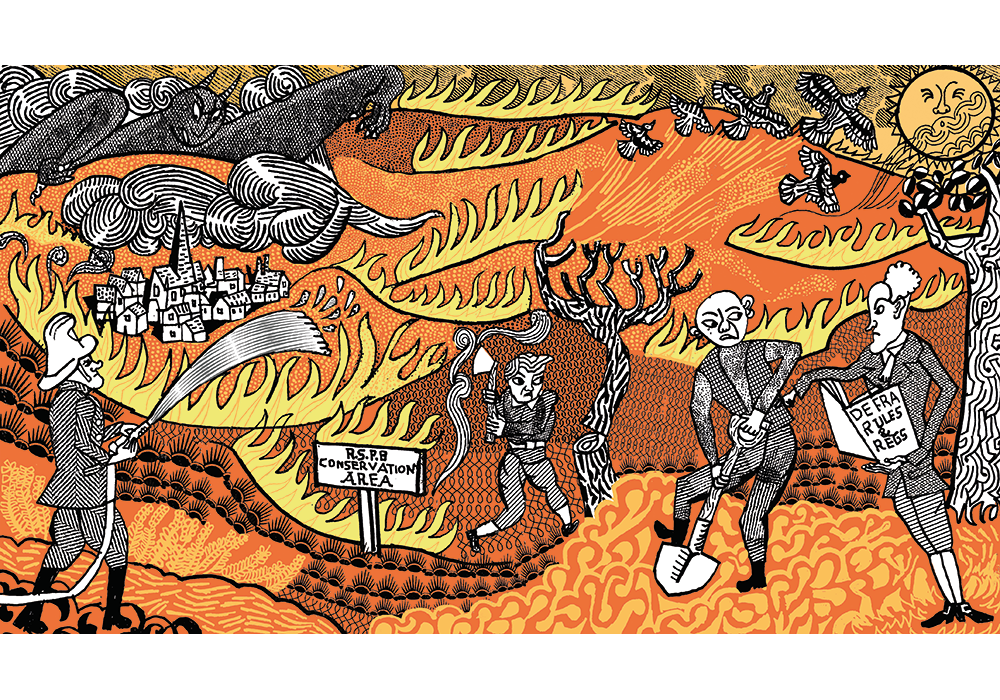
Bordeaux and Madrid are threatened by flames. In Sicily, arsonists tied burning rags to the tails of cats to spread fires. Here in Britain the Cairngorms and Peak District national parks are ablaze. It’s the climate Armageddon, say the greens. If only we had built more wind farms and eaten fewer cows this would not be happening.
Hot, dry spells undoubtedly make fires more likely, but awkwardly for those blaming climate change, wildfires are getting less frequent worldwide, not more, as the globe warms. The acreage burned has decreased steadily since 2000, according to Nasa’s satellites, and is thought to have almost halved in a century. The great fires of 1871 in Wisconsin and Michigan burned more than a million hectares long before anybody drove a car, before even Joseph Swan’s first light bulb, when the world was cooler.
It has been known for many decades that the longer you go without a fire, the worse the fires will be
It is not just the trend that is surprising. Hard to believe, but this year is an unusually quiet year for wildfire: so quiet it is breaking records for lack of fires by this date, even in Europe. If you don’t believe me, check the figures produced by the Global Wildfire Information System: as of last week, the world had seen 106 million hectares burn this year, the lowest at this date since these records began in 2012. In Europe, just 3.6 million hectares have burned – less than half the average for this date. That’s cold comfort to people driven from their homes in France, but it is nonetheless a fact.
The real issue is that climate change is a handy excuse for politicians who have failed to take precautionary measures to prevent wildfires. They can just shrug: it’s global warming, innit? It has been known for many decades that in fire-prone habitats, the longer you go without a fire, the worse the fires will be. So preventing the build-up of tinder by controlled burns is the most important factor.

The California filmmaker Gabriel Mann’s hard-hitting 2023 documentary Hotshot showed in detail how fire suppression has made today’s fires harder to control. He has no patience with those who use climate change as an alibi. ‘They tell you the sky is falling and it’s all the fault of our modern, shitty climate,’ he says. ‘But when was the climate not shitty?’
Here in Britain the government has consistently and relentlessly demanded less ‘cool’ burning – low-intensity, controlled fires – in winter on heather moorland, Britain’s most fire-prone habitat. Such fires have been used by farmers and gamekeepers for generations to create a mosaic of short and long heather. This encourages fresh young heather shoots for sheep and grouse to feed on and makes open areas for rare birds such as golden plover and curlew to nest in. If done in winter it can burn off the rank heather plants while leaving the moss underneath barely touched, as demonstrated by a famous video in which a gamekeeper places a Mars bar in the moss, lights a fierce fire over it, then picks up the unscorched, unmelted chocolate bar, unwraps it and eats it.
Natural England argues that regular cool burning harms the habitat; researchers at York University and elsewhere argue the opposite: that it encourages the growth of sphagnum moss and other species by letting light in. But both sides agree that regular cool burns can dramatically reduce the risk of much more damaging wildfires, which burn down through the moss layer and into the peat. Cutting heather instead is less effective but better than nothing. Yet Natural England has banned heather burning on deep peat altogether and is pushing hard to limit it further everywhere – or at least tie it up in complicated licensing rules. As a result, the fuel load on heather moorland has been increasing; in places the heather is now waist-deep. The National Fire Chiefs Council warned last year that such restrictions on heather management would increase ‘the danger to firefighters and the public’.
Unlike private owners, bodies such as the Royal Society for the Protection of Birds (RSPB) and the National Trust are refusing to burn and reluctant to graze heather moorland, as they join the cult of ‘rewilding’. With the support of government, they plan to mitigate the fire risk by ‘rewetting’ moors with leaky dams to hold back rainwater. But this approach is useless in a drought.
Case in point: the Tintwistle fire in the Peak District spread from a wild camp in woodland on to a heather moor owned by United Utilities and managed by the RSPB. This moor had been extensively ‘rewetted’ yet it went up like a torch and the fire spread, drowned Manchester in smoke, burned deep into the peat and was only contained – for now – when local gamekeepers and Greater Manchester Fire and Rescue used two diggers and a bulldozer to create a firebreak on its northwest flank on the neighbouring Stalybridge estate. But so quick is Natural England to prosecute landowners and gamekeepers for even inadvertently breaking rules about managing habitat that they were anxious they might be punished for doing this.
Richard Bailey, coordinator of the Peak District Moorland Group, estimates that the past month’s firefighting by gamekeepers would have cost the taxpayer millions of pounds if done by the fire service. Many long, hot, hard days and nights have left gamekeepers and their families under severe mental strain, alleviated a little by generous food drops from Micklehurst cricket club. You can imagine how much it sticks in the craw for these gamekeepers that they have been working to save land managed by an organisation that makes the risk worse.
The nearby Dovestone fire was also started on RSPB-managed land after a man drowned in the local reservoir and his friends commemorated him with fireworks. The Cairngorms fire too began on land owned by the RSPB at Abernethy. The irony is not lost on locals that the very same people who tell us that climate change is an existential crisis are also the ones urging us to stop using the one tool we know helps to mitigate the problem. If your view is that climate change is a massive threat, why are you pursuing policies that increase fuel load?
The North York Moors fire last year affected 2,500 hectares of moorland, smouldering for more than a month in the peat and releasing vast quantities of carbon dioxide. Yet no Defra minister bothered to visit. The cost of fighting these fires does not fall on their department, so why do they care, says Jamie Blackett, founder of Ground Cry, a new organisation campaigning on behalf of ground-nesting birds like curlews.
Both sides agree that regular cool burns can dramatically reduce the risk of more damaging wildfires
The authorities know their policies increase the fire risks. Here is what the Cairngorm National Park says in its Integrated Wildfire Management Plan about plans to increase shrubs and other vegetation by reducing deer and stopping burning: ‘These habitats will take many years to develop and during the intervening period fuel loads will increase, as will the corresponding need for fire risk mitigation.’ So they knew the risk was increasing. But little was done. John Kirk, a board member of the Cairngorms National Park Authority, told the Strathspey Herald: ‘Everyone is furious… the entire Abernethy forest has no firebreaks.’
Andrew Gilruth, chief executive of the Moorland Association, says: ‘While Scotland has a clear plan to manage the excess vegetation, in England the authorities are obsessed with rewilding and restricting all commonsense measures for reducing fuel loads.’
In May, before the drought, Gilruth wrote to MPs who represent moorland constituencies to point out that the number of firefighters is down by a quarter over the past seven years and that the fire service relies heavily on gamekeepers’ vehicles, water bowsers and other equipment. Banning the burning of heather means fewer keepers can justify having such equipment. He described Defra’s refusal to change policy on heather burning as reckless.
Sadly he was proved right. So was I. After I warned in these very pages last year that government policy was worsening the fire risk on moorland, it gives me no pleasure to say: ‘I told you so.’





Comments