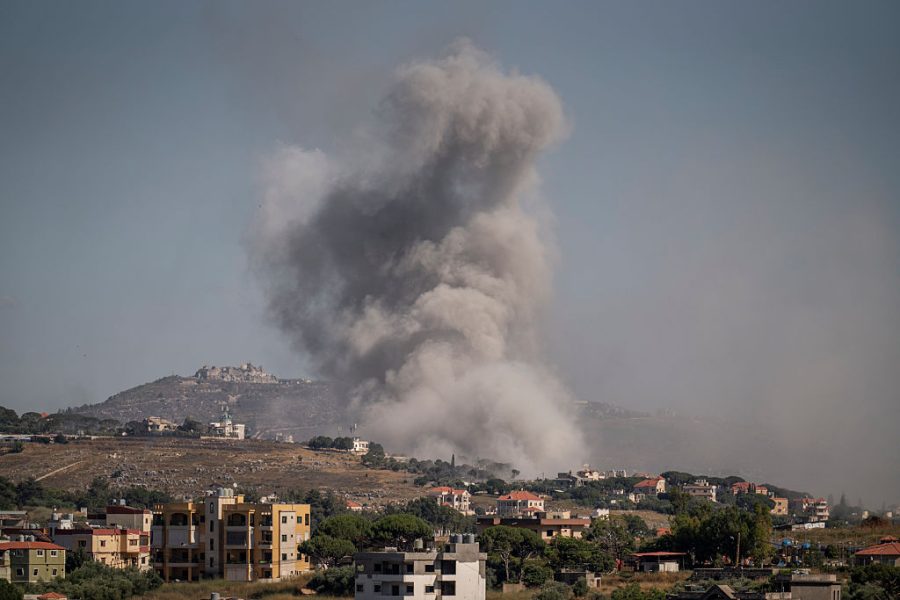
As the 60-day period of negotiations stipulated by the Memorandum of Understanding between Iran and the US gets under way, the issue of Lebanon is fast emerging as a central bone of contention. It is also revealing significant differences in the stances of America and Israel.
Israel has sought throughout to detach its battle with the Iranian proxy group Hezbollah in Lebanon from the negotiations – and from the larger effort to settle the conflict between the US and Iran. The logic is as follows: Hezbollah intends to continue its war against Israel. Jerusalem is aware that the US administration very much wants the current negotiations to succeed, so the Israeli government is currently engaged in the difficult task of seeking not to lose ground in an ongoing fight with an Iranian proxy, while simultaneously not coming across as a spoiler to a US administration keen to conclude its own conflict with Iran.
Iran, predictably, is keen that Israel should not succeed in this effort. As part of this, Tehran is determined to link the two fronts (i.e., Iran/Hormuz and Lebanon), insisting that failure in one means failure in both. Iran hopes by so doing to formalize a mechanism by which it can both protect its main Levantine proxy and create and widen divisions between Washington and Jerusalem.
Israel has no capacity to destroy Hezbollah in its entirety in Lebanon
Regarding the former goal, Iran hopes that US commitment to the success of any agreement will lead it to pressure Israel to withdraw from Lebanon – or otherwise stay its offensive against Hezbollah so as not to endanger the agreement’s implementation. Should Israel seek to defy US desires in this regard, this will serve the secondary goal of encouraging differences between Iran’s two enemies.
After initial wrangling between the US and Iranian sides over the issue of Lebanon, they have now reached agreement on the establishment of a “deconfliction cell” intended to ensure the cessation of military operations in the country, as required by the MoU. The mechanism includes the United States, Iran and the official government of Lebanon, along with the two countries who are mediating the negotiations, Pakistan and Qatar.

Israel is excluded from the deconfliction cell, and it is not at all clear that the mechanism will succeed in its intended purpose. This is because a direct conflict is still under way between Israel and Hezbollah, the dynamics of which are in direct contradiction to the Geneva negotiations.
Iran believes that it emerged victorious from the war which recommenced on February 28. It is now interested in reaching an arrangement with the United States, which it sees as formalizing this achievement – and which it intends will include new arrangements on the Strait of Hormuz and the unfreezing of financial resources currently out of its reach. At the same time, Tehran has no intention of ending the broader strategic contest with the US. It also has no interest in concluding the conflict between Hezbollah and Israel.
Israel, having been attacked twice by Hezbollah in the last three years (on October 8, 2023 and March 1 this year) is, however, determined not to simply accept the status quo ante bellum. As Israeli Defense Minister Yisrael Katz bluntly expressed it this week:
Even if there is an American demand – we will not withdraw from Lebanon. 200,000 residents will not return.
Katz is referring here to residents of Israeli border communities who have quit their homes because of the danger of living close to the border fence with Lebanon thanks to Hezbollah’s liking for repurposing anti-armor missiles to target civilians and their homes.
Israel is also concerned at the practical implications of a deconfliction cell involving Iran and Qatar which is intended to manage ongoing friction between Hezbollah and Israel. As an un-named Israeli intelligence source quoted in Haaretz put it:
Transferring intelligence information, coordination plans or warnings ahead of a possible IDF attack to a body that includes Iranian or Qatari representatives is preposterous… These representatives cannot be trusted, and any shred of information that reaches them will immediately leak to Hezbollah and endanger human lives.
Israel has no capacity to destroy Hezbollah in its entirety in Lebanon, short of a ground invasion of the whole country – which is outside of the scope of possible options. At the same time, the current diplomatic process under way in Washington between the governments of Israel and Lebanon stands little chance of success, given the simple and stark fact that Hezbollah is stronger than any coercive force available to the Lebanese authorities. The Beirut government therefore simply has no capacity to force Hezbollah (which itself is represented in the government) to do anything it doesn’t want to. And neither Hezbollah nor its Iranian masters want it to stand down.
This means that further conflict in Lebanon is only a matter of time. At the same time, Israel has, under US pressure, currently ceased advancing in Lebanon and is in a defensive stance. Where is all this likely to be heading?
In the short term, with US encouragement, a partial Israeli withdrawal from some of the areas of Lebanon captured since February 28 is likely. A complete withdrawal, by contrast, probably won’t happen. Israel’s strategy since October 7 has been characterized by a desire to place barriers between its own civilian communities and potentially dangerous areas. This is the upshot of the Gaza war; it has been implemented also in Syria.
In Lebanon, the November 2024 ceasefire left the IDF in five outposts north of the border. The clear Israeli desire now is for the army to hold a zone around six miles from the border across its entire line – placing civilian communities out of range of anti-tank missiles – for as long as Hezbollah remains the de facto ruler of Lebanon. This is likely to happen but will also be accompanied by partial withdrawals from areas beyond this point. These will be handed over to the Lebanese Armed Forces, and one way or another will almost certainly then be reoccupied by Hezbollah.
What all this goes to prove is that the three months of war between February and June changed little of the deeper dynamics. The long war conducted by Iran and its Islamist proxies, intended to result in Israel’s destruction, is still under way. What has changed, at least for now, is that Israel needs to conduct this fight with the additional complication of not upsetting a US administration that is trying to make its retreat look like a peaceful outcome.


Comments