
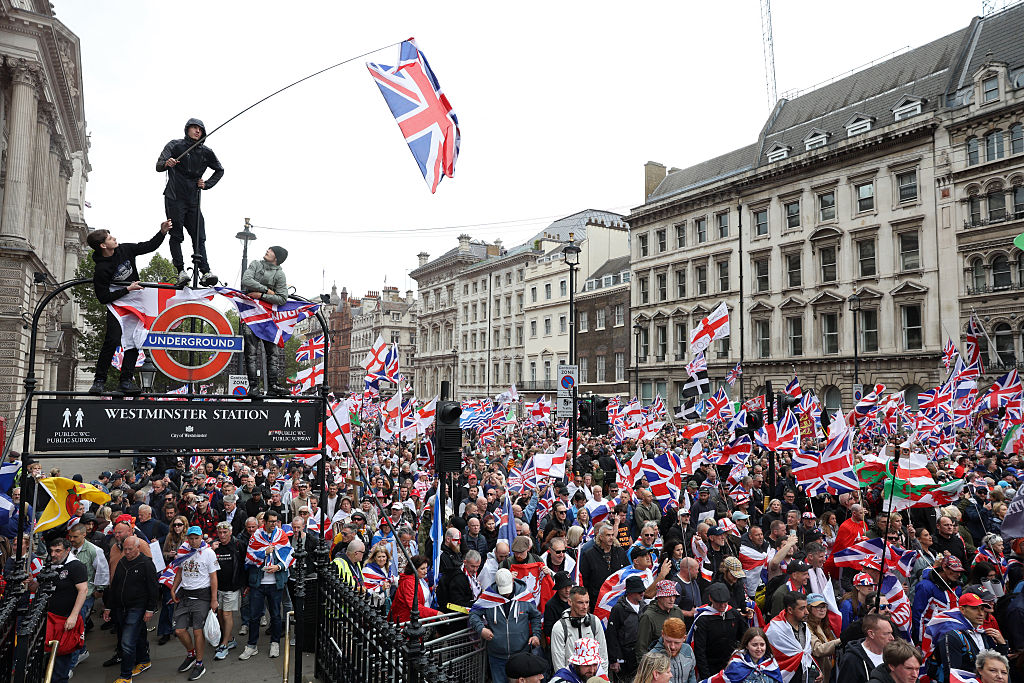
Perhaps the strangest thing about the Unite the Kingdom rally was just how unremarkable it felt. There were no mass chants calling for the death of particular groups, no calls for the eradication of foreign countries, and no flags of terrorist groups or tyrannical theocracies waved in the crowd. Nobody cited scripture to urge the slaughter of another people, nobody waved terrorist symbols, and nobody I saw during the entire day covered their face.
Of all the political protests we’ve witnessed since Labour won the general election – and we’ve witnessed many – this was the one he chose to obstruct repeatedly
We live in such peculiar times that this is what set the march apart from the dozens of others which have descended on the streets of London over the last couple of years, totally unchallenged – even protected – by the police and our government. Yet this outlier was the first march Keir Starmer decided to speak out against since taking office as Prime Minister, threatening police action and the full force of the law against those involved, and pulling out all the stops to block foreign speakers from entering the country at the last minute. Of all the political protests we’ve witnessed since Labour won the general election – and we’ve witnessed many – this was the one he chose to obstruct repeatedly. This was the hill he chose to die on.
And just in case anyone had forgotten what the other type of march looks like, they handily held one just around the corner so we could compare and contrast. The far-left omnicause supporters took to the streets waving their PLO and Iranian flags – the ones representing the Islamic Republic regime, not the sun-and-lion version indicating solidarity with the Iranian people. Some were even sporting Al-Qassam Brigades red triangles, a symbol made popular by the terrorists when marking out targets for death in videos.
Unite the Kingdom focused mostly on domestic issues, British society and Christianity. Mostly the crowd waved Union flags, St George’s crosses and saltires. The other march featured few no Union flags, but a sea of red, white, green and black PLO flags.
Much of the traditional media coverage referred to these two marches as the ‘far-right’ march and the ‘pro-Palestine’ march, representing another imbalance in how the marches were treated. The left-wing march was afforded the courtesy of being described as it wished to be, but not one single person I met on the other one would have identified with the ‘far-right’ description. Both descriptions are questionable, because any march truly supportive of Palestinian Arabs would surely call for the end of Hamas and other terrorist groups’ stranglehold over their lives, and any far-right rally worth its salt would forbid the presence of black people, Jews or migrants of any type rather than proudly welcoming them and featuring them on stage.
When Keir Starmer declared Tommy Robinson’s march ‘a reminder of what we’re up against in the battle of our values’, many taking part would have agreed with him wholeheartedly. But though he predicted those on it would be ‘peddling hatred and division, plain and simple’, I saw nothing of the sort. Far from ‘hate speech’, I heard plenty of love speech – love for nation, for unity, for freedom. That political and social outlook might not be to everyone’s taste, but after constant and unchallenged ‘globalise the intifada’ and ‘from the river to the sea’ mobs paraded through our cities and past synagogues, it seemed utterly disingenuous of Starmer suddenly to declare that he ‘will act decisively against hatred’ and ‘use the full force of the law when that hatred manifests as violence’ just when his leadership of his own party and the country itself is at its weakest. Perhaps it’s a coincidence that the UTK march openly challenges Labour’s positions and actions in government, and that its most popular spontaneous chant was, once again, ‘Keir Starmer’s a wanker’. No, there’s no way that’s what inspired him to act tough all of a sudden.
In the end, the reports that he has told friends he would finally step down as leader and PM came after this mass popular display of disgust at his record from a crowd made up of many varied types of Britons—working class, middle class, young, old, white, black, poor, rich, you name it.
The point is that most of what I heard at the UTK event was basic common-sense talk you’d hear around the country in pubs, shops, homes or anywhere, really. It’s not always sophisticated political theory or solution-focused strategy, but it does reflect the hopes and fears of a massive portion of our society.
Street protests and marches aren’t the place for technical politics or intellectual debate. They’re rough around the edges, and you can always find crazies and nasties in them if you look hard enough. But their overall mood and tone are a useful reflection of their participants’ collective vibe. The actions of their leaders in the run-up to and during the protests are good indicators, too, of their intentions. Robinson has spent weeks putting out videos urging attendees to keep their faces uncovered, not to rise to provocations from anyone, and to meet any conflict with a smile. If his background bothers our political class so much, they could at least acknowledge the responsible way in which he called for peaceful political dissent.
Compare that with the constant wrangling and arguing of the anti-Israel march organisers, who repeatedly forced their rallies on the rest of us over a period of more than two years, and who were eventually found guilty in court of breaching Public Order Act conditions designed to prevent disruption to a local central London synagogue. In that case, the judge ruled that a speech delivered from the stage by Ben Jamal of the Palestine Solidarity Campaign constituted unlawful incitement because it actively suggested, persuaded and induced protestors to bypass the police perimeter.
The real test for any government is whether it can apply the same standard to dissent it dislikes as to dissent it finds convenient. On Saturday, that standard looked painfully absent: one set of demonstrators treated as a threat to the nation’s moral order, warned against and subjected to live facial-recognition policing, while the other was granted the softer language of protest even after years of intimidation, disruption and open extremism. If Starmer wanted to talk about ‘the battle of our values’, he might have begun by explaining why patriotism alarms him more than the politics of revolutionary violence. Now it seems it may have dealt him the final blow in his slow motion downfall.

Comments