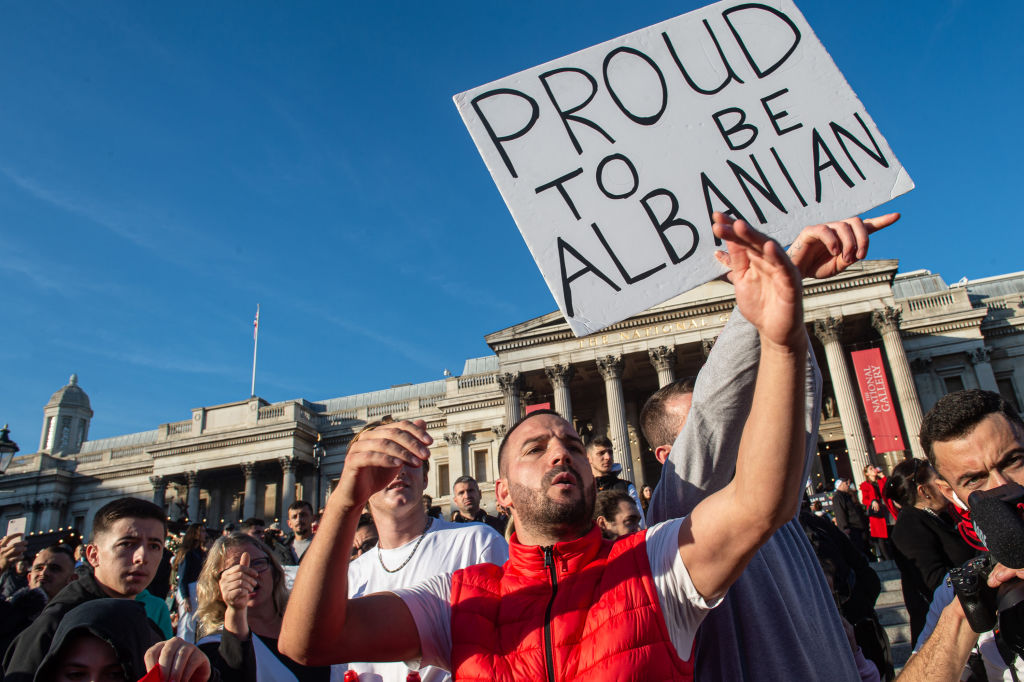
At a formal dinner recently, an aristocratic English lady asked about my experience of the UK. I told her I had loved it from the moment I arrived from Albania, aged 17. I then paused and mischievously added ‘as a stowaway’. I expected that to be a conversation killer. Instead, her eyes lit up. ‘How wonderful! My brother left England for Canada 45 years ago. As a stowaway too. What an adventure!’
The Albanians shut out of a legal route into Britain are lured by conmen who tell them not to bother with visas. Some end up in cannabis farms, then in prison
I arrived in Britain hidden in a lorry from Belgium, by way of Italy, which I had reached by boat. For the first four years I worked in a restaurant and at Sainsbury’s before unexpectedly entering Oxford to study maths. I was the outsider who learned the language, loved the culture, got a job and paid his taxes. I wonder, sometimes, if Britain still likes a story like mine.
As the Albanian Ambassador I would not normally stick my neck out in this way. But British ambassadors in Tirana speak freely about Albania’s failures and its need for reforms, with the serene authority of people who have not recently checked the news from home. Consider this my small act of reciprocity.
We are an ancient people, with our own proud, positive values. Lord Byron wrote of Albanian hospitality in ‘Childe Harold’s Pilgrimage’; I read it at school.
More recently, Albania lived under the most brutal communist dictatorship in Europe. It was so complete, so paranoid, that it left us uniquely isolated even within the Eastern Bloc. The poverty and chaos were real. As was the subsequent exodus from the country. I was part of it.
What followed is a story rarely told in Britain. A country of fewer than three million people rebuilt itself after the collapse of tyrannical communism with remarkable speed. British tourists who visit Albania are often surprised: not only by the quality of its beaches, but by the warmth of its people and the sense that something exciting is happening here.
There is also a chapter of our history that matters enormously in the present climate. During the Nazi occupation, Albanian families sheltered every Jewish refugee who asked for help. Not a single one was handed over to the Nazis. Uniquely in occupied Europe, the Jewish population in Albania was higher after the war than before it. Trust and hospitality are to Albanians what fairness is to the British: a national characteristic. When speaking about the dangers of dehumanising a community through lazy headlines, it is worth remembering which nations kept faith when the stakes were mortal.
Which brings us to Britain, a country with an instinctive moral intelligence I have genuinely loved. When discussing immigration, there are now politicians for whom the word ‘Albanian’ has become a rhetorical instrument. It scores points in tabloids, and it excites social media. In some ways, using Albanians as a punchline plays better than discussing the NHS or education. The cost is borne not by Albanians, who are resilient, but by Britain’s own self-image, and by every other minority watching the boundaries of acceptable rhetoric stretch a little further each year.
The rhetoric seems to affect policy. The visa system for Albanians now costs hundreds of pounds, requires multiple visits to a suburban office outside Tirana, a dense application and produces a six-month permit if you are fortunate. Italy and Germany have created workable legal mobility for Albanians. In those countries, Albanians are not condemned as criminals. They are recognised as the hard-working taxpayers they actually are.
By contrast, the Albanians shut out of a legal route into Britain are lured by conmen who tell them not to bother with visas. Some end up in cannabis farms, then in prison.
I have visited some of them. At Wormwood Scrubs, unprompted, staff told me they are among the best-behaved inmates. The men I met are mostly in their twenties, mostly there for drug offences. They felt shame, not grievance. Almost none had arrived with a visa. All had borrowed money to pay traffickers. The policies that generate the headlines also generate the prisoners. This is a policy that creates the problem it is meant to solve. It doesn’t stop Albanians migrating into Britain. It simply ensures they do so illegally.
Albanians in Britain are building homes, fixing boilers, practising medicine. They pay taxes. Their children speak English at home. They are exactly the immigrants politicians claim to want. But those same politicians have designed a system which makes their legal arrival in Britain nearly impossible.
Britain shaped me. Oxford shaped me. Kate Bush, Monty Python, and a deep faith that things ought to be fair; these shaped me. I still believe in the Britain that once made a teenage kitchen porter feel, against considerable odds, entirely at home. The Britain where, uniquely in the world, a child’s first words are ‘that’s not fair.’ That Britain is worth defending. Even from itself.

Comments