
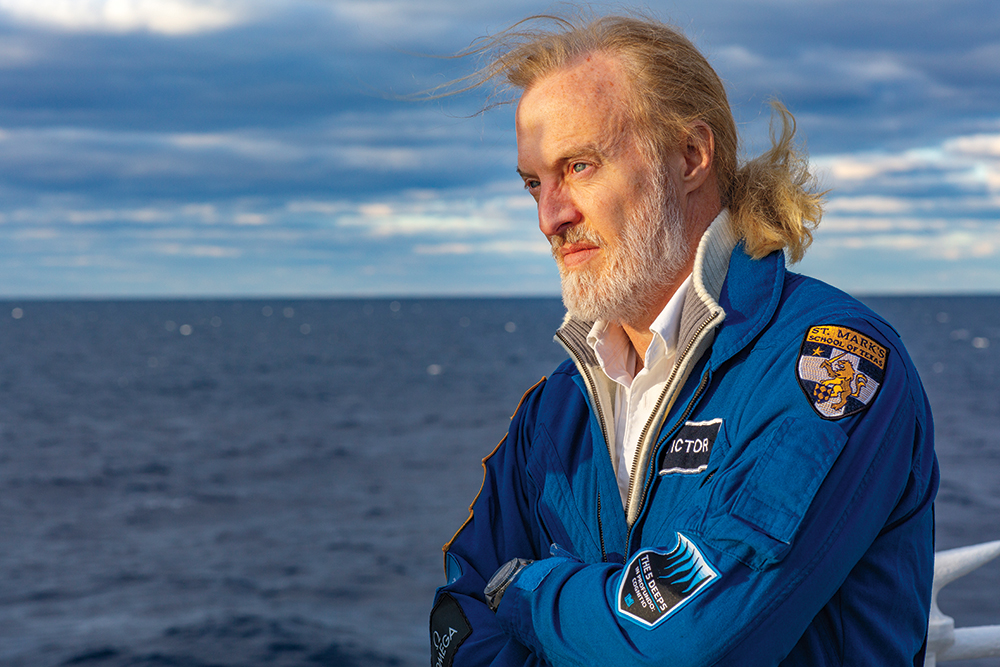
“You can just do things.”
It’s a popular phrase on X, usually in response to someone accomplishing something remarkable, taken to mean that there’s nothing stopping you from doing something out of the ordinary. SpaceX might post video of a rocket landing – “you can just do things.” Victor Vescovo might be the living embodiment of the phrase.
My first introduction to Vescovo was an email from him, extending an invitation to be a guest at his table for the Explorers Club Annual Dinner. The name was vaguely familiar to me but didn’t immediately register. Who was this mysterious correspondent?
‘I found it personally offensive that it was the year 2015 and we still had not been to the bottom of four of our world’s oceans’
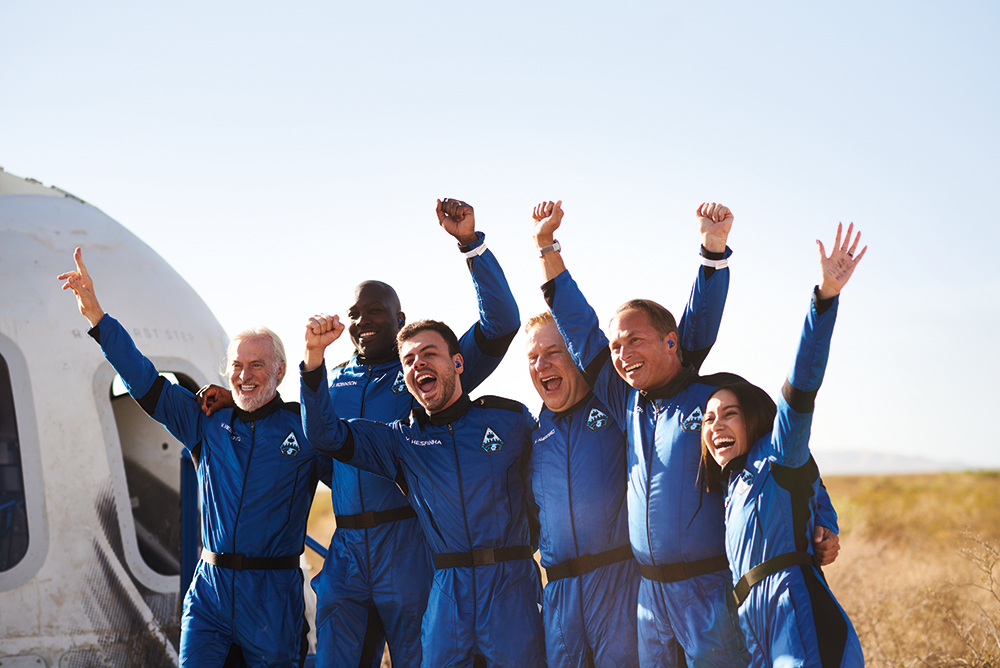
I’ll give you just a few superlatives: first person to reach the Five Deeps; first person to reach both the highest point in the world (Everest) and the lowest point in the world (Challenger Deep); first person to visit the Challenger Deep and also visit space, with a trip on Blue Origin’s New Shepard spacecraft in 2022; discoverer of two shipwrecks, the USS Johnson and the USS Samuel B. Roberts, both sunk in 1944 during the Battle off Samar. Along the way, Vescovo managed to be banned from Indonesia when the government designated him a pirate.
When meeting Vescovo, your first thought is of the Dos Equis guy, which he tells me he gets a lot. He looks the part, and his exploits might put him in contention for the title. I wanted to know more about this intrepid explorer.
I was off to Dallas, where he makes his home. He’s bounced around the world and lacks the Texas accent, but he’s a Texan through and through. I arrived on a warm February afternoon and knocked on his door to be greeted by the barks of two schipperkes – small but feisty dogs first bred in Belgium.
Entering Vescovo’s home, you’re greeted by Viking paraphernalia that’s scattered around the foyer – “gifts that get sent to me, I don’t really know where they came from,” he says.
It’s the home of a bachelor-explorer, beautiful and purpose-appointed, meaning there isn’t much in the house that isn’t useful to him or his beloved dogs, Ivan and Nikolai. I later note, when offered a drink, that there’s very little in the fridge other than a stockpile of Diet Coke and Topo Chico.
I’m given the house tour, which includes a spare bedroom that’s been converted into his 3D-printing lab. As we walk by the theater (a big sci-fi film and book buff, I find) I see a 16th-century katana (or samurai sword) laying on a table – he’s just picked it up in Japan. “I’ve always wanted one,” he says. “You have no idea what it took to get this into the country.”
He takes me to the building next door, which he recently built after purchasing and tearing down his neighbor’s house to build the combined study, carpentry and metalworking studio, and garage for his supercars, which include two vintage Lamborghinis and his high school car that he’s particularly fond of, a 1984 Pontiac Trans Am Firebird, still in mint condition.
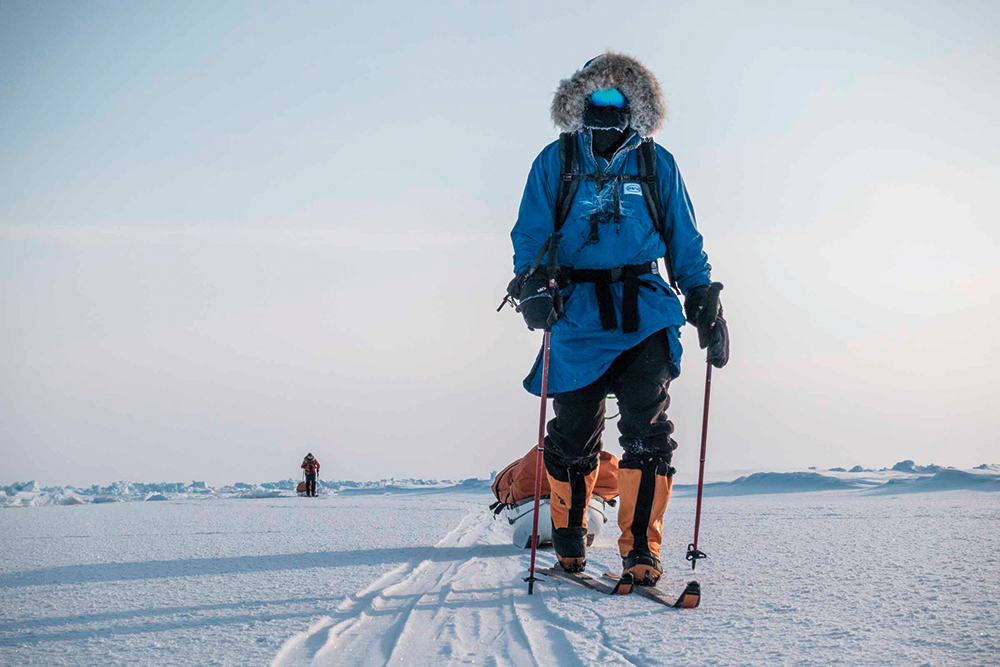
Vescovo got bit by the exploration bug early on in life during a trip to Tanzania soon after college, where he summited Mount Kilimanjaro on a whim – resulting in the search for bigger mountains to summit. Eventually he completed the Explorers Grand Slam, summiting the highest peaks on all seven continents, plus expeditions to the North and South Poles.
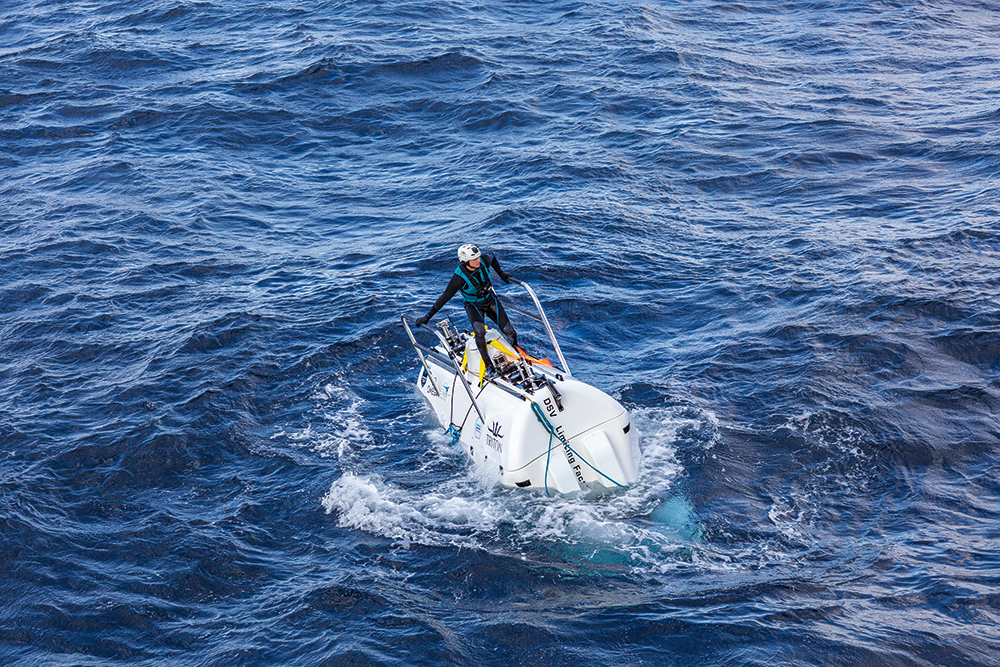
In 2015, Vescovo set his sights on something new – the world of submersibles.
“I read an article about Richard Branson, who was trying to do what he called the Five Dives project, but they chose some technology that was not fully mature or even appropriate for what they were trying to do and eventually they abandoned the project. I said ‘no, no, you could do it.’ And that’s when I started sketching out in my head.”
The Five Deeps, or the deepest points in all the five oceans, were still a mystery.
“I found it personally offensive that it was the year 2015 and we still had not been to the bottom of four of our world’s oceans.” Vescovo reached out to Triton Submarines, a maker of bespoke submersibles for the private market.
“They made it look like it was, you know, ready to go, kind of just give us the money and we’ll build it. It wasn’t near that way. But it did start the discussion going and I ended up getting enough confidence in them that they could build the machine after we talked through what they wanted to build and what I wanted to build.”
The result was the Limiting Factor, a $50 million titanium boat that holds two people and withstands the pressures of the deepest points of the ocean. The Five Deeps Expedition would be the first mission to reach all of them. It launched in December 2018 with the first-ever solo dive to the bottom of the Atlantic Ocean, and culminated in August 2019 when Vescovo became the first person to reach the bottom of the Molloy Deep in the Arctic, and thus, the first person to reach the bottom of the Five Deeps.
‘I’m a very practical guy who just happens to do impractical things’
Knowing he would need a solid, reliable watch for his dives, one day he wandered into an Omega boutique in Dallas and purchased a basic Seamaster Planet Ocean.
“I was looking at the different Seamasters and the woman said, ‘oh, do you dive?’ And I went, ‘yeah, sort of, I’m going to try and go to the bottom of the Atlantic Ocean next month.’ She went, ‘oh, that’s nice,’ you know, whatever, here’s your watch. When it hit the press someone at Omega noticed I was wearing a Seamaster. I got a call from Switzerland and they said, ‘are you really doing this? Tell us about that.’ I get a call back the next day. They said, ‘our CEO wants to meet you and have you for lunch in Switzerland. Can you come by?’”
That watch now holds many of the same distinctions as its wearer: the only timepiece that’s been to the Five Deeps, the only solo dive to the Titanic, and, yes, it’s been to space. Plus, “it’s made of titanium. Just like my submersible,” Vescovo quips.
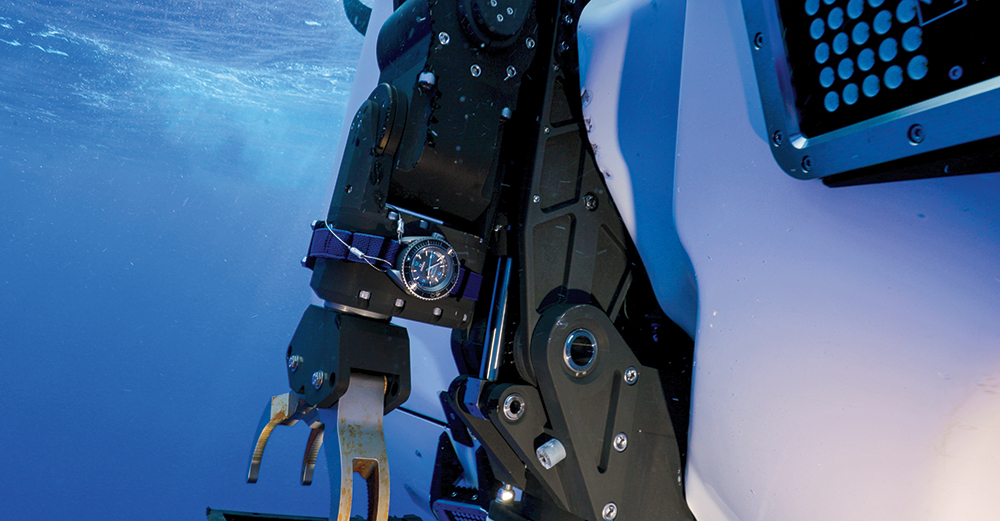
He’s worked with Omega on R&D, strapping a specially designed prototype to the side of the Limiting Factor on some of the dives, which helped to develop the 6000m Ultra Deep, the deepest diving watch they’ve ever made.
In his kitchen, he shows me the prototype Ultra Deep that he took to the bottom of the ocean, one of only three in existence – the other two are in the Omega archives in Switzerland. It’s gigantic, and not actually wearable; about 2.5 inches thick.
That afternoon we’re off to Addison Airport, a small private airport in Dallas where Vescovo wants to take me flying in a Cirrus SR-22. He first acquired his pilot’s license at 18 and has since been rated to operate all manner of flying vehicles including gliders, jets, and helicopters. Knowing my interest in getting a pilot’s license he takes me around the plane for the preflight checks. He explains the thoroughness with which he does his procedures – “it’s why I’m still alive. I’m a very practical guy who just happens to do impractical things.”
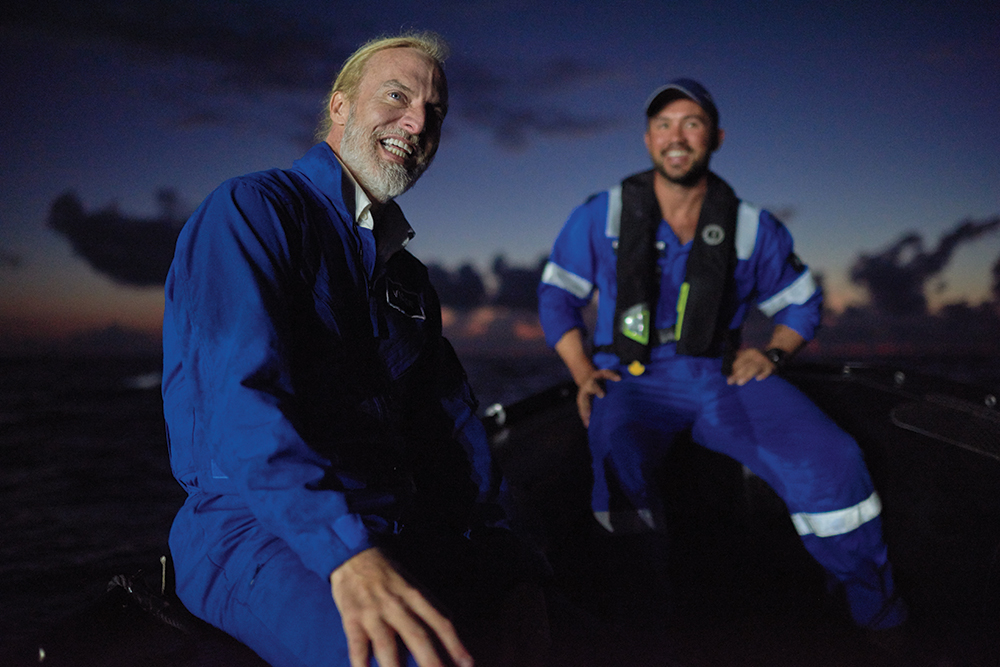
Over dinner later that night at Javier’s, a Mexican restaurant I later discover is a Dallas institution, we chat a bit about his life and business dealings.
We’re greeted by the valet, then the host, then various other restaurant employees, who all know his name and welcome him warmly. We order margaritas at the bar while we wait for our table and a stranger comes up to say hello – he had just watched the Discovery Channel documentary on the Five Deeps Expedition.
It wasn’t a straight line to exploration. At one point, Vescovo did have a normal-ish day job. Born and raised in Dallas and with schooling at St. Mark’s, Standford, MIT, and Harvard led to early stints at Lehman Brothers and Bain before starting his own private equity fund with a partner. He spent a few decades investing in middle-market industrial companies, buying and fixing underperforming companies, which gave him both the financial freedom and technical know-how for his more recent exploits.
He’s now focused on his own investments, which, I put to him, is more of a “moonshot” investment thesis.
“Yeah, fair enough,” he says to that characterization. “My investment philosophy when it comes to venture capital is obviously, I want to have a really good return to my investments. But I also, even if they fail, want the company to have pushed the ball forward technologically and in areas that I believe humankind has its greatest technological needs. In life sciences, in space, in defense, and aerospace, because I also am passionate about doing what we can to keep the United States as a strong military power… I do believe that a core strength of freedom and democracy is superior technology in defense and aerospace. I spend a lot of time and money on that.”
Vescovo spent 20 years as an intelligence officer in the US Navy Reserve, where he was mobilized several times in hot conflicts around the globe, which may be where that investment thesis comes from. Some investments include AstroForge, who are attempting to mine minerals from asteroids; Sceye, which is building stratospheric airships that will provide bandwidth and internet connectivity; and another in Colossal Biosciences, which last year made global headlines for de-extincting the dire wolf – supposedly the woolly mammoth is next.
“This coming week, I’m probably going to make a small seed investment in a startup firm that’s trying to build data centers in space,” he tells me.
But now he’s onto what may be an even more ambitious endeavor – mapping the floors of the world’s oceans. While the drier parts of the planet have been well sorted, only about 25 percent of the global seafloor has been mapped.
There are a few reasons for this. First, you may have noticed that the oceans are huge. Second, it’s really expensive. Third, it’s really hard.
“The ocean is impenetrable by radar. So the only way you can map the sea floor is by using multibeam sonar and that’s a slow process,” Vescovo tells me.
And there isn’t necessarily immediate incentive to do the mapping.
“The only people that really are interested in mapping the ocean are governments and academics. Yes, there are oil companies, but they don’t publish their data and they go in very specific areas,” he says.
And when mapping is done, it’s not done cost efficiently, something Vescovo hopes to change.
Vescovo has been building and testing a new manned ocean floor-mapping vessel that will require just a single crew member.
“When they build a ship to map the sea floor, it does 20 other different things. It does drones, it does wet lab, dry lab. It has a crew of 40 or 50. That’s just how they do things, and it makes it incredibly expensive, like anywhere between $20 to $100 a square kilometer.
“I went ‘this is ridiculous. What is the minimum that I need to map the sea floor, and I’ll build it out.’ I put my business hat on and started with the sonar.”
The semiautonomous mapping vessels will be at sea for two weeks at a time, similar to the way that oil rigs operate, with the ability to be at sea 90-95 percent of the year. Vescovo estimates the cost to map the sea floor will be $3-4 per square kilometer – an order of magnitude lower than current rates.
In the age of self-driving cars and AI, I wondered why the vessels couldn’t be fully autonomous sea drones.
“If it’s fully robotic, you’ve got to put in several $1,000,000s of equipment for that one-percent scenario where it’s going in and out of port. And also, [drones] tend to be smaller. They don’t map as much; they don’t have as much power. They go up and down a lot. So the sonar quality is lower. So why don’t you just make a really big drone? Well, now it’s something that, you know, any pirate would want to come and pillage it. So having a crew of one solves a lot of problems.”
You must always consider the pirates.
The next morning Vescovo picks me up from my hotel in one of his white Lamborghinis. We’re off to check out Old Parkland, a former hospital and now an invite-only office park developed by billionaire real estate developer Harlan Crow to look like an old college campus. Vescovo keeps his office there, as does George W. Bush and many of the major players on the Dallas scene.
As far as I can tell it’s a lot of family offices and VC funds – no riffraff like accountants and lawyers. On the morning I’m there, Treasury secretary Scott Bessent is on campus giving a talk to the Economic Club of Dallas. The campus is littered with art and historical artifacts from Harlan Crow’s personal collection, something he’s well known for.
Vescovo is giving a talk to a salon (of sorts) on campus that morning, a presentation discussing his exploits, past and future, extolling to his audience the virtues of putting their money to good use to help better society. “How many yachts can you waterski behind?” Vescovo asks the group, invoking Bud Fox’s question of Gordon Gekko.
Afterwards, one of the attendees says in a fantastic Texas drawl that Vescovo seems to be “a guy who hates being at sea level.”
I ask Vescovo if he has time for a social life or if he may want to slow down at some point.
“I think human beings have the capacity to do two big things. And those big things are career, social, and family, adventure, or military. There’s no way a human being could do all four. In my life I frequently did two of them.”
He’s never been married or had children. “Who wants to be the second or third priority to someone?” he asks. “I have great friendships. But that’s materially different than being involved romantically or in a family situation with someone. Because if I go off on an expedition for two months, they’re like, ‘cool, let me know how it goes. Send me a postcard.’”
As for slowing down? It seems not. One of his more interesting new projects moves from the ocean to the air – developing high-altitude piston-powered aircraft.
“I’m hoping in the next one to one and a half years we’re going to be able to take that [plane] up hopefully above 60,000 feet. It’s a tough challenge,” Vescovo says.
But why, when we have jets that can handle it with no problem?
“Well, sometimes what I do, I try and develop technology for technology’s sake and for the adventure of it.”






Comments