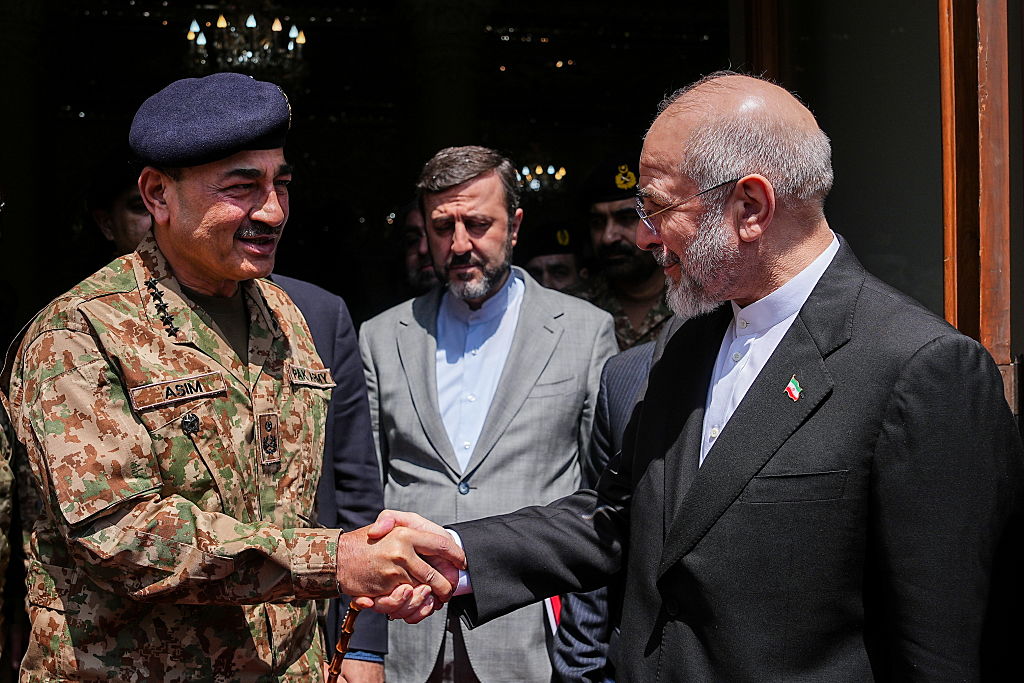
Perhaps we should be used to be this by now. Yet again, there have been a flurry of promises to rapidly achieve peace in Iran. Yet again, the American administration has threatened to destroy the nation’s infrastructure. J.D. Vance is again flying to Pakistan for more talks. And yet the conflict shows no sign of ending. We don’t know whether the Iranians will actually turn up. A foreign ministry spokesman said yesterday that Iran will not be joining the talks. The speaker of the parliament Mohammad Bagher Ghalibaf has also made clear that the regime won’t negotiate under threat of civilizational destruction.
Why would they resist peace talks? There is both a diplomatic and domestic answer. On the diplomatic front, Tehran’s promise to reopen the Strait of Hormuz last week was a masterstroke. The logic was clear: Iran could appear compliant, willing to engage and seemingly flexible ahead of negotiations. The US, meanwhile, would likely continue their own blockade.
That calculation proved correct. Indeed, the US has since reinforced its own blockade, fired on a tanker, and even sent Marines to board a ship. This helped further Iran’s claims – to the world as much as to the US and the negotiators – that they are the injured party, battling an unpredictable and inflexible United States. Non-western nations took note: Iran had shown itself a better custodian of the strait than Washington. Meanwhile, the Islamic Revolutionary Guard Corps could portray itself as the blameless, plucky underdog.
This is only half the story. Inside Iran, the elites are asking what their country will look like after this conflict. Who will the peace favor and who will be caught up in the inevitable reckoning? Iran’s embattled President Masoud Pezeshkian is fighting a rearguard action to save himself from political obsolescence. He resents the dominance of the more thuggish elements of the IRGC, under whose orders he now operates. And Foreign Minister Abbas Araghchi, as Zarif before him, knows that his room for maneuver is extremely tight. Araghchi is caught between the IRGC, who do not want a deal with the Great Satan, and a sizable percentage of the Iranian people, already laboring under economic hardship. They do not want to see their electricity grid, water plants and sewage systems destroyed by the Americans and Israelis.

It is now clear that the IRGC has been strengthened by the American attack. This fundamentalist militia rose to prominence in the aftermath of the Iran-Iraq war, securing business contracts to rebuild Iran and gradually establishing a vice like grip over successive presidents. Beyond the invisible ayatollah, not one member of the Khamenei family has spoken out since the start of the war. That tells its own story about Iran’s future. It seems the US has destroyed this particular dynasty.
Mohammad Bagher Ghalibaf, speaker of the parliament, has long been seen as a regime hardliner. Yet he has been the subject of some extremely harsh criticism from his former IRGC colleagues for the simple act of sitting down with the United States and entertaining their demands. Lord only knows what his welcoming party would look like should he return to Tehran having made the slightest concession.
It is unclear where Iran might be willing to compromise. Neither the US nor the Iranians have changed their position since the start of the war. That limits the room for negotiation. The only realistic opening is Iran’s stockpile of highly enriched uranium, estimated to be around 400kg. If Iran gives this up, or makes it unusable, it could be presented as a win for Donald Trump and an acceptable concession for Mojtaba Khamenei from his hospital bed, and the IRGC figures who are controlling his intake of vitamins. On the home front, such a deal could be framed as less a capitulation than a tactical trade, returning full control of the strait to Tehran to Iran.
But perhaps Ghalibaf and his team don’t have to worry about returning to Iran with a deal. Tehran believes they are winning this war while the United States believes it is still in charge. Both views contain elements of the truth, but neither allows either party to engage in substantive dialogue to end the conflict. In fact, further US military action seems likely, albeit performative and symbolic action. After all, Trump needs the space to walk away from a war of which he seems tired and bored.
I’ve written before in these pages that wars only end when at least one party sees no value in continuing to fight. That is harder when what’s contested is so entrenched. The causes of this conflict are older than the man leading the US negotiating team. And they are vast in scope and complexity, formed partly by the War on Terror yet go back to at least the 1980s, when Islamist terrorism was the Islamic Republic’s most famous export. Perhaps even to the socialist presidency of Mohammad Mossadegh in the early 1950s.
The best we can hope for in these talks is an extension of the ceasefire. Agreeing to stop the shooting is relatively simple – neither side need lose face in such an agreement. An extended ceasefire would allow the hazy outline of a deal to emerge, even if it takes months or possibly years. We can only hope for such an outcome. Only then can the suffering of millions of Iranians, Lebanese and Gazans come to an end.
Comments