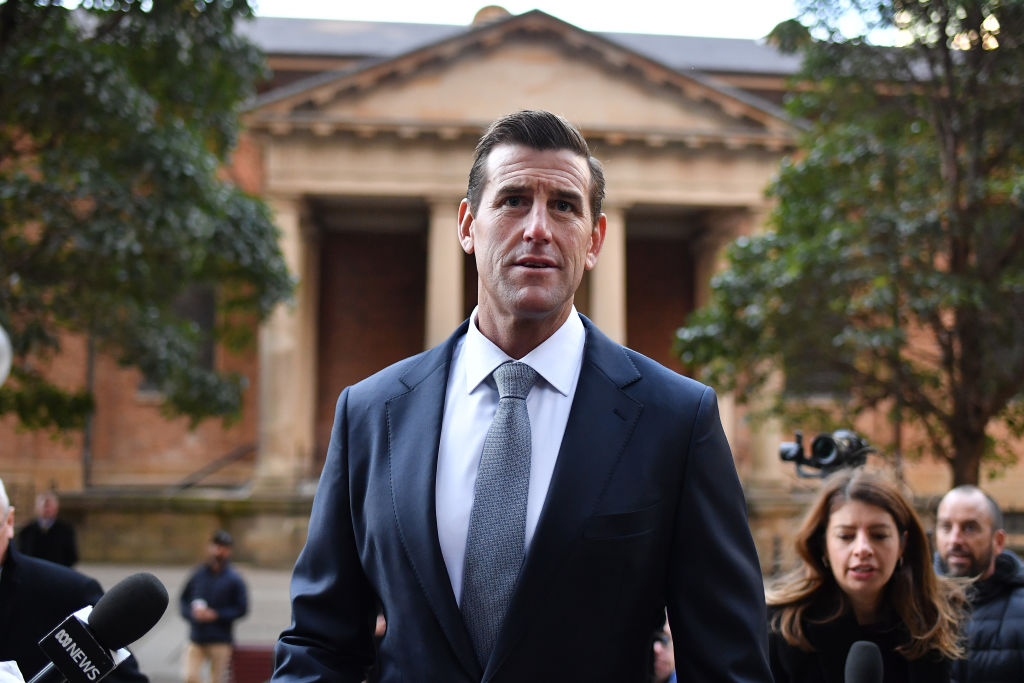
Australia’s most decorated war hero, Ben Roberts-Smith VC, is a mountain of a man. But today, he has been cut down to size.
Arriving at Sydney airport this morning on a flight from Queensland, Roberts-Smith was met by Australian Federal police officers, who escorted him to a car waiting on the tarmac. He was arrested, handcuffed and taken into custody in front of hundreds of onlookers watching from the airport terminal.
If proven beyond reasonable doubt, not only he will be besmirched, but so will Australia’s SAS regiment
Roberts-Smith is expected to be charged later today on five counts of the war crime of murder, arising from his tours of duty in Afghanistan as a corporal in Australia’s elite Special Air Service regiment. Conviction on any one count carries a maximum sentence of life imprisonment.
His alleged war crimes were uncovered by a detailed investigation by the Sydney Morning Herald and Melbourne’s Age newspaper. They related to alleged incidents of cold-blooded executions of captured Afghans either by Roberts-Smith himself, or by other soldiers under his direction, between 2009 and 2012.
These incidents were separate to Roberts-Smith’s exceptional bravery in the 2010 action against the Taliban in which he won the Victoria Cross and the high public profile that came with it. In 2022, as a VC holder, Roberts-Smith even attended the funeral of the late Queen in Westminster Abbey, his medals pinned to his broad chest. That was just one instance of the widespread public recognition of his heroism in battle, which included a lucrative post-army career.
The war crimes allegations made by the newspapers were detailed and meticulously ‘legalled’ before publication. Nevertheless, Roberts-Smith sued the papers for defamation, confident of vindication. But the reverse happened. In 2023 a defamation judge found that the newspapers’ claims were ‘substantially true’, and Roberts-Smith lost not only his case, but his reputation. He was also financially ruined.
His appeals to overturn the judge’s findings failed and Australia’s High Court refused to hear his final appeal. Roberts-Smith had lost on the civil test of balance of probabilities, but not the beyond reasonable doubt test of a criminal trial.
That may now change. Roberts-Smith will face a criminal trial relating to his alleged war crimes. The charges themselves result not just from the civil case, but from long and painstaking official investigations of what happened in Afghanistan by military and civilian-led investigations. Roberts-Smith has denied any wrongdoing.
The five charges relate to the war crime of murder, one of jointly commissioning a murder, and three of aiding, abetting, counselling or procuring a murder.
‘It will be alleged the victims were not taking part in hostilities at the time of their alleged murder in Afghanistan,’ Federal Police Commissioner, Krissy Barrett, told the media on Tuesday afternoon.
‘It will be alleged the victims were shot by the accused or shot by subordinate members of the ADF in the presence of and acting on the orders of the accused.’
The charges against Roberts-Smith are very grave. If proven beyond reasonable doubt, not only he will be besmirched, but so will Australia’s SAS regiment, of which a detachment of 90 men has just been deployed to the Middle East.
It will be a civilian court trying the decorated soldier, with a judge and jury very unlikely to have any first-hand experience of war, especially the exceptionally vicious sort of conflict that arguably brutalised many who served in Afghanistan against an equally brutal Taliban enemy. That is not to excuse any of the conduct Roberts-Smith is accused of. But what an environment like that does to a man is surely hard to fathom in a Sydney courtroom from the cosseted perspective of civilian life.
Now, however, Australian criminal law must take its course. Having attended the Queen’s funeral, Roberts-Smith finds himself a guest of His Majesty. He will most likely, once charged, be remanded in custody pending his murder trial.
As for Roberts-Smith’s Victoria Cross, it is uncertain he will forfeit it, even if convicted. In 1920, King George V said ‘no matter the crime committed by anyone on whom the VC has been conferred, the decoration should not be forfeited. Even were a VC to be sentenced to be hanged for murder, he should be allowed to wear his VC on the scaffold.’
He may no longer face that fate, but Ben Roberts-Smith still faces the real possibility that he will become Australia’s most decorated life prisoner.



Comments