

There is an old joke about Nigel Farage, put about by former colleagues. ‘Why is Nigel like a beech tree?… Because nothing grows under him.’ The comparison to this acid-leafed tree which stifles all beneath it is one the Reform UK leader has never accepted. ‘I don’t fall out with people,’ he once said. ‘They fall out with me.’
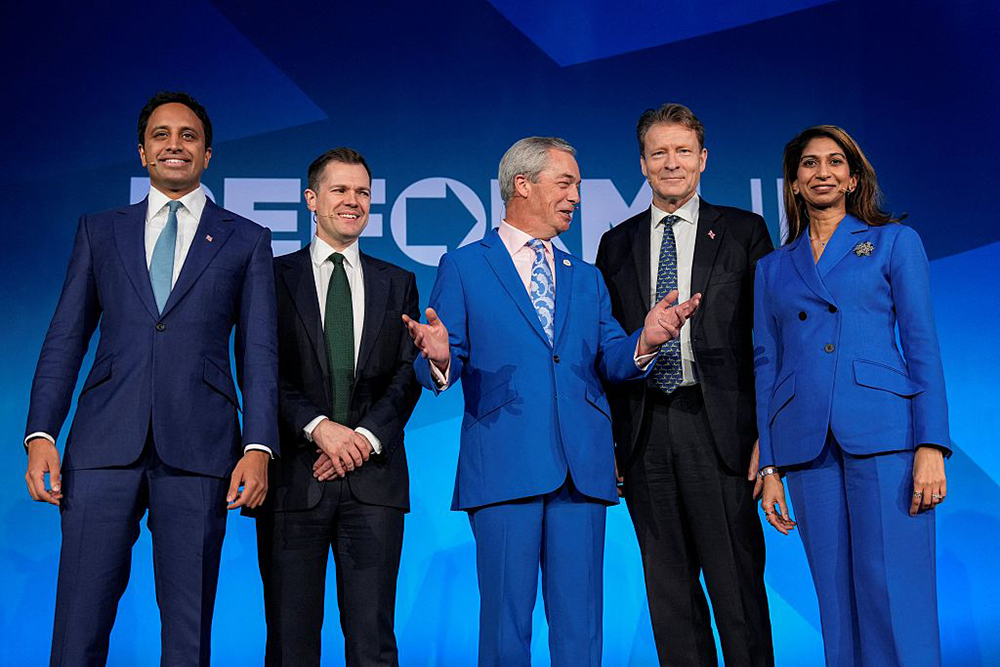
Like Tintin, Farage has enjoyed many different adventures in different guises: ‘Nigel in America’, ‘Nigel in the Jungle’, ‘Nigel in the City’. This week, we got another: ‘Nigel and the Gang of Four’, the leader who seeks power only to yield it to others. Four names were unveiled as part of Reform’s new ‘shadow cabinet’ to show he is building something bigger than himself.

Robert Jenrick, onetime hope of the Tory right, is now recast as Farage’s ‘shadow chancellor’. His first speech identified two areas where his new party is most vulnerable to attack by his former colleagues: welfare and fiscal stability. In pledging to restore the two-child benefit cap and retain the Office for Budget Responsibility, Jenrick showed a ruthless desire to deny the Tories any oxygen as the party of prudence.
Richard Tice’s role is akin to that of John Prescott in New Labour. As ‘shadow deputy prime minister’, he heads a souped-up super-ministry of various briefs and connects the leadership to its party grassroots. Energy, trade, business and housing are all part of his portfolio. Having listened to the grievances of almost 1,000 business leaders over 50 breakfasts in recent months, Tice will champion more joined-up, long-term policymaking.
Zia Yusuf meanwhile gets the post he craved, ‘shadow home secretary’, after waging what one senior figure calls ‘a six-month lobbying campaign’. His mission is no easy one: working out how to deport 600,000 illegal migrants over five years. He can at least compare notes with Jenrick on how to bolster Reform’s internal 100-page plan, after the two spent last summer one-upping each other on their respective proposals.
Suella Braverman completes the quartet in the education and equalities brief. Schools is another area of Tory strength, and the party has a good story to tell on academies. Braverman used her first speech to make much of her own work at the Michaela Community School in Wembley and to lean heavily into cultural issues, such as gender identity and DEI. Tellingly, her remarks received the most applause from the Reform faithful.
At lunch over red wine and
venison pie, the ‘shadow cabinet’ toasted their new titles
Jenrick and Braverman are recent recruits, Yusuf and Tice are ‘long-marchers’ – an acknowledgement of the party’s different wings. All four are regarded as among the most deserving of such posts and spent weeks discussing their roles with Farage. At lunch over red wine and venison pie in Victoria on Tuesday, they toasted their new titles. ‘We start as we mean to go on,’ joked one attendee.
Aiding them in their mission is James Orr, the party’s new head of policy. He is working alongside his old friend Danny Kruger on preparations for government, adding a dash of varsity blues to Reform’s turquoise trimmings. The research department – modelled on the famous Conservative Research Department – will be bolstered from eight to 20 staff. Party policy groups are aiming to produce written bills by the end of 2026.
The new team’s orders are to ‘flood the zone’ with rallies, interviews and speeches in the coming weeks. As Reform is not the official opposition in parliament, Braverman, Yusuf, Jenrick and Tice intend to use their contacts, profiles and individual press officers to shape the political weather. Two case studies show how Reform can do this. The first is Jenrick’s victory on Sentencing Council guidelines last spring, with aides suggesting the media mattered more than the despatch box. The second is Labour’s decision to U-turn on plans to scrap local elections, a tribute to Reform’s legal firepower.
The inevitable criticism of the new roles is about the omissions: why announce only these four? ‘It was a policy-lazy announcement,’ claims one senior Tory taking issue with Reform’s à la carte approach. ‘They’ve dodged the hard work on social policy.’ At £208 billion, the Department of Health’s budget is more than double that of Education (£100 billion). If the NHS is Britain’s true state religion, might it not be wise to ordinate a priest who can preach a message to the masses?
The lack of a spokesman for either foreign affairs or defence has been seized upon by some Tory MPs as proof of Reform’s lack of credibility. The absence of former cabinet ministers like Jake Berry and Nadhim Zahawi in this context was striking. A onetime MEP raises another point: given Farage’s criticisms of the EU Withdrawal Agreement, would it not have been wise to name a ‘shadow attorney general’?
All in good time, say those around Farage. Eighteen months ago, the party barely existed. Now it is on the verge of supplanting the Tories. With fewer than 80 days until the local elections, the focus is on keeping up momentum and killing off the Conservatives in Scotland, Wales and much of England.
After 7 May, the argument goes, more experts will arrive, who can take on roles in an expanding team. These would be in the mould of Colin Sutton, the party’s police and crime adviser since August. Best known as the detective who caught serial killer Levi Bellfield, he is precisely the kind of low-key, hardworking and impressive figure Reform wants to attract. If the Tories do look ‘dead’ after May’s elections, the hope is that anyone of substance who is on the fence will be convinced to throw in their lot with Farage.
The difficulty for Reform is precisely the same one that Labour encountered prior to 2024. Talented people are often unwilling to give up their jobs, years out from an election, to plan for office when power is not assured. After victory, there can arise the awkward problem of people management. Thus far Farage, the self-styled ‘political entrepreneur’, has been able to keep growing his venture, even while others’ share offerings are being diluted down. But it could prove harder as more people come on board, with Johnny-come-lately figures jostling with those who have slogged their guts out for years.
At the height of her imperial pomp, Mrs Thatcher was depicted in one 1980s cartoon, sitting at the cabinet table surrounded by 20 other Mrs Thatchers. It is a critique that the Tories now throw at Farage, depicting him on social media as running every brief. For now, his colleagues are relaxed about him being seen as a strong leader – but only time will tell whether his top team can thrive underneath the ‘beech tree’.

Comments