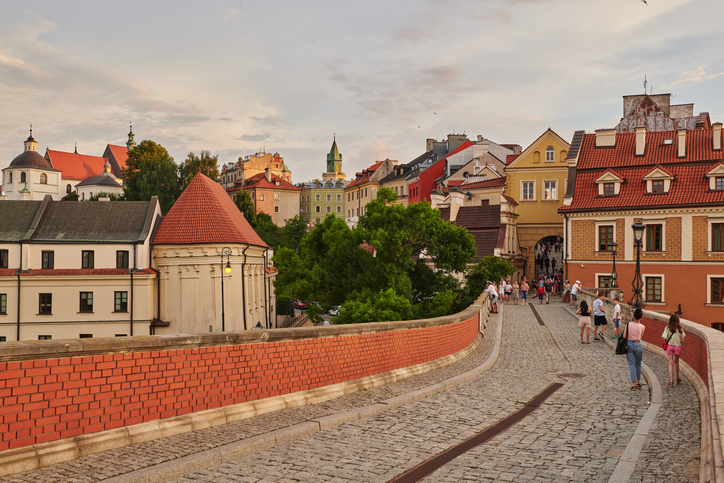
Going to Lublin in eastern Poland is a bit like visiting Pompeii. The city’s old town – compact, intricate, fetchingly tarnished – is as haunting as Krakow’s and more authentic than the reconstructed Warsaw. But something is missing, and you can feel it. Before the war, the Jewish population of Lublin stood at 43,000. Now, it is just 40. Structures remain but their purpose has gone forever, replaced by a palpable absence.
Lublin was once a centre of Jewish life, the foremost in Europe. From the 16th century onwards, it teemed with yeshivas and synagogues, rabbis, philosophers and publishing houses. The Jewish ‘Council of the Four Lands’ operated from Lublin, an effective authority for all the Jews in the country. There were Jewish schools, Jewish restaurants, Jewish tailors, Jewish hospitals. Nobel Laureate Isaac Bashevis Singer, in his novel The Magician of Lublin (his father was a rabbi from the region) described the atmosphere as it once had been:
The few sites which survive are part of Lublin’s tourist trade
The dusk descended… In the shops, oil lamps and candles were lit. Bearded Jews, dressed in long cloaks and wearing wide boots, moved through the streets on their way to evening prayers… Smoke came from the chimneys; housewives were busy preparing the evening meal: groats with soup, groats with stew, groats with mushrooms…. In Lublin one felt only the stability of a long-established community… Old customs prevailed here: the women conducted business and the men studied the Torah.
But Lublin, once the Nazis took power, was also the first city in the Nazis’ ‘general government’ region to suffer Operation Reinhardt: ‘the Final Solution to the Jewish Question’. Not only was its population of Jews ruthlessly exterminated; almost their entire quarter was dynamited by the Nazis, who resolved that no trace of Jewish Lublin should remain.

Now, the few sites which survive are part of Lublin’s tourist trade. The 4-star establishment I’m staying at, Hotel Ilan, promotes itself as a Jewish hotel (the restaurant serves a ‘set Shalom’ of starters, like herring, chopped liver and chicken soup with matzah balls). It occupies the handsome old building of the former Yeshiva Chachmei (‘Academy of the Sages of Lublin’), opened in 1930 and, for a brief, doomed decade, ‘the largest and most prestigious rabbinical school in the world’.
Nearby is the old Jewish cemetery, where along with the graves of eminent rabbis and Talmudic scholars, other Hebrew tombstones, shipwrecked and shattered, lie covered by neglected, bushy grass. Next to the Ilan is the city’s last working synagogue, ransacked by the Nazis but restored and reopened in 2005. The hotel staff will give you the key at any time, letting you sit in its spartan, high windowed hall of worship, with chandelier, mezuzah, menorah and ark. It has everything, in fact, except a congregation.
No one in Lublin knows this better than Tomasz Pietrasiewicz, the 70-year-old founder of NN Theatre, a local institute housed in Grodzka Gate – once the mediaeval city-marker between the Jewish and Christian worlds. Back in the 1990s, Pietrasiewicz, a director, intended it to be a simple theatrical space. But everything changed when, one day, he had an overwhelming realisation about his city. If its lost Jewish population had been such a massive part of Lublin’s culture, why did Pietrasiewicz’s own generation know so little about it? Why had the communist regime effectively colluded with the Nazis by covering it up? NN, he decided, would be dedicated to restoring the memory of Jewish Lublin and rescuing its lost Jews – as individuals – from vanishing a second time into the past.
Practically, this has meant much more than the odd exhibition or stage play. Pietrasiewicz committed himself to an ongoing process of questioning, recording and compiling information on the lost community. Looking rather like a Stasi archive, NN is filled to bursting with shelves and shelves of identical files. There’s one for each of the city’s 1,500 or so vanished Jewish homes, a file for every single one of the city’s 43,000 murdered Jewish residents. Some carry detailed information – about 900 homes and half the city’s Jews are now accounted for – while some files are still empty. Many of them, Pietrasiewicz admits, are bound to remain so. Occasionally, a Jew is simply mentioned, unnamed, in someone’s recollections, and a file is duly created for them. This is what Tomasz Pietrasiewicz has called NN’s ‘ark of memory’.
Alongside this are 5,000 recordings which can be accessed in a special listening room: oral histories of vanished Jewish barbers, shoemakers, ice-cream parlours, bakeries, or attempts to recreate the soundscapes of demolished Jewish streets. Each year on 16 March, to mark the destruction of the Lublin ghetto in 1942, NN organises a commemoration – the ‘Mystery of Light and Darkness’ – in which the names of the dead are read out, and the lights in the Jewish area temporarily extinguished. ‘It was not enough,’ Pietrasiewicz has written:
For the organisers of the Holocaust to sentence Jews to death. They also wanted to push them into the abyss of oblivion… To the dark utopia growing out of the very core of evil, we have contrasted a completely different utopia – filled with light.’
For the darkness, you don’t have to go very far. It can be found in spades at the Majdanek concentration and death camp on the outskirts of the city. Here, over a two-and-a-half-year period, an estimated 78,000 died under the camp’s five commandants, two of whom so exceeded their brief they were executed by the Nazis themselves. While nearby Belzec and Sobibor (where about a million more died) were destroyed by the German authorities – forests of trees planted over the killing grounds – Majdanek was abandoned in a hurry as the Red Army arrived in 1944, and much of it remains.
Lublin itself is a lesson in how swiftly what seems most rooted and secure can vanish forever
There are watchtowers, workshops, barracks where prisoners were shorn even of their armpit hair – gathered up and sold for industrial felt and yarn. Another barrack houses the washroom where newcomers were submerged in ‘an enormous concrete tub full of water reeking of carbolic acid’, and made to wash under showers which alternated, as if by design, icy and scalding water. In Barracks 41 is an original gas chamber, grey, low-ceilinged, its walls streaked with blue traces of Zyklon-B poison, old tins of which are piled up in another room. One onlooker, Zygmunt Godlewski, gave a description of the dead:
The cadavers looked horrible. Men, women, children, all of them naked, with tangled hands. Women, perhaps mothers, held children by their necks or hugged them.
Bodies were burnt in the crematorium ovens (which stand intact) or, if there were too many, on pyres at the local Krepiec forest. A memorial to the Jews in Lublin’s town centre has a scrap of poetry by Yitzhak Katznelson, who died at Auschwitz in 1944: ‘Seeking my dear and near in each handful of ashes…’
After the war, the ashes at Majdanek, fifteen piles of them, were collected together in a great mausoleum, finished in 1969 and shaped – its designer intended – like a Slavic burial urn. On its vast circumference is engraved a quote from another poem, Franciszek Fenikowski’s Requiem: ‘Our fate is a warning to you.’
It is a warning which, in Europe, seems to go increasingly unheard. It feels surreal to read such words in such a place at a time when in Britain a Jewish MP is barred from visiting a local secondary school, Jewish plays are cancelled at the Edinburgh Festival, when the number of school commemorations of the Holocaust has, since 7 October 2023, more than halved.
Lublin itself is a lesson in how swiftly what seems most rooted and secure can vanish forever. It’s captured movingly in ‘The City is Leaving,’ a text NN’s Tomasz Pietrasiewicz wrote in 2024, for an installation of the same name, extracts of which I print here:
The city is leaving. Languages, letters, inscriptions, menorahs and mezuzahs are gone…. The Torah scrolls and their burnt shreds are leaving. Books, newspapers, signs, posters, postcards and letters…. Pieces of bricks and stones from the street are leaving. There are no more jugs, cups and plates. Clothes, hangers, wardrobes, sideboards, tables, mirrors are gone…. Shops, soda shops, exchange offices, stalls, slaughterhouses, bakeries are leaving…. The living, the dead, entire families are leaving…. Names, addresses and dates, street names…. Houses and streets are leaving…. Dreams go away…. A river flows out of the darkness from under the earth, washing away silt, sand, ashes, memory…. Rust, mould, moisture and dust enter. The wind is blowing.


Comments