
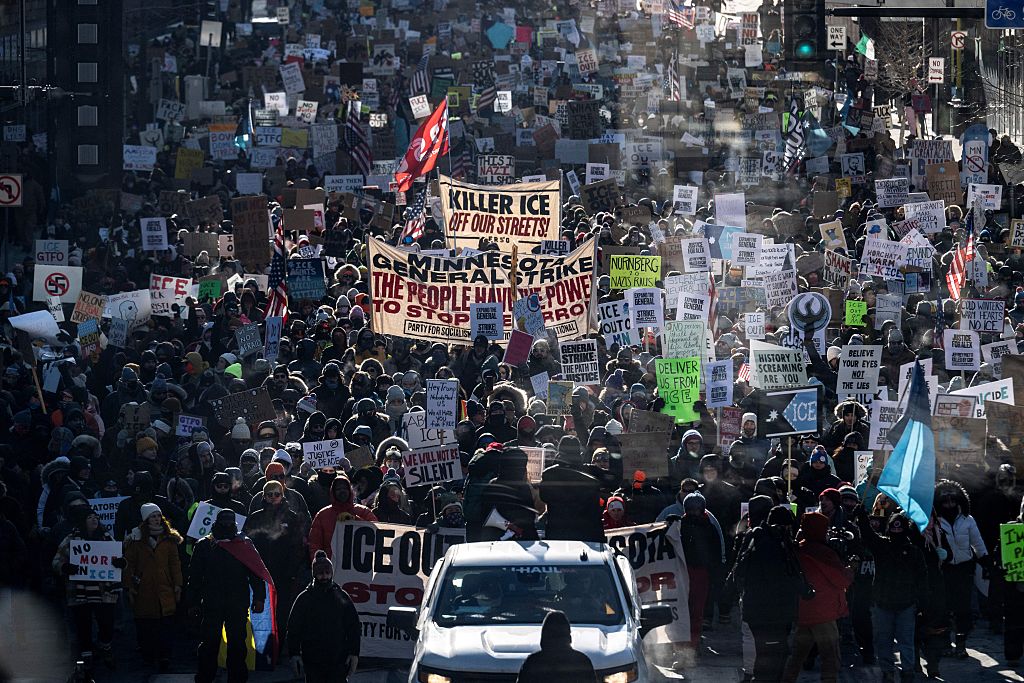
The fights in Minnesota aren’t just between the protesters and ICE, they also seem to be between President Trump and Department of Homeland Security Secretary Kristi Noem. Behind the scenes, Trump officials have been lukewarm, at best, over Noem’s performance. And polling shows her department its deep underwater. Significantly, they sent border czar Tom Homan, not Noem, to Minnesota on Monday to signal their high-level commitment to its operations there. Those tea leaves do not portend a long and happy future in Washington for Secretary Noem.
In another development Monday, the administration may have signaled its willingness to work with Minnesota Governor Walz to calm down the dangerous street confrontations in Minneapolis. White House press secretary Karoline Leavitt told reporters that Walz had initiated the phone call and that the President thought it had gone well. Without further details, it’s hard to know what that positive discussion means, but it could foreshadow a lower profile for federal agents in Minnesota. And more cooperation from local law enforcement.
What about the larger picture – the two shooting deaths by federal immigration agents? The angry mobs surrounding agents’ vehicles and the agents themselves? The apparent coordination of the mob actions, using encrypted communications? The disruption of a church service by a progressive gang?
To make sense of this Minnesota mayhem, it helps to step back from the chaos and focus on the core differences between the protesters (and their political supporters) and federal agents, ICE, Customs and Border Patrol, the FBI and Homeland Security (and their supporters).
First, as tensions have risen and street confrontations grown larger and angrier, both sides have become locked into their positions. The phone call between Walz and Trump may be an attempt to unlock the key protagonists. The question is whether either side can deescalate without paying a high price with their respective bases.
Polls show that median voters now think the federal government has gone too far in its enforcement actions. This public sentiment, plus strong support from the Democratic base, has convinced the party’s leaders at the city, state and federal levels to oppose federal deportation efforts. That means all those efforts including safe removal of the most violent criminals. In effect, Democrats are doubling down on the policies of the Biden administration, which opened the borders to millions of illegal immigrants. One key now is whether Minnesota will back off that stringent opposition.
The most consequential effect of rising public opposition to ICE operations is the likely closure of the national government, or at least parts of it, in a few weeks when temporary funding expires. That closure was signaled this weekend when Senate Minority Leader, Chuck Schumer, switched his position, which had previously supported passing the necessary budget bill.
This weekend, he announced he would oppose any bill that funds the Department of Homeland Security in its current form. Maine Senator Angus King, nominally an Independent but who usually votes with Democrats, has said he would join Schumer now that federal agents have moved into his home state. The administration has said it will combine all department budget bills and force a vote on the combination package.
The federal agents in Maine have a very different aim from those being confronted in Minnesota. The agents in Maine are there primarily to deal with the rampant fraud committed by Somali immigrants (some of them legal immigrants; some full citizens; and some illegal immigrants). The fraud appears to be a widespread, national problem and includes substantial sums being transferred to terrorist groups in Somalia.
Most voters have not clearly distinguished between the distinct problems of financial fraud and violent crime, both committed by illegal immigrants. That distinction is important. The FBI, Department of Justice and Treasury are responsible for finding the fraudsters, recovering what money they can and prosecuting the offenders. The Department of Homeland Security and its sub-agencies, such as ICE and Customs and Border Patrol, are responsible for detaining and deporting illegal immigrants.
The DoJ is now investigating not only the fraud itself but also whether public officials committed criminal acts in failing to stop it. Expect these investigations to spread to other states and to raise major questions not only about deporting illegal aliens but even about stripping citizenship from some convicted felons.
In recent months DHS has shifted its focus from removing all illegals to focusing on the most violent and criminal gangs. The public favors this new focus but the Trump administration has not capitalized on that favorability.
Public policies in “sanctuary states” have also blurred the distinction between violent criminals and all illegal immigrants and made enforcement more difficult in practice. How? Because sanctuary cities and states refuse to allow ICE and Border Patrol agents to pick up detainees in jail, so the agents must go out into the community to find those illegal immigrants. When federal agents do find them, other illegal immigrants are often living or traveling with them and they, too, are picked up, whether they are wanted for violent crimes or not. Average voters are squeamish about the arrest of non-violent immigrants, even is they came in to the US illegally.
These opposing views are playing out in Minnesota where street confrontations have grown worse, despite brutally cold weather. Local law enforcement has done little to contain these confrontations or ensure the safety of federal officials. Indeed, “progressive” officials in Minnesota, like segregationist governors in the American South in the early 1960s, seem determined to capitalize politically on the confrontations.
Since ICE and Border Patrol are forced to conduct their enforcement operations in full public view (because of Minnesota’s refusal to allow them into local jails), they offer high-profile sites for protesters to gather. Some lawfully scream at federal agents. Others unlawfully impede them, leading to still more violent confrontations. Those confrontations are exactly how the shooting deaths of Renee Good and Alex Pretti occurred.
One of the crucial, unanswered questions is whether the crowds impeding ICE agents are part of an organized, well-funded conspiracy and, if so, who is funding it. The FBI and Department of Justice are investigating that question and are likely to bring RICO charges against an organized criminal conspiracy.
The chasm of mistrust between the federal agencies and their opponents can be seen in the characterization of the deaths of Good and Pretti and the lack of trust over whether the investigations will be conducted fairly. Who is charged with investigating the deaths? The law is clear. The federal government has sole responsibility for the investigation and prosecution of these acts. Even so, Minnesota officials have openly stated that they don’t trust the federal investigations and intend to conduct their own investigations and prosecutions.
The big picture here is not about personnel or political posturing, it is about basic differences in ideology between a party that closed the border and the party that opened it. The gap between those two sides has grown more incendiary, less bridgeable and, sadly, more lethal. The Trump administration is determined to undo the effects of Biden’s open borders, the crime associated with “sanctuary cities and states,” and the widespread fraud that went undetected in public programs. The question is whether they can do that without stirring up even more frenzied opposition.
What the Trump administration cannot undo is deepening mistrust between the differing sides of almost every public issue. Immigration enforcement is the most prominent of those issues, but it is not the only one.
The gap between opposing ideologies and the bottomless pit of mistrust is dangerous. It represents the deepest chasm between federal policy and local opponents since Washington enforced civil rights laws across the segregationist South in the early 1960s. That’s an ominous analogy.




Comments