
Donald Trump’s strangely artificial Board of Peace event in Davos on Thursday looked like a Hollywood rendering of an international summit. Everything was too slick, faintly uncanny. Like an AI-generated image, it was photo-real yet failed the most basic human glance test. Too perfect. No wabi-sabi.
The first tell was visual: the set, complete with a crisp new institutional logo: a globe on a shield, flanked by olive branches. It carried the unmistakable whiff of Grok or ChatGPT, but the strangeness went deeper than design. The speeches themselves were weirdly messianic and utopian.
The most peculiar part was the show-within-a-show: a piece of political meta-theater featuring Marco Rubio, Steve Witkoff, Jared Kushner and a pre-recorded video greeting from Ali Shaath, newly appointed head of the National Committee for the Administration of Gaza, the technocratic body intended to run Gaza’s civil administration under the new framework. Like Hamlet’s play-within-a-play, The Murder of Gonzago, this may yet prove to be the event’s central dramatic device, designed to force an uncomfortable truth into the open. If that sounds far-fetched, stick with me.
The segment, billed as a showcase for Gaza’s reconstruction, unraveled into a series of contradictory and fantastical claims that strained credibility. Kushner, long associated with the Peace to Prosperity plan from Trump’s first term, once again took center stage. Despite its wholesale rejection by Palestinians at the time, the plan has been defrosted, reheated and rebranded. Today it is called Phase B of the Trump “point plan.” But it is the same meal, just a bit staler.
Undeterred, Kushner radiated optimism. “We do not have a Plan B,” he declared. “We have a plan. We signed an agreement.” He spoke of holding Hamas to its commitment to disarm, planning for what he called “catastrophic success.” The concern most normal people have is that the catastrophe will vastly outweigh the success.
He noted, correctly, that roughly 85 percent of Gaza’s GDP has long come from aid. “That’s not sustainable. It doesn’t give these people dignity. It doesn’t give them hope.” He may be right. Yet he spoke as if Palestinian mainstream politics were not riddled with corruption and the systematic embezzlement of aid. Yasser Arafat died a billionaire. Hamas leaders today are exceptionally wealthy, many living comfortably in Qatar. The Palestinian economy depends on only one natural resource – victimhood, and is consequently deeply addicted to aid. When the reserves dry up, withdrawal will be brutal.
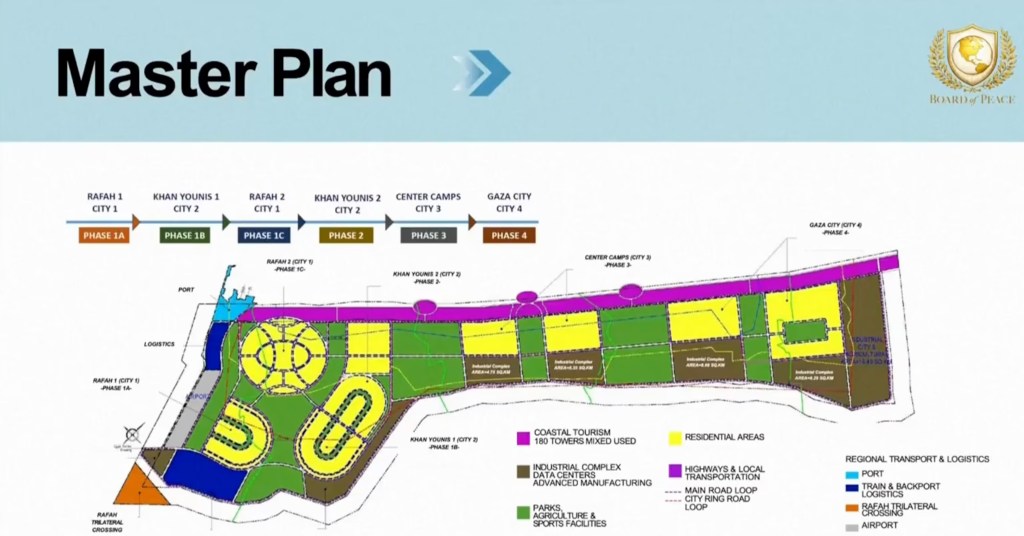
Still, Kushner promised speed, showing absurd Jetsons style building renders. “In the Middle East they build this in three years,” he said, airily ignoring that such feats of construction are often achieved through brutal migrant slave labor regimes. In “New Gaza,” he implausibly promised “100 percent full employment and opportunity for everybody.” His PowerPoint projected over $10 billion in GDP and average household incomes exceeding $13,000 by 2035. It was absurd.
What renders these claims detached from reality is not only the scale of destruction since October 7, but the historical record. For years, billions in aid and resources were siphoned away from civilian prosperity and into the Palestinian war economy: tunnel networks, weapons stockpiles, command infrastructure, salaries for fighters and stipends for the families of terrorists. Alongside this sat entrenched corruption, the enrichment of leaders abroad, and the systematic militarization of what should have been civilian reconstruction.
Against that backdrop, projecting a tripling of Gaza’s GDP and a leap to near-western household incomes within a decade reads less like an economic plan than a childish fantasy. It assumes not merely the physical rebuilding of a shattered territory, but a total transformation of governance, incentives, and security structures that have been absent for decades. Without confronting how aid was weaponized, and without dismantling the culture that turned international generosity into an engine of violence, the Davos numbers are laughable.
“This really gives the Gazan people an opportunity to live their aspirations,” Kushner said, as if those aspirations had not already been expressed when Gaza was handed enormous opportunity for growth, peace and self-rule, only for its population to elect a genocidal Islamist jihadist movement that abused and impoverished them on the promise of fighting Jews, and ultimately launched an invasion of Israel, slaughtering civilians in their homes and at a music festival. Perhaps their aspirations are not quite what Kushner imagines.
And that video message from Shaath, set to rousing music: “Judge us by our actions. Hold us to clear standards and stand with the people of Gaza as we take responsibility for our future,” he urged. So we will.
Shaath cited the proposed imminent reopening of the Rafah crossing with Egypt as proof that a new phase had begun. The claim sat uneasily alongside the grand redevelopment promises, given that much of Gaza remains in ruins, littered with unexploded ordnance, with infrastructure destroyed and a large displaced population.
If Shaath is unfamiliar to western audiences, billed simply as a “technocrat” with a background in civil engineering, they might wish to watch his Arabic-language speech from just 11 months ago at a conference titled “The Palestine Forum – The Genocidal Israeli War on Gaza: Scenarios for the Day After.” In that address, he presented in Arabic a paper outlining 13 possible post-war outcomes, ranked “mathematically” by probability and desirability.
Ironically, he now heads the body responsible for implementing the very scenario he described as the least likely: “moving from crisis to prosperity, President Trump’s project within the framework of the Abraham Accords.” He characterized Trump’s plan as “dangerous talk,” describing it as an attempt to turn catastrophe into prosperity through a so-called “new deal.”
Certainly the Palestinians don’t want this plan. They rejected it outright during Trump’s first term, choosing neither peace nor prosperity. They later launched the October 7 invasion as if to confirm their preference, opting once again for the more traditional Palestinian tradition of terrorism and violence. But maybe that decision changed some minds? Maybe not.
In that same speech, delivered well into the war, Shaath opened with a dedication to wounded Palestinians, invoking the 1925 Arabic poem “Nakbat Dimashq,” written in response to the French bombardment of Damascus during the Great Syrian Revolt: “For red freedom there is a door, knocked upon by every blood-stained hand,” he said to the gathered conference.
The reference would have sailed over most western heads, particularly through the patchy simultaneous translation. But it would not have been lost on Arab audiences. It romanticizes violent resistance and martyrdom as the path to liberation, equating Israel’s defensive actions in Gaza with French colonial brutality, while erasing the fact that the current devastation followed the October 7 atrocities initiated by Hamas and joined by other factions and civilians. Those crimes were committed against Israeli civilians in undisputed territory. They included mass murder, rape and kidnapping.
The analogy is grotesque. France was an imperial power imposing alien rule for exploitation. Israel is a sovereign democracy defending its existence against terrorist entities embedded within civilian populations. It has no imperial project, only a right to self-defense under international law.
The rhetoric of “red freedom” sanctifies bloodshed. It feeds extremism. It is especially revealing coming from the man now tasked with overseeing a Trump-backed technocratic administration that claims to prioritize demilitarization, disarmament and non-violent governance. However carefully the Davos video was scripted, it could not erase what Shaath said less than a year ago.
So why the spectacle? Why this fairytale fantasy?
So when Kushner announced the mission statement of the 14 technocrats under Shaath as committing them to “cultivating a society rooted in peace, democracy, and justice, operating with the highest standards of integrity and transparency,” concluding with “we embrace peace,” it sounded unconvincing.
Of course Trump, Kushner, Rubio and Witkoff know this. They know the Palestinians rejected the plan once and are likely to reject it again. Their aspirations, repeatedly demonstrated, have centered on “resistance” and violence rather than coexistence and peace. Stating this is neither pessimistic nor racist. It is empirical.
So why the spectacle? Why this fairytale fantasy? Trump might as well have promised every Gazan a unicorn to ride into the sunset. One can only hope there is a method here, not just madness.
Perhaps there is. Because running in parallel to the Davos performance is another Trump production: a significant US military buildup in the region, accompanied by blunt warnings that if Hamas does not disarm, “they’ll be blown away.” He repeated the threat in talks with Abdel Fattah el-Sisi, stating that compliance would become clear ‘in the next two or three days, certainly within three weeks.’
And so we return to Hamlet. The inner play exists to expose the truth. Trump loves to put on a show. Without elevating him to Shakespearean genius, one is left wondering whether this extravagantly staged promise of wealth, investment, recognition, and statehood is itself a test. Everything is on offer – a virtual paradise lacking only the 72 virgins. All that is required is compliance.
If it fails, nobody will be able to say he didn’t try.



Comments