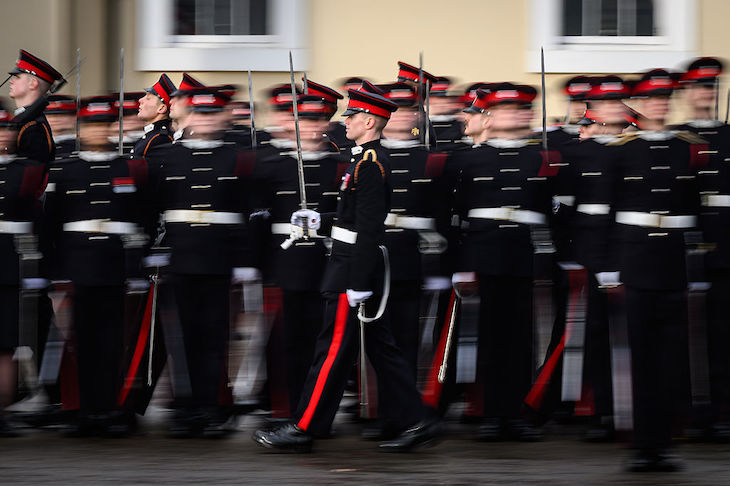
My friends were baffled. Why, at the age of 30, was I going back to school? And, worse, to an institution where your days are longer, your freedoms more limited, and being shouted out is a common occurrence? But last year, that is exactly what I did. It was the best decision of my life.
In the spring of 2025, I passed the Army Officer Selection Board. From September through December, I left my civilian life behind and embarked on the intensive short commissioning course at the Royal Military Academy, Sandhurst. It was the least ‘free’, least comfortable, least independent place I have ever lived. But, somehow, I had never felt more liberated or content.
Every morning, we got up at 6am to sing the national anthem in our pyjamas
For the outsider, so much of the Sandhurst experience appears very strange indeed. For an institution which champions the sense of purpose it gives to those who work for it, many of the British Army’s routines and habits appear arbitrary. Every morning, we got up at 6am to sing the national anthem in our pyjamas. Creases had to be ironed into uniform. If you wanted to go to a lesson, to the gym, to the car park, you had to march there. Clothes and possessions had to be placed in drawers in a particular order, or punishment would ensue.
‘On exercise’, things got even stranger. Even in the mud and wet, we were to be clean shaven. Feet would be inspected at dawn to ensure they had been dried and powdered. The opportunities to earn press-ups multiplied. Missing a departure time by a minute, accidentally turning on a light after dark, being separated from your rifle for just a moment would all land you in trouble.
Nothing the Army does, however, lacks purpose. Every small detail of a cadet’s time at Sandhurst is calibrated to instruct and shape, and to teach the Army’s values: courage, discipline, respect, integrity, loyalty, and selflessness.
A Sandhurst education is fundamentally about fostering a particular type of character amongst the Army’s future leaders, a character embodied in the college’s motto, ‘Serve to Lead’. Senior officers participate in the gruelling physical training sessions and sleep in the same rough conditions as the cadets. A significant amount of time is dedicated to teaching potential officers how to look after the troops in their charge. Sandhurst teaches the importance of servant leadership: a poignant reminder of which is in the college’s chapel, where the names of the many young officers who have given their lives in service adorn the walls.
Everything about Sandhurst is alien to the dominant, liberal cultural in Britain – particularly that which is promoted to the young adults who leave school and head to university campuses or on their travels. It teaches that your own interests are always secondary to those you are responsible for. The idea of sacrifice – the ultimate selflessness – is impressed upon cadets at every turn.
Sandhurst pushes its cadets hard. The hills are steep, the nights are long and sleepless, the cold bites. A military education does not shield students from these hardships. When someone struggles, it seeks not to insulate and cocoon, but to give individuals the competencies and self-belief to succeed.
The problem with the whole conversation about national service in this country is that it is based upon a flawed premise: that it would be a burden for young people. Nothing could be further from the truth.
A year with the military would offer Britain’s school leavers a better preparatory course for life than any university degree ever could. Those whom I encountered during my time at Sandhurst belied every stereotype going about Britain’s young. In my cohort, I trained alongside state-school educated ex-soldiers and Old Etonians; Britons from Wigan and the Wirral, as well as those of Caribbean and Cameroonian descent; doctors and lawyers, nurses and priests; conservatives and self-avowed socialists. A significant proportion of the intake were women.
Sandhurst pushes its cadets hard. The hills are steep, the nights are long and sleepless, the cold bites
But the diversity of our group was simply not as relevant or important as our underlying unity and sense of shared purpose. That unifying idea is expressed symbolically in everything you do, from the uniform you wear, to the standards you all must meet. But it comes in more intimate forms too: in the unique loyalty and togetherness that is generated amongst people who confront adversity together.
There was a seriousness to the other cadets I met which contrasts starkly with the image of Britain’s youth as somehow directionless and materialist. At the outset of the course, I remember one of the youngest cadets in our platoon being asked to stand up and explain why he had decided to join the Army. He answered that he simply wanted to do ‘his bit’ and serve.
Some say the military itself would not benefit from a much larger cohort of people participating in voluntary schemes, either as soldiers or officers. This is a grimly defeatist perspective. The armed forces need to grow. Those participating in a limited, voluntary scheme would be a receptive audience. The services could be selling a career to school leavers; persuading them of the sense of mission, belonging and pride that military life can bestow. Those completing the gap year scheme could be offered routes into the reserves which would allow them to continue a military career without having to give up a civilian one.
Norway, Sweden, Denmark, the Netherlands, Germany and now France, amongst many others: all these European states are operating some form of voluntary or compulsory national service at scale. If my time at Sandhurst taught me anything, it is that Britain needs to revisit the question of whether it might not be to the immense advantage not of just our armed forces but also our school leavers that they are afforded the same opportunities. Sandhurst was the most challenging thing I have done – but it was also the most worthwhile.



Comments