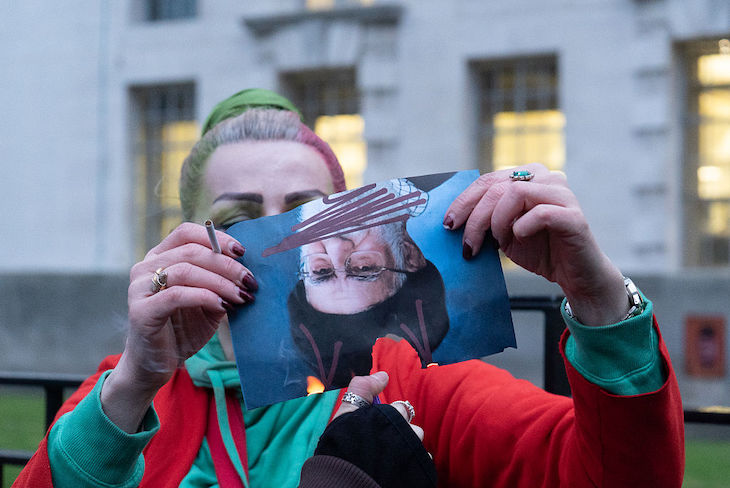
As Iranians defiantly take to the streets, many outsiders wonder why the crowds are chanting the name of the late Shah and his heir, the Crown Prince. What is it about the last dynasty that ruled Iran that has such a great fascination for Iranians, both at home and abroad?
The Shah’s return would not be the first time that this dynasty has helped to rescue Iran
Many Iranians – including those, like me, who were born there but forced to flee – look to the past as a golden time. The Crown Prince has repeatedly said that he has every interest in overseeing a transition to a democratic and free country. All Iranians long for the day when our beloved country can be free again.
The Shah’s return wouldn’t be the first time that this dynasty has helped to rescue Iran. While Iran has a rich and tremendous culture, the truth is that by the early 20th century, Iran was a broken, disintegrated country. It was falling apart, and the Pahlavi dynasty that came into power in 1925 saved Iran from disintegration and abuse by colonial powers.
It also played an important part in an ongoing movement: the revival of Iranian nationhood and identity. It didn’t start this movement, but it certainly propelled it forward. The last Shah and his father, two great monarchs of Iran, sent people abroad. They sent students abroad. They opened the country. They used the wealth and resources of the country to develop it.
Iran also had a good relationship with its neighbours, particularly Israel. When Jews were being expelled from Egypt, Iraq and Syria, the Shah personally paid the ransoms that were demanded by these regimes so they could make aliyah to Israel.

Iran had a proud name, and, back then, Iranians really could stand proudly amongst the society of nations. But the 47 long years of the mullahs’ rule has shattered Iran. The Islamic regime has, by every metric, destroyed my beloved country. It has wrecked our natural environment. The regime heaps contempt on the rich fabric of our cultures and traditions that make up Iran. Iran’s leaders have destroyed our reputation abroad.
The majority of Iranians today are under the age of 40, and so they’ve only known our country to be a pariah. Iranians know what a rich culture, language and history we have. Persian culture permeated throughout Asia and the Middle East. But when I brought up the name of Iran as a child, it provoked abuse and ridicule. As I got older, I was asked questions such as: ‘What do you think of terrorism?’ Now, I’ve reached the age of 42, I feel I’m made less welcome, particularly in my field of classical music, because of my name; some doors are open to Iranians, some doors clearly are not.
Coming from a place that’s seen as a pariah when you know of its proud history ultimately means that you have to constantly justify existing. After 47 years, Iranians are tired of this way of life.
I love Iran, but hate the leaders who have run my country into the ground. The Islamic regime represents the darkness of a religion that has had a hold on Iranians for too long. This religion was imposed on us by the sword, and so our current frustration inevitably reflects our feelings that, every time we’ve had a chance to make progress as a nation, that obscurantism has strangled it to death. And before you start to say that all religions are equally bad: no, they are not. That’s an insult to people who’ve had to deal with the sort of violence that this religion, Islam, has done to Iran for 1,400 years.
The very people who have the most to lose from rebelling against the regime in Iran one might say have nothing left to lose: women, religious minorities and ethnic minorities – those people who have suffered the most at the hands of the mullahs – have been at the forefront of this struggle against the regime.
How can those in the West help? We’re asking you to amplify our voices, not based on what you wish to see us say, but on what Iran’s people are really demanding. We have had enough of people saying: ‘Well, I hope for the best, but of course, I’m not holding my breath’; or starting a conversation by asking: ‘Wasn’t the Shah a bloodthirsty tyrant?’ and so on, ad nauseam. These comments do nothing to help as Iranians like me eagerly await news from our homeland. Instead, please listen to your Iranian friends – and don’t for a minute doubt that the overthrow of my country’s brutal leadership would make the world a better place.
If you saw fit to have moral outrage over other issues but are bothered by the fact that Iranians are throwing off a regime that’s anti-Western and thus somehow has a unique moral probity, you had better probe your own moral sense and ask some hard questions.
As for those who are with us: don’t forget us. I promise you – for those who love Iran, and its people – so much more is coming.
This is an edited transcript of a video Mahan Esfahani published on X



Comments