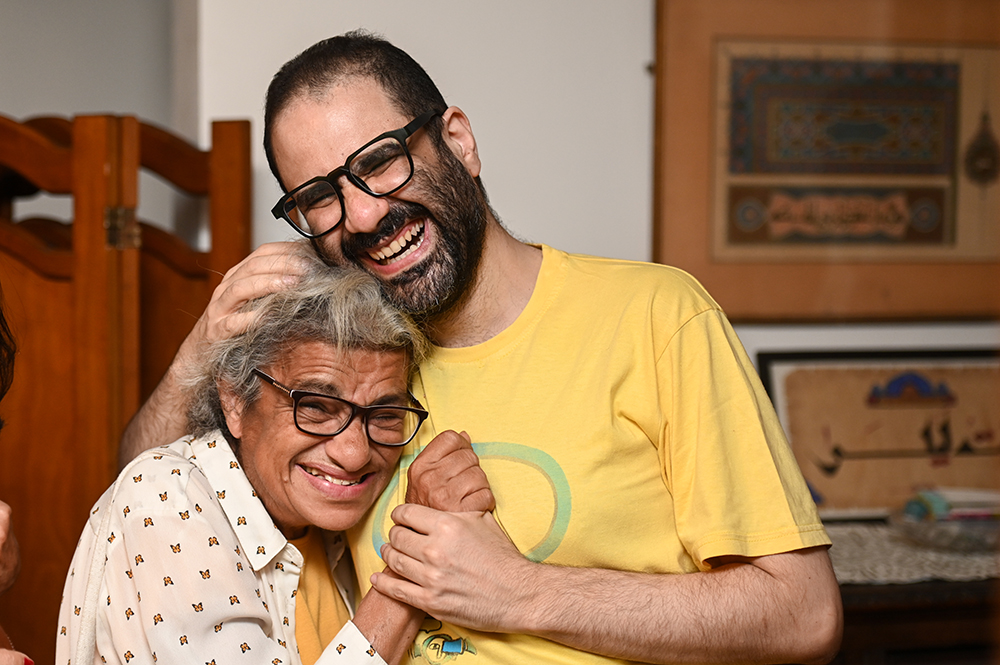


What would you like the priorities of His Majesty’s government to be? I have quite a long list. Sorting out the economy would certainly be up there, as would closing the border. But I imagine the government has had to put such things on the backburner because it turns out that one of its actual top priorities has been ensuring that Alaa Abd el-Fattah can come to the UK.
Who, I hear you ask? El-Fattah turns out to be an Egyptian ‘activist’ who has lately spent a certain amount of time in the prisons of General Sisi. In 2021 he gained British citizenship through his mother, who lives in the UK. I think that clears up any fears of the anti-integrationist movement in this country by the way. That is good enough for me – to my mind, once an Egyptian who is in prison in Egypt is given British citizenship, he becomes as British as you or me. I’m sure we can look forward to seeing him down the Dog and Duck on the first Saturday evening that he’s available.
Everything that should be a priority is not, and the last things that should be a priority are made a priority
That certainly seems to be the attitude of Keir Starmer’s government. Last week the Prime Minister announced that he is ‘delighted’ El-Fattah is back in the UK and has been ‘reunited with his loved ones, who must be feeling profound relief’. He went on to pay tribute to the dogged efforts of ‘Alaa’s family’. You’ll notice by now that Starmer is on first-name terms with the former Egyptian prisoner. ‘Alaa’ has already become one of those celebrities who need only be known by a single name, like Kylie, or Cher.
In any case, the Prime Minister wittered on that ‘Alaa’s case has been a top priority for my government since we came to office’. Which explains a lot. If you happen not to be able to find paid work in the UK, fear not, the government has been too busy on Alaa’s case to give a thought to you.
Unfortunately, the government has made such a big homecoming fandango for El-Fattah that a few people have started to look into what our latest arrival actually believes. Of foremost concern is the fact that he seems not much to like the country that has done so much to spring him from Sisi’s jails. In a set of social media posts from 2010, he called the British people ‘dogs and monkeys’. He also described British history as ‘pure BS’, claiming that we ‘enslaved a fifth of humanity’ and ‘massacred millions’. Why exactly someone would want to come to a country filled with so many infidel ‘dogs and monkeys’ is, I suppose, a question for another day. But these are El-Fattah’s views about us and once again we can all agree there is nothing wrong with that and it all just makes him another weave in the rich tapestry of our diverse and multicultural nation.
In a set of other online posts, El-Fattah said he wanted to kill ‘all police’, and – astoundingly enough – he has stern views about Jews and Zionists. The latter should, according to our latest import, all be killed. It is ‘heroic’, he has said, to kill ‘any colonialists and especially Zionists’, adding of Zionists: ‘We need to kill more of them.’
It is worth dwelling on that. After the Manchester synagogue attack in October, Starmer, David Lammy and all the rest of them stressed how we can’t let ‘hate’ into our country, and need to stop people riling up nastiness. But all the time they were making a priority of bringing a man into the UK who hates the British people, wants police officers to be killed and thinks the only good Zionist is a dead Zionist.
At such moments, of course, Starmer’s political opponents realise that there might be some political capital to be made from highlighting this obscenity. Robert Jenrick and others spent the post-Christmas period rampaging across X trying to highlight El-Fattah’s historic views and point at Starmer’s evident present-day numpty-ness.
But, as I can often be found saying, there is always another level to this hell. On this occasion it comes from the following fact.
It is not merely Starmer who has made El-Fattah into the human rights case de nos jours. It turns out that each of our swiftly rotating previous Conservative governments also thought that his case should be a priority for them. Liz Truss’s government thought so, as did Rishi Sunak’s. The Home Office also made the release of this Egyptian a priority by granting him citizenship. The then foreign secretary James Cleverly boasted: ‘We will continue to work tirelessly for his release.’ Again, you and I may have thought that the Home and Foreign Offices might have tried to bring migration down several notches. Instead they ramped migration up to historic highs. And why not, when they were working so ‘tirelessly’ for El-Fattah’s release.

Which party was in power when British citizenship was given to El-Fattah while he was still in jail? Why the gloriously competent Tory government of Boris Johnson, of course.
In any case, put aside for the time being the political game which has resulted from the case and consider the following rather more important question. Does anybody anywhere in government have access to Google? Or any other search engine? Does anybody in the Home Office have the capability to press ‘Control’ and ‘F’ on their keyboard and search for past public comments by a foreign national they are so eager to bring into the UK? There was a time when we might have had some faith that a British official might phone an Egyptian counterpart and ask a few questions about a chap before awarding him citizenship, let alone making a ‘priority’ of getting him on to these shores. But all the government officials, Labour and Conservative MPs, and actresses such as Olivia Colman, who campaigned for El-Fattah’s release seem not to have taken a moment even to Google him.
That is the problem for the UK. Everything that should be a priority is not a priority, and the last things that should be a priority are made a priority by governments of all stripes. Happy new year, by the way.




Comments