Christmas is traditionally a time of joy, merriment and peace on Earth. Not so in the little town of Erbach, Germany, this year, where depraved individuals destroyed a living nativity scene, tortured two donkeys, vandalised and looted the Christmas market, and proceeded to smash up and defecate in a nearby Protestant church. Tidings of comfort indeed.
No luck in central Brussels, either, where the head of a baby Jesus was removed and stolen from a nativity scene. Another Jesus met a similar fate in Amiens, France. The plexiglass was smashed, the infant’s head knocked off, and other nativity figures damaged. The perplexed president of the neighbourhood committee informed a radio station that ‘the nativity scene has existed for about 30 years and nothing like this has ever happened.’
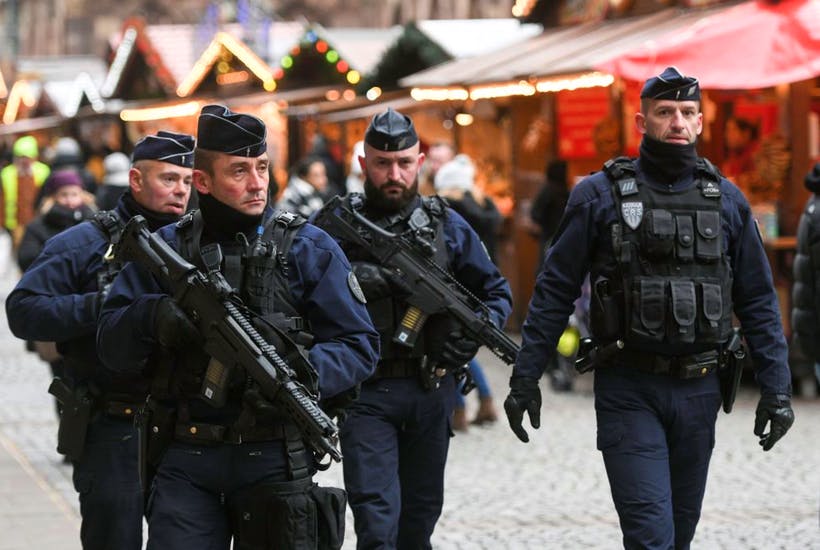
Such wanton destruction is not only directed at displays – a symbolic assault on the Christian story itself – and the occasional hapless donkey. Densely packed Christmas markets, one of the most visible representations of Christianity and western holiday culture there is, have become targets for carnage. In the wake of several high-profile attacks and foiled attempts at violence, police patrols, tight security measures and physical barriers have become ubiquitous around festival stalls. Citizens are visually reminded that the constant threat of terror – disproportionately Islamic – lurks.
It was the Berlin lorry ramming in 2016, the first successful, large-scale terrorist attack on a European Christmas market, that led to the widespread introduction of vehicle bans and bollards – not to mention additional armed and plain-clothed police, screening points, CCTV, bag checks and increased private security. A spate of attacks across Europe in 2017, including ‘hostile vehicle’ rammings, did little to assuage fears.
Public celebrations of Christmas suddenly required anti-terrorism measures in Europe. Moreover, the threat was coming from within.
Left to fester, the danger has only grown. Over the past three years, the costs in Germany for public events have risen on average by about 44 per cent – a surge driven by sharply increased security requirements. Now many of the markets resemble fortified zones, and unaffordable security costs have led to some cancellations. France has also thrown money at security and cancelled its traditional New Year’s Eve celebrations due to a ‘very high’ threat of terror. Tellingly, the threat is significantly lower in the more eastern European countries such as Hungary and Poland.
In Britain, the season of the bollard is well and truly upon us. Trafalgar Square, home to London’s Christmas tree and glowing Christmas stalls, looks like a military zone, with railings, police vans and blockades. The fortifications around ‘Winter Wonderland’ would give the Count of Monte Cristo a run for his money.
It’s particularly jarring when these defences are disguised as something more innocuous or even decorative – a flowerbed, a seat, or simply a device designed to manage crowd flow and guide people along the street. It is not unusual for councils to decorate the new infrastructure, wrapping red bows around square bollards to mimic oversized Christmas presents. The half-hearted attempt to simulate festive cheer is wholly at odds with the stark symbolism of the bollard. Few things could sum up the cognitive dissonance of modern life so well.
The latest development is in Birmingham, which recently installed new ‘hostile vehicle mitigation’ bollards in preparation for Christmas. Birmingham City Council even released a video excitedly announcing the measures. The backing music is hilariously incongruous. It would better fit a reality TV show about weight loss in the noughties than a post about jihadists mowing down innocent people at a Christmas market:
But few Christmas celebrants want to enter a pint-sized Alcatraz to drink mulled wine and munch gingerbread. While providing short-term relief, it doesn’t inspire ‘confidence’ in any meaningful sense. It speaks to a profound loss of confidence in modern multicultural Britain. We should be able to gather freely and without fear, as we always did.
The council’s language is obfuscatory, too. Do ‘hostile’ cars, vans and trucks have minds of their own? These vehicles aren’t going to radicalise themselves.
It’s the same old story – dancing around the topic in case we are criticised for the crime of noticing. Not only are we faced with danger, it is taboo to identify what and who is causing it. We are forced to accept the abnormal as normal, lest the state-approved narrative of a hyper-diverse urban paradise begins to unravel. Preparing for terrorism is simply ‘part and parcel’ of living in a major city, as London’s mayor once said.
Christmas is an indispensable, joyous part of our story. Dickens described it as ‘the only time I know of, in the long calendar of the year, when men and women seem by one consent to open their shut-up hearts freely.’ But if we can only preserve our time-honoured traditions by installing unsightly concrete barriers, enforcing police patrols and gaslighting the public, then something has gone terribly wrong.


Comments