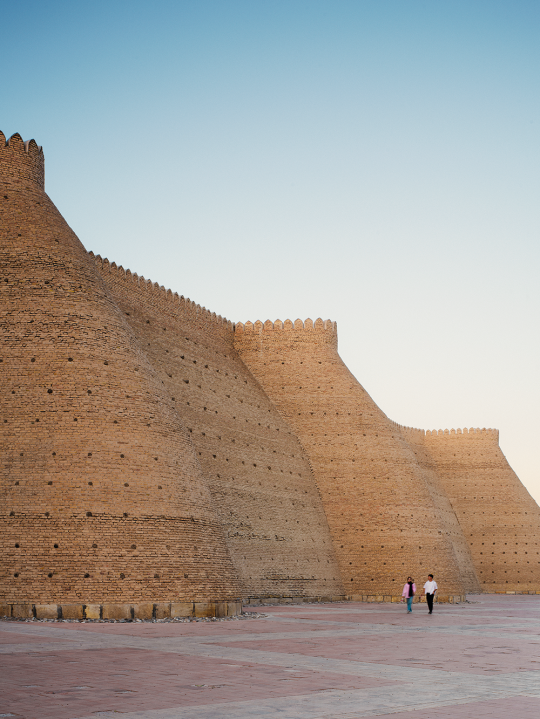
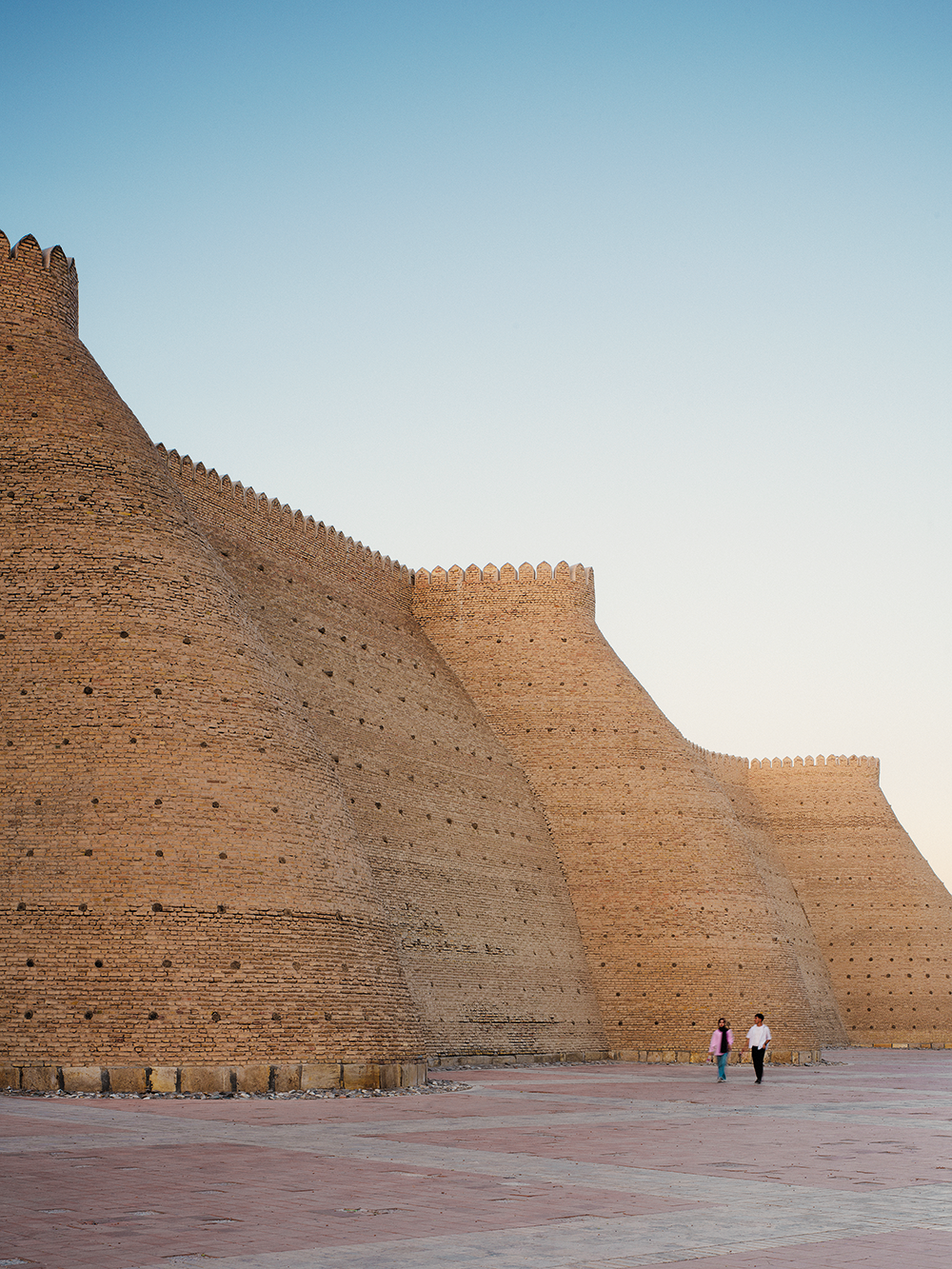
In the ruins of a 16th-century mosque, in the heart of the ancient silk-road city of Bukhara, dozens of abstract figures stand mute and motionless. As the desert sun dips below the horizon, and the shadows thicken, the effect is eerie. Wandering among the statues alone, you feel as though you’ve stumbled upon the aftermath of a forgotten, inscrutable rite.
But these aren’t Ozymandian relics. They’re an artwork, ‘Close’, installed last summer by the British sculptor Antony Gormley. His work was one of more than 200 scattered across the Unesco World Heritage city as part of the inaugural Bukhara Biennial, which ran from 5 September to 23 November last year. I was one of a handful of journalists invited out to see the closing ceremony of what was Uzbekistan’s first contemporary art fair: the bold centrepiece of the government’s attempt to transform its international reputation through culture.
Uzbekistan is an unlikely spot for a contemporary art fair – and, until quite recently, a rather dumb place to admit to being a foreign hack. After the collapse of the USSR, the central Asian country was all but closed to the outside world. Its first independent president, Islam Karimov, while nominally democratically elected, proved to be an autocrat of the old school. Dissidents were boiled alive, independence movements bloodily suppressed. Karimov ‘won’ re-election three times (each with a miraculous 90 per cent of the vote), eventually dying in office in 2016. Until 2019, citizens needed exit visas to leave the country.
Yet Karimov’s successor and current president, Shavkat Mirziyoyev, has overseen an ‘Uzbek spring’. The pace of change was cautious at first, but in the past few years it has gone whiplash fast. As with neighbouring Kyrgyzstan and Kazakhstan, the country is undergoing an orgy of building, as Russian, Chinese and Gulf money rushes into the region. Alongside the Bukhara Biennial, Uzbekistan’s Art and Culture Development Fund (ACDF) – which was founded by presidential decree in 2017, and sponsored our trip – will open a new Centre for Contemporary Arts in March. It has also commissioned two new national museums – both to open by 2028 – one for the capital Tashkent designed by the lauded Japanese architect Tadao Ando, and the other for Samarkand. And last October Unesco was persuaded to hold its first annual general meeting outside Paris for 43 years in Samarkand.
The Dubaified gaudiness of this boom is easy to mock. And it’s not hard to notice where corners have been cut. Despite being open for two years, my hotel in Bukhara still had a half-finished feel: plastic wrapping peeling off the lift doors; my balcony gazing over an empty swimming pool and the skeleton of a partially destroyed tower block opposite. Still, I was coming from a country that has spent £32.7 billion attempting to build one high-speed railway line; the scale and ambition of this investment by contrast was sobering.
Is this how H.G. Wells felt when Stalin invited him to the Soviet Union in 1934?
‘Art-washing’ – where autocratic regimes use culture to launder their dirty reputations – is a buzzword of the chattering classes. Last year’s Riyadh Comedy Festival brought it to the fore: comedians from Jack Whitehall to Dave Chappelle were accused of ‘selling their souls’ to help rehabilitate the Saudi government. As I touched down in Bukhara, an uncomfortable thought came to mind: was I a useful idiot? Is this how H.G. Wells felt when Stalin invited him to the Soviet Union in 1934? Marvellous rates of potassium production, Joe. Terrible shame about those gulags.
‘It’s definitely got art-washy vibes; it’s icky,’ one of the artists displaying at the Biennial told me. The opening in September had been ‘complete chaos’, they admitted. To accommodate the extra visitors, the entirety of the old city had been pedestrianised, and the workmen assigned to help with installation were still busy ripping up flagstones and pouring concrete as the show was meant to be starting. Working with the Uzbek state was ‘complicated. The connections I’ve made with the locals have been genuine. But this feels like it’s for the government, not the people.’
Uzbekistan is around 95 per cent Muslim, and consensual sex between adult men is illegal. Bukhara, meanwhile, is far more conservative than Tashkent. It was rare to see Uzbek couples holding hands, and most women wore headscarves. So there had been some tension when, as one artist put it, ‘the government flew in a bunch of queer artworld kids… they didn’t know what to do with us.’ Another reported that their hotel staff had been distinctly frosty since they invited a male friend back to their room for what, they claimed, had been an innocent, friendly drink. The resulting furore took a few days to untangle.
After Putin’s invasion of Ukraine, western sanctions briefly gummed up the art market. But central Asia and the Middle East have stepped in, providing a ready forum for Russian wealth to continue to mingle with the international art world. And in Bukhara, the global arterati were out in force: trailing scarves, chunky glasses, air kisses and immaculate D&G trainers, soon smeared with the ever-present desert dust. Yet in significant ways, it felt spiritingly unpretentious – and far less exclusive than similar shindigs such as the Venice Biennale. There were no VIP visiting hours, entrance was free and all artists – from global superstars such as Antony Gormley and Delcy Morelos to local ikat weavers – were paid the same flat fee: £5,000.
Such egalitarianism was built in by design, the show’s curator, Diane Campbell Betancourt, told me: ‘A biennial can’t heal the heartbreaks of the world, but I could use it to address some of the profound unfairnesses of the art world. There were difficulties with being the first [in Uzbekistan] – but freedoms too, such as the flat fee structure.’ They had had more than 1.8 million visitors in ten weeks; domestic tourism was up 330 per cent. ‘Even if one person was profoundly transformed, that’s enough. But it’s been more than one.’
As for art-washing: ‘It happens everywhere. Did you see how Donald Trump created his own system for the Venice Biennale? Everyone is culture-washing right now. People have been living under oppressive structures since the dawn of time, but they take care of each other, and you can see that in Uzbekistan. This project is about the people who actually live in Bukhara – how can we transform their lives now?’
It’s an idea echoed by Guyane Umerova, who chairs the ACDF, the show’s organisers. At only 40 years old, she has an extraordinary portfolio, tasked with single-handedly overseeing Uzbekistan’s cultural offering as well as boosting tourism. ‘We wanted to put Uzbekistan on the map of contemporary art,’ she says. ‘It’s not about trying to change international perceptions. But the last 30 years [under Karimov] blocked us. This biennial is a message of cultural diplomacy – we’re ready to engage, to open up, and we want to be part of that.’
‘It’s definitely got art-washy vibes; it’s icky,’ one of the artists displaying at the Biennial told me
Educated in the UK, Umerova is representative of a generation of Uzbeks who were forced to build their careers abroad. But now, since the country’s post-2016 glasnost, many have returned. They’ve been lured by lucrative tax breaks for entrepreneurs – and a narrow, but potentially consequential, chance to reshape their country. ‘We want to continue to progress. Look at what’s happening with Saudi Arabia and the Middle East. It’s a beautiful moment, and we’re part of it.’
She argues that events such as the Bukhara Biennial are a revival of the historic role of these great silk-road sites; that central Asia could once again be the axis on which geopolitics turns. ‘Our caravanserais were made for cultural and national diplomacy. People were selling goods, but also sharing their cultures, their languages, their food.’ I asked about art-washing. She seemed wearily bemused: ‘Is the British Museum just for art-washing? No, it’s a social, cultural space. And we want the same here.’
Uzbekistan is a young country. More than 60 per cent of its population is under 30. The biennial was seemingly – and with terrifying confidence and efficiency – run by people barely out of university. Its executive producer was 25; its deputy director had just turned 30. During the Arab spring, a previous generation of autocrats learnt the cost of a youthful, restive and educated population who feel their ambitions have been stifled. Looked at cynically, weren’t art fairs and new museums cheaper in the long run than armoured cars and water cannons?
‘These regimes have seen what can happen,’ one curator told me. ‘They can’t help but pay attention. I’m originally from Nigeria – there is so much corruption there, I wish its leaders had used some of the oil money for this.’
On one of the final nights of the festival, I attended a ‘plov party’: a celebration of Uzbekistan’s national dish, a delicious concoction of rice, raisins and fatty lamb. It was surreal, joyous – strobe lights flashed across the weathered stone, chefs dished out food to a cheerful scrum clamouring with spoons and bowls, and a DJ spun Tajik electronica.
I was pulled into the mosh pit at the front. Girls and boys danced together, took selfies and hefted each other on their shoulders. It was innocent and happy – and apparently fuelled just by plov and fiercely sweetened tea. One girl told me that the local teenagers had loved the biennial landing in their city, not because they were dead keen on contemporary art, but because of the free food and parties. I tried to explain ‘art-washing’, but gave up when the thumping music made it impossible to talk.
I stumbled out, flushed and sweaty, and bumped into the curator. Looking at the happy crowd, they said: ‘Perhaps I’m being idealistic, but surely for young Uzbek people seeing this, it can’t help but have an effect.’

Comments