Amid the many disappointments and commercial flops the music industry saw this year, perhaps the most egregious was the complete failure of Arcade Fire’s album Pink Elephant. The failure represents not merely the probable end of the band, but also the death of Obama-era rock.
Pink Elephant received dismal reviews and didn’t even chart on the Billboard 200. Given that their last album, We, reached #6 as recently as 2022, and their previous LPs, Reflektor and Everything Now, topped the charts, this is a near-unparalleled fall from grace for a once-mighty act. That the married pair who compose the nucleus of the band, Win Butler and Régine Chassagne, announced their separation a few months later was the particularly rancid icing on the already-stale cake.
Their split was not a huge shock, as Butler had been accused of sexual misconduct in 2022 by several young fans. The revelations hurt the release of We and may well have put paid to Arcade Fire as a band. It came as a surprise that they even put out a new record. Their audience has wholly rejected them. There was no tour, save a few promotional gigs around the time of the release, and with the news of the separation of the lead songwriters – as well the post-We departure of Butler’s younger brother, Will – it seems likely that Pink Elephant will be their last album.
If so, it’s the end of one of the most curious and unlikely careers in music. When Arcade Fire’s first LP, Funeral, came out in 2004 – the age of such alternative bands as the Killers, Keane and, of course, Coldplay – it occupied a wholly different position in the mainstream. The album – a collection of downbeat yet stirring semi-orchestrated songs inspired by the deaths of various family members – was a critical success and several of its most anthemic numbers, not least “Wake Up,” crossed over into popular consciousness almost immediately. David Bowie, Lou Reed and David Byrne were all ardent fans and supporters; U2 used “Wake Up” as their intro music for their 2005 Vertigo tour.
Funeral was more of a personal than a political album, but it became very clear, very quickly that the band had wider ambitions. Their sophomore album, Neon Bible (2007), was suffused with a combination of millennial dread and sarcastic commentary on George W. Bush’s second term. It all worked very well, in a slightly freshman-at-college way; songs like “Black Mirror” and “Windowsill” – where Butler declared “I don’t want to fight in a holy war… I don’t want to live in America no more” – oozed with the kind of get-out-and-protest energy that later led to movements such as Occupy Wall Street, Black Lives Matter and, ironically for Butler, #MeToo.
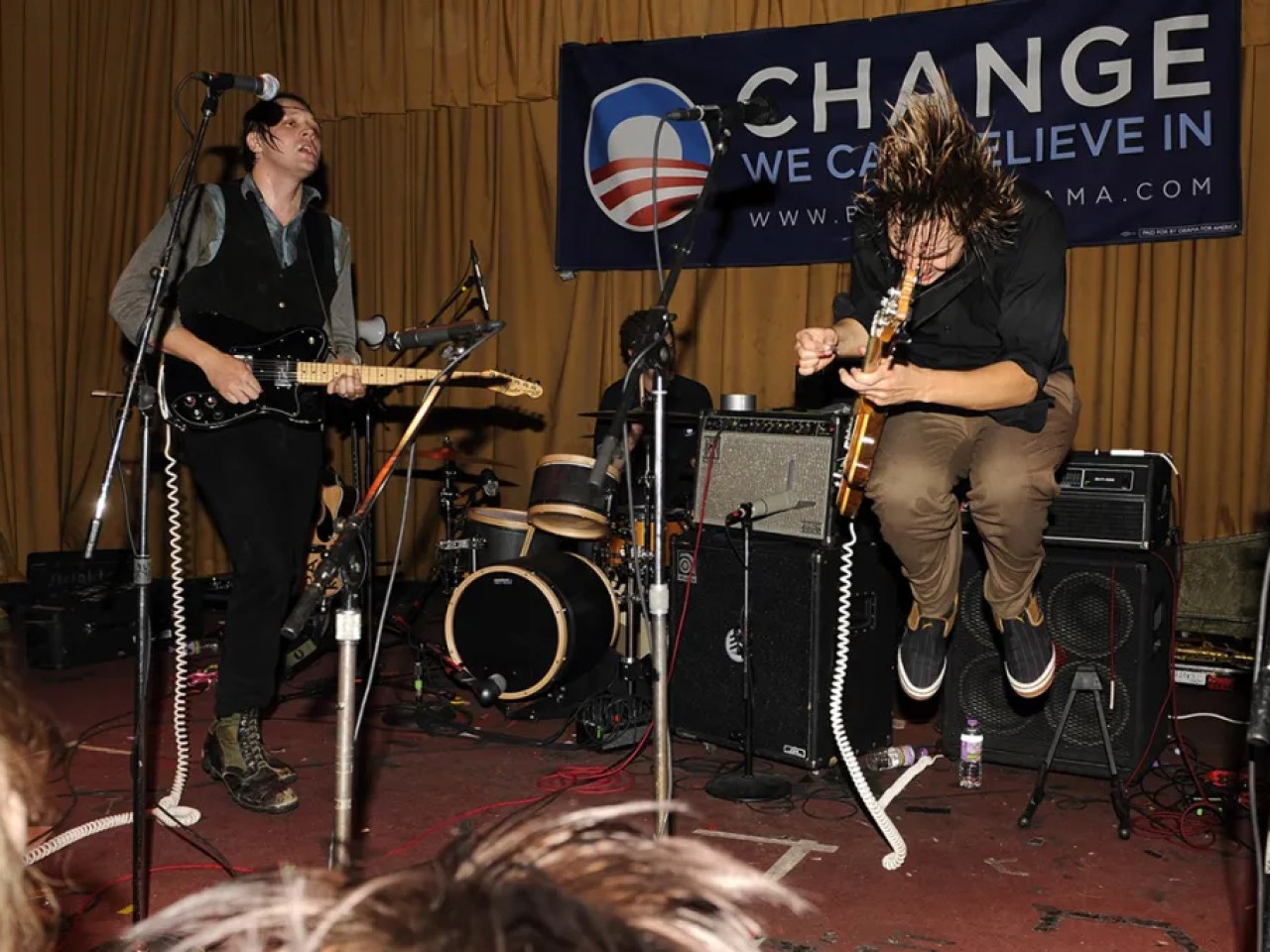
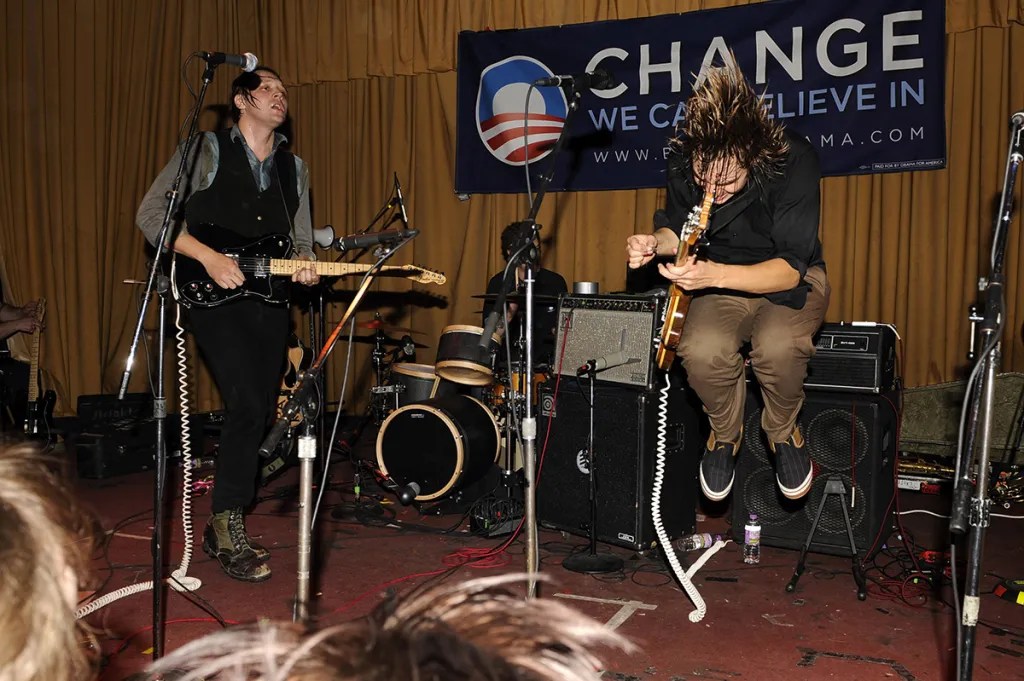
But Bush was replaced by Obama, and Arcade Fire found themselves at the forefront of what Sarah Palin described, with atypical withering accuracy, as “that hopey-changey thing.” Looking back on it now, nearly two decades later, the coming of Barack Obama seems one of the most staggeringly anti-climactic developments in American politics – a blizzard of hype and expectation that eventually curdled into nothingness and precipitated the rise of Donald Trump and MAGA. But many people were over-invested in Obama’s success and Arcade Fire became virtually his house band. They campaigned for him in 2008 and performed a private concert in 2009 as a thank-you show for his staffers after the inauguration.
There are some people who are great fans of the next two Arcade Fire albums, The Suburbs (2010) and Reflektor (2013), and both have some outstanding songs. Yet without the clear focus of Funeral or Neon Bible, or indeed the hunger that fueled both, there was a growing sense that, in the similarly unfocused Obama era, Arcade Fire was all too keen to embrace its status as “the next U2” and produce huge rock anthems that played well to arena audiences but had little to say about the world the band was dominating. But hey, they had famous fans, including the president, and they were making an awful lot of money. What could go wrong?
The answer came in 2017, when, clearly angered by the Trump era’s insolence, the band released their fifth and weakest album, Everything Now. A laborious satire on consumerism and the music industry, it came complete with all manner of clever-clever promotion – the creation of the fake “Everything Now Corp” and attendant gimmickry including fake advertisements and fake reviews. If the record had boasted better songs, it might have worked. But they were depressingly weak and overthought – though the album was a commercial success.
We was a partial return to form – the nine-minute orchestral epic “End of the Empire” is magnificent – but even here, there is an irritating sanctimony that reflected the post-Covid Biden era in America. As Butler sang “Feeling uninspired, oh, standing at the end of the American empire,” he was far more apposite than he could have imagined. And then came public shaming, cancellation, a flop album and now, presumably, the band’s relegation to history.
It wouldn’t have been surprising to see Arcade Fire out stumping for Kamala Harris last year, but by that point they were very much personae non gratae. Even before Butler’s humiliation, though, there was something about the band that spoke to another era. Sometimes, an act can see where the future is heading and decide to call it a day, as in the case of R.E.M. At other times, as with the Killers or Coldplay, the appeal lies in studiously non-politicized music that can remain popular whatever direction the electoral winds of the day blow. Yet Arcade Fire are so redolent now of a different America, for better or worse, that they arouse little more than a weary nostalgia for what might have been and never was. An apt reflection, then, on the career that they so nearly had – and which died its own death.
This article was originally published in The Spectator’s December 22, 2025 World edition.



Comments