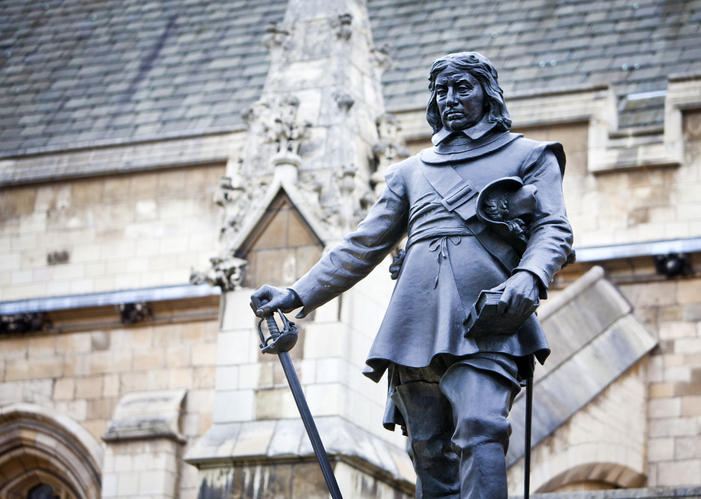
It is a cherished myth among Oliver Cromwell’s many critics that our only home-grown military dictator ‘cancelled Christmas’. It gives the Ollie haters yet another reason to loathe the warty-faced old brute, alongside his notorious Irish massacres (of which more later) – but is it true?
In fact, there is no evidence that Cromwell initiated or played any personal part in the series of measures clamping down on traditional Yuletide festivities. These were introduced by an increasingly Puritan-dominated parliament between 1647 in the immediate wake of the English civil war, and 1656 – when Cromwell was firmly in the saddle as Lord Protector – though as a strict Puritan himself, he would doubtless have approved.
Before the civil war, Christmas was widely celebrated in England in ways similar to how we mark it today: in the twelve days between Christmas Eve and 1 January (though then the new year still officially dated from 25 March) there was much merriment, copious quaffing of beer and gross gobbling of turkeys, beef, geese, mince pies and ‘plum pudding’. Presents were exchanged between family and friends, and wealthier folk boxed up small gifts for their servants (hence the origin of ‘Boxing Day’). There were even Father Christmas figures who presided over the fun as Lords of Misrule.
Traditional Christmas celebrations continued covertly wherever parliament’s writ was weaker
All this was anathema to the growing numbers of Puritans in and out of the Church of England. The ‘Godly party’, as Cromwell and his cronies liked to call themselves, frowned on the festive season as a sinful time of drunkenness, idleness, gluttony and general debauchery. The thought that people could let their hair down and enjoy themselves for such an extended period galled them into repressive rage.
Basing their objections on Biblical grounds, the various parliaments that followed their victory in the civil war held that celebrating Christ’s birthday had no scriptural justification. They attempted to abolish the festival, which they condemned as a ‘Popish’ hangover from Catholicism (Christmas literally meaning ‘Christ Mass’). However, strict enforcement of the ban was patchy outside London, and traditional Christmas celebrations continued covertly wherever parliament’s writ was weaker. Christmas returned with full jollity when the ban was rescinded on the restoration of Charles II in 1660.

Cromwell’s image as a miserable and humourless old meanie chiefly derives from Royalist propaganda, though there is abundant evidence from his life and letters that he was a man of strong emotions who wept as easily as Winston Churchill. On the morning of his great victory over the Scots at Dunbar for example, he was seen to be biting his lips under the tension until the blood ran down his chin. In a letter to his brother-in-law, Valentine Walton, informing him of the death of his beloved son at Marston Moor, Oliver consoled the bereaved father with a beautiful line that still brings tears to my eyes: ‘Sir, there is your precious child full of glory, to know sin nor sorrow no more.’
In an age when English was in its springtime, Cromwell was a master of the language with few equals, as his speeches and battlefield despatches make very clear. Ringing phrases like ‘God made them as stubble to our swords’ and his magisterial ‘In the name of God, Go!’ dismissal of the Long Parliament are remembered today nearly 400 years after they were uttered.
The myth that Cromwell cancelled Christmas is probably as difficult to shift as the legend that he was a genocidal monster intent on the extermination of all Irish people. That legend is based on Cromwell’s storming and sacking of the towns of Drogheda and Wexford in 1649 when he was putting down a rebellion by English royalists as well as the native Irish.
The Drogheda-born Irish historian Tom Reilly has written no fewer than four books demonstrating that the victims of the ‘massacres’ were soldiers rather than civilians. He points out that by the laws of siege warfare as they then existed, the victors were entitled to kill any armed enemies who had refused quarter. Nevertheless, the baby-killing label will cling to Cromwell like knotweed – at least in Ireland.
No one can deny that by modern standards Oliver was a religious bigot with a particular down on Catholics, but in the context of real Popish plots to kill Protestants in their beds, his bias may be understandable. It is worthy of note that his biographer Lady Antonia Fraser (herself a Roman Catholic) concluded, in the words of one review, that Cromwell ‘was no tyrant, was not ambitious, had a bursting conscience and was civilised. The evidence she has assembled is overwhelming’. Hard and narrow Oliver may have been, but he was certainly much more than the Grinch who stole Christmas.
Comments