The big controversies in chess are often about games that were never played. In 1972, Bobby Fischer forfeited the second game of his world championship match against Boris Spassky in a dispute over cameras. In 2006, Vladimir Kramnik forfeited game five against Veselin Topalov, protesting a ruling over bathroom access. Weeks after his notorious withdrawal from the Sinquefield Cup in 2022 following a loss to Hans Niemann, Magnus Carlsen played just one move before resigning an online game against the same player. In 2024, Carlsen and Ian Nepomniachtchi, level in the tiebreak stage of the World Blitz final, chose to share the title.
Carlsen has added a new chapter at the Total Chess World Championship Tour Pilot, held in Budapest earlier this month. A poor performance in the group stages left him with the humbling task of competing in a four-player knockout for 17th place, and even in some danger of losing the top spot in the world rankings. He went on to forfeit five games across four days: two against Bibisara Assaubayeva and three against Vladislav Artemiev.
Viewed charitably, the forfeits against Assaubayeva were somewhat defensible, coming as they did when Carlsen had already won the daily set. Tournament rules – unwisely in my view – dictated that all games be played, regardless of the match situation. The forfeits were poor conduct, but Carlsen was correct to describe those games as meaningless.
The forfeits against Artemiev, however, came when the match was still an open contest. Why then did he countenance a forfeit? Forfeited games do not count for international rating, and that consideration evidently mattered more to Carlsen than the battle for 17th/18th place, with the negligible financial incentive that accompanied it.
Carlsen put it bluntly in an interview with Norway’s TV 2: ‘Of course it’s cynical, but we’re playing for 17th place, so rating points and things like that matter.’
The irony is that Total Chess, from the organisers of Norway Chess, was fashioned with Carlsen in mind, given his clear preference for fast time controls. The event saw a blend of blitz, rapid and ‘Fast Classic’ – the latter an experimental time limit in which players have 45 minutes plus a 30-second increment for every move – slower than rapid, but about half the length of regular classical games. The growing popularity of faster time controls, significantly influenced by Carlsen himself, certainly made the governing body Fide more receptive to the Fast Classic time control.
Carlsen’s repeated forfeits were almost universally decried by his competitors. Fide has since referred his conduct to its Ethics and Disciplinary Commission. The tournament was billed as a ‘pilot’ event before the proper first edition in 2027, which will even have Candidates places at stake. But its absurdly convoluted format clearly needs a rethink.
Below, a highlight from the final, in which Alireza Firouzja defeated Anish Giri with a sharp mating attack in the endgame.
Anish Giri–Alireza Firouzja
Total Chess Pilot Final Day 2, Rapid, Nov 2026
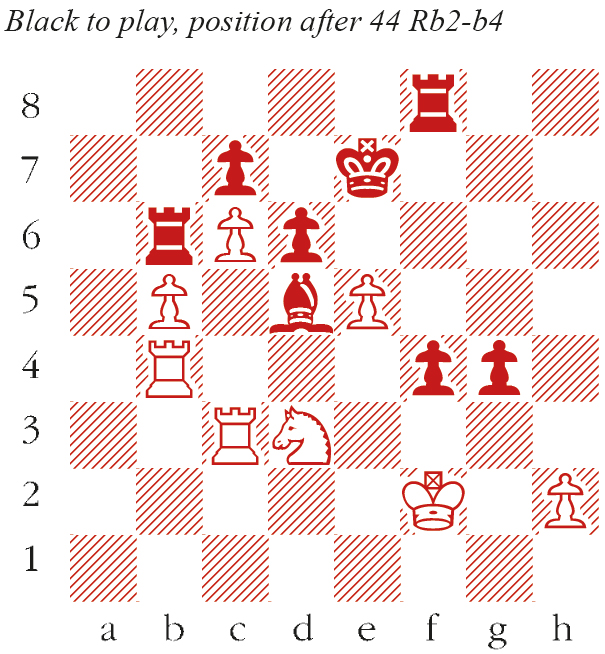
44…g3+! 45 hxg3 fxg3+ 46 Kxg3 Rf3+ 47 Kg4 dxe5! A crucial finesse. Instead, 47…Rb8 is too hasty: 48 Nf4! shelters the king and invites 48…Rxc3 49 Nxd5+ with a fork, so White is on top. 48 Rb2 There was nothing better, but now mate is inevitable. Rb8 49 Re2 Rg8+ 50 Kh4 Be6 Now 51 Rh2 Rh8+ 52 Kg5 Rg3 is mate, so White resigns






Comments