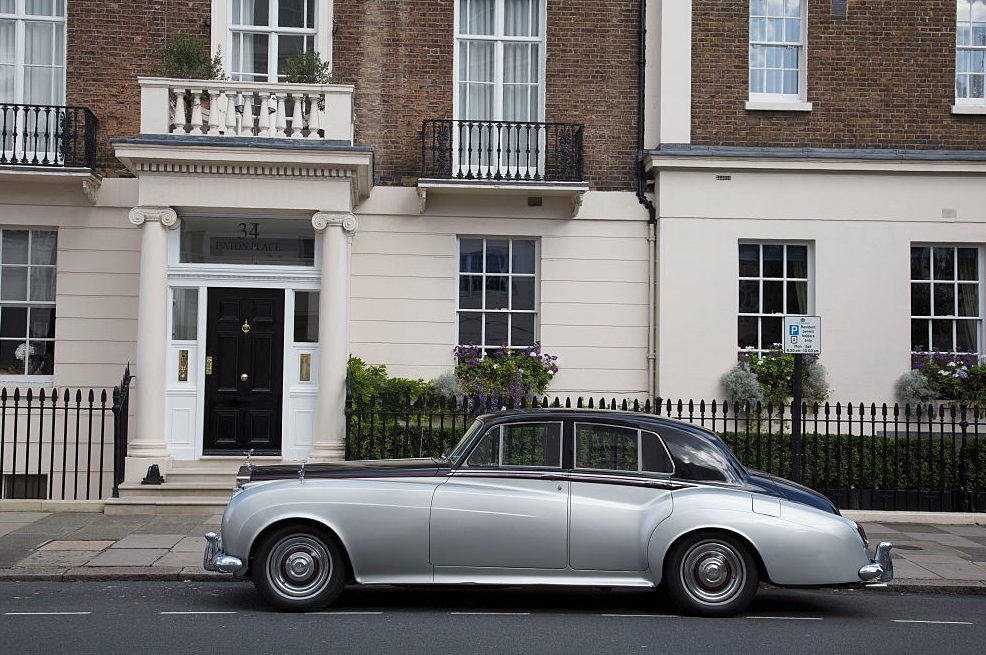
News that London’s super-prime property market is nosediving feels like a shaft of low sunlight illuminating the last leaves of autumn. A sudden cause for celebration amidst the gloom of November. Across London, prices have fallen at their fastest rate in 17 years. This is at a time when famously no new housing is being added by successive governments.
Maybe working hard and having bright ideas might count for something again
For years we have been told that the problem with London house prices was a question of stock and absolutely nothing to do with the unsavoury billionaires bidding up prices in SW1 to insane levels. Nothing to do with the merely rich, as opposed to the super-rich, being pushed into new areas and the consequent shuffling on throughout the city. The departure of the non-doms, and I would suggest in particular the post-Soviet non-doms, gives the lie to that particular convenient fiction.
It turns out that the BVI-owned icebergs in Belgrave Square were having a direct bearing on the price of a flat in Wandsworth, and once this market has ‘cooled dramatically’, as one estate agent discussing the client roster of ‘discretionary and international buyers’ put it, prices could start returning to some level of normality.
Much is being made of the taxation of non-doms scaring off the super-rich, but I would wager a bigger factor is the war in Ukraine taking the bottom out of the Russian market, which has now taken their trade to Dubai instead, and, since the war in Iran, who knows where. Seeing the divorce battle of Russian billionaire nickel magnate Vladimir Potanin, and his ex-wife demanding £600 million for her reasonable needs reminds us just what we have been missing since their departure.

Having moved out of London, it is striking now to return and walk through Knightsbridge or Kensington and feel the absence of that vaguely threatening wealth. The Maybachs and blacked-out Bentleys turning left out of Kensington Palace Gardens, the sketchy bodyguards and the strange closed-off restaurants all feel gone and have taken their air of oppression with them.
It also can’t be coincidental that this absence has coincided with the UK placing several high-profile Russians on international sanctions lists after the invasion of Ukraine, forcing London’s service industry to pay attention to their clients when they would normally rather avoid doing so. Sanctions have provided the silver bullet no amount of speculation on shady origins or bad press could provide. It turns out that, on government-mandated closer examination, some on their client lists were absolute rotters.
Walking through the city, London feels like it is exhaling. Pubs are full and new nightclubs, shops and restaurants are springing up. The lifting of London’s billionaire hoo-doo exposes another lie peddled through the oligarch years: that somehow this wealth would trickle down to all of us and the explosion in pointless, airport luxury across the city would provide a universal benefit.
In reality, London’s role as a laundry for dirty cash had a stultifying effect. Being awash with vast loot from mineral reserves in Siberia, coupled with zero interest rates, pushed asset prices up at the same time as wages stagnated. The natives were priced out and the going solution across the UK was not to innovate but to chase the oligarch buck, either by mirroring their warped sense of luxury or by selling off the family silver, as some great British institutions can attest.
The departure of the billionaires therefore adds something else. Aspiration can return, the sense that you don’t have to have stolen a coal mine or a small Soviet republic to be able to aspire to a London mansion. Maybe working hard and having bright ideas might count for something again. I’d far rather have the newly minted billionaires behind Anthropic or GTA 6 living in Eaton Square, purely because it feels like a possibility that one day I, or much more likely my children, might be able to join those ranks.
The review of London’s property market highlighted that while central London was struggling, London’s outer boroughs were in better shape: ‘Most purchases here are made by people who need to move, either for work or for their children’s school.’ In other words, where the lights are on and where life happens. Now we are no longer mesmerised by oligarch wealth, dare we dream of a similar future for central London as well?




Comments