
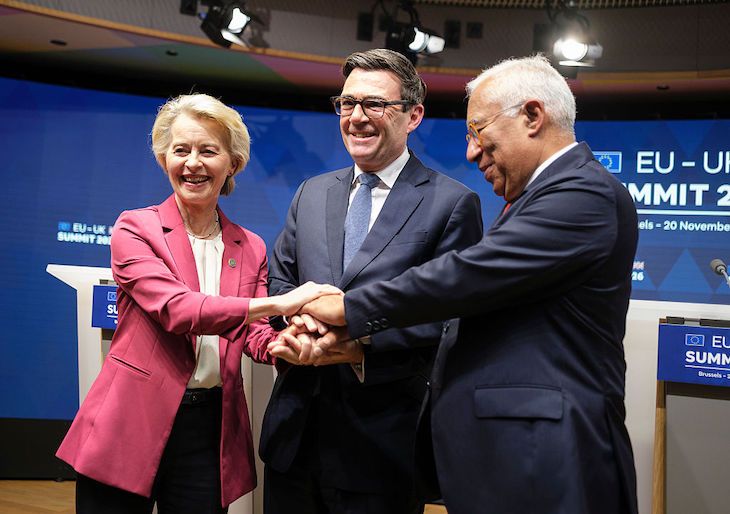
Andy Burnham turned up in Brussels with a shopping list of things he’d ideally like to secure from the EU but seemed a tad surprised when he was presented with a bill. Not the kind of bill you get from a salesman in a souk either – a bill that’s negotiable. It’s a fixed catalogue of prices if we want to get much more access to the European market.
The Prime Minister (accompanied by a ludicrous charabanc full of ministers – Miliband, Healey, Haigh and even the chief whip sat down at the big summit table) set off promising to draw a line under ‘a decade of drift’. He came home having had a different line drawn for him: around how far he can go.
This is the fifth major effort at a new deal with the EU in recent times – after Cameron 2015-16, May 2017-19, Johnson 2019, Sunak 2023 – and we shouldn’t be terribly surprised that it unfolded much as the others did.
At 9 a.m. EU officials briefed the British media that there was no deal and there would not be one until the UK allows European students into our universities for tuition fees in line with the £9,000 a year British students pay, rather than the £36,000 a year paid by overseas undergraduates. A last-minute ambush has always been par for the course, and this time it was executed over dinner the night before by member states, who rejected what the Commission had been set to agree.
In the end the Brits had to concede that the issue will be resolved over the next few months. A lot of foreign leaders and senior Eurocrats send their kids to British universities, including the Commission President, Ursula von der Leyen, so this is not something they are going to drop. There will doubtless be a fudge on the exact level of fees but, without concessions, the EU won’t ratify what has been agreed. The bill could be as high as £450 million.
Also parked for six months is the thorny issue of whether Britain will be allowed into the EU’s Made in Europe scheme, a protectionist effort to clobber China with tariffs. We can either join and see the cost of Chinese imports soar or stay out and face the same kind of punishment when selling goods which are not predominantly European into their market (though there is some sort of carve out for British cars). The quid pro quo seems obvious; the more Made in Europe we want, the less EU students are likely to pay.
Like all EU deals, its beauty is in the eye of the beholder. If economics are your priority, you will seize on the easing of border restrictions and the Treasury estimate that it’s worth 0.5 per cent of GDP, or around £17 billion, by 2040.
But despite claims that consumers will immediately see a drop in food prices, none of this actually kicks in until 2028 (which, coincidentally or not, most people I know in Labour expect to be the year of the next general election).
Those of you who, like me, are professionally cynical will turn to section 4.3 of the Treasury impact assessment, which reads: ‘The policy increases both GDP and the population (through higher net migration) by similar proportions, so the impact on GDP per capita is 0.0 per cent at one decimal place.’ In other words, it won’t make the people currently in Britain richer at all.
Under the agreement, most routine checks on food exports go – though these only account for about 0.8 per cent of UK exports. The two carbon markets are linked, which spares British steel from the EU’s border levy. And 100,000 young people a year will be able to move each way.
If sovereignty is what you care about most, the need to accept (with rather marginal UK input) rules drawn up in Brussels will never be a price worth paying, and it was this aspect which Nigel Farage led on in his press conference reacting to the deal. He said it was the start of the process of reversing the biggest democratic exercise in British history from a Prime Minister who only 25,000 people (in Makerfield) have ever voted for.
I understand why Farage cried betrayal, but I actually think there’s a very good case that today revealed how unlikely it actually is that we rejoin.
This is ‘probably the limit of what we can achieve in this parliament’, Burnham said. That’s from a Prime Minister who has said Brexit failed, talked about rejoining in his lifetime and called for an ‘honest discussion’ about free movement.
We were promised a speech from Burnham before Christmas on the options and then a decision about which to pursue. Instead, today fired the starting gun on talks about talks about talks. The Prime Minister promised a year-long ‘informal brainstorming’ with the EU. Ye gods, shoot me now.
But even this seems to misunderstand where Brussels is coming from. They don’t want to talk about how best to mix the ingredients for an EU-UK friendship banquet, they want the UK to pay set prices for the meal. At the joint press conference, Antonio Costa, the European Council President, made clear there isn’t much negotiating to be done. The EU respects whatever Britain chooses, but ‘you know our principles well’: the four freedoms can’t be split, and rights come with obligations. Put simply, more access means free movement and paying into the budget. Labour’s red lines rule out both until the election.
Burnham’s belief is that the voters are ahead of the politicians in rethinking Brexit and that the people he met on the doorstep in Makerfield are open to a new approach. But if he thinks the voters of working-class Northern towns will translate anger at the Boriswave into embracing a new suspension of migration controls, I’m not sure he was listening carefully enough.
The danger for Burnham is that he has legitimised more political focus on migration and that the expectations he has raised with left-wing voters about rejoining will collide with reality every bit as hard as the Starmer-Burnham deal today has done so.
The Tories and Stay Out, the Vote Leave successor organisation, put their focus on the process and the distraction. Oliver Lewis, chairman of Stay Out, said: ‘Burnham has been played like a fiddle by Brussels, which took one look at how badly he wants a deal and decided British taxpayers should foot the bill for cheaper fees for EU students before it will sign anything. Brussels isn’t interested in anything other than our cash.’
The main Tory point, from deputy leader Alex Burghart, was that ‘Rather than fixing the big problems facing the country like the spiralling welfare bill and the need to fund our defence, Andy Burnham is reopening the divisions of the past.’ This is, bluntly, the only line the Tories can use which won’t antagonise the rich southern Lib Dem voters they are targeting.
Polls show the public wants a closer relationship with the EU but doesn’t want the toxic hassle of another Brexit war. If Burnham had turned up, made his claims of economic gain and left again, there would be political upside here. Instead we are back at square one with years of talks beckoning.
As Farage said to me earlier in the week for my cover piece in the magazine, it was ‘déjà-vu on steroids’.
The EU ambushed the government, issued demands for money with menaces, proved a tougher nut to crack than ministers (jacked up to the eyeballs on hopium) had expected, we agreed to talks about talks and to work together towards things that are expensive and undesirable.
Colour me surprised. It’s what happens every single time. Burnham came, he saw, he collided with a brick wall.




Comments