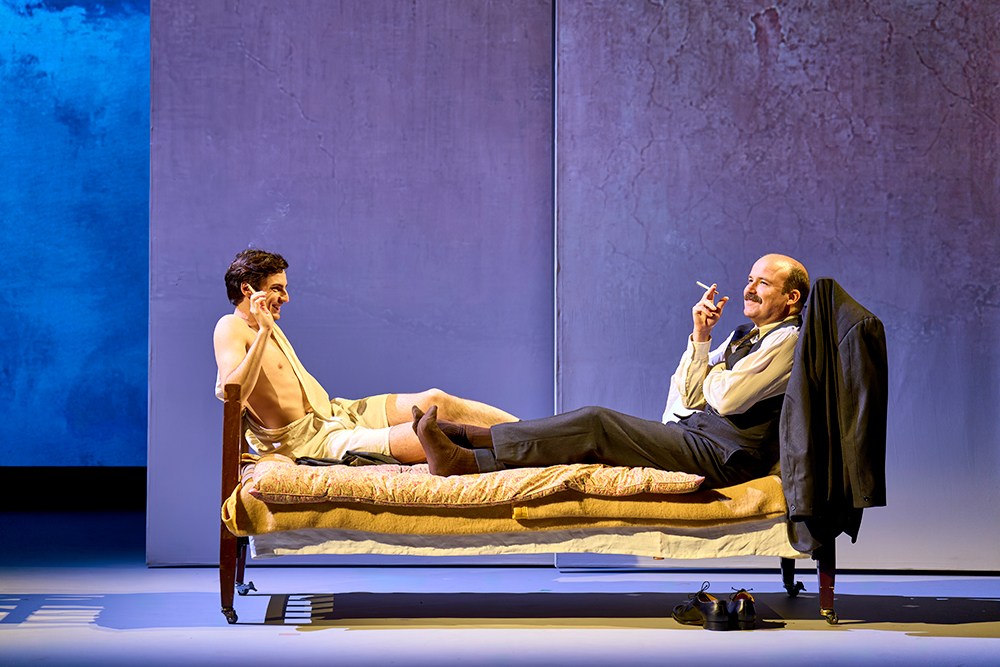


I rarely go to the theatre these days because it’s so expensive. But last week I managed to get two ‘discounted’ tickets (a snip at £105 each) to see The Standard of Living at the Theatre Royal Haymarket. It’s been billed as the latest state-of-the-nation play by James Graham, the writer of Dear England, among other things, although it’s actually about the life and work of John Maynard Keynes.
The first thing to say, before I come to my reservations, is that it’s very well done. Graham, with help from director Nicholas Hytner, has overcome the challenges of bringing to life a play about a 20th–century economist. That’s less difficult in Keynes’s case than it would have been in, say, Milton Friedman’s, because he was a member of the Bloomsbury group and had affairs with both Lytton Strachey and Duncan Grant. Indeed, he was extremely promiscuous, frequently engaging in ‘cottaging’, with one scene in the play taking place in a public lavatory in Whitehall. Not only that, but midway through his life he switched sides and married a Russian ballerina. That detail provides Hytner with an excuse to break up discussions about monetary theory with frequent bursts of ballet.
The majority of the audience appeared to be well-heeled retirees – the asset-rich 1 per cent
The play also takes a decent stab at dramatising the conflict between Keynes and more orthodox economists by having him argue at regular intervals with Friedrich Hayek, the Austrian free marketeer who regarded Keynes’s faith in the benign powers of the state as pure folly. But it’s not really a fair fight, because Hayek is constantly interrupting his criticisms to praise Keynes’s largeness of spirit and says at the end, after his premature death: ‘He was the only great man I ever knew… The world will be a very much poorer place without him.’ My view is that the world is a much poorer place because of him.
The fact that the play sides with Keynes, even including a pointed reference to the risk of populism emerging during periods of economic downturn, went over well with the audience, not surprisingly. The majority appeared to be well-heeled retirees and members of the same class as Keynes, which he described as the ‘educated bourgeoisie’. These are the asset-rich 1 per cent who’ve benefited from successive government stimulus packages, seeing their houses in north London rocket in value.

One of the consequences of Keynesian economics, although it’s coded ‘left wing’, is that it has disproportionately benefited the most well-off. Keynes urged the architects of monetary policy to keep interest rates low, believing that would accelerate the ‘euthanasia of the rentier’. In fact, it enabled the quantitative easing that has showered rentiers in gold, some of it visible on the fingers, wrists and necks of the women in the audience.
This irony was nicely illustrated in the play’s coda, set in 1976, 30 years after Keynes’s death. The occasion is the 40th anniversary of the Cambridge Arts Theatre, which he built at the bidding of his wife. One of his achievements, we’re told, is the creation of the Arts Council, which, in the words of his wife, has done so much to broaden access to the arts, particularly opera and ballet. In fact, the distribution of state aid to institutions like the Royal Opera House and the Royal Ballet enabled them to keep ticket prices below market rates. And who has benefited from these subsidies? Why, the very people warmly applauding the great man from the stalls.
Another irony is that 1976 was the year Denis Healey had to go to the IMF to ask for a bailout. James Callaghan, the then prime minister, squarely blamed the Keynesian economic policies of his predecessors, announcing at the Labour party conference that you could no longer spend your way out of a recession. The IMF loaned the UK £2.3 billion, but only on condition the government cut £2.5 billion from public expenditure, a bitter pill for the Keynesians to swallow. That paved the way for Margaret Thatcher’s more Hayekian approach, which proved more successful, for a time at least, although you wouldn’t know it from this play.
I don’t want to end this review on a sour note. For Keynes’s critics to be given any air time at all on a West End stage is a mercy we should be grateful for, and Graham does at least try to be even-handed. I thought his Channel 4 drama Brexit: The Uncivil War was particularly good, although that may be because the devil in that particular drama – Dominic Cummings – had all the best tunes. The Standard of Living is less balanced, but still worth your time if you can get a discounted ticket. I just hope you find a cheaper one than I did – unless you’re lucky enough to be one of Keynes’s heirs.






Comments