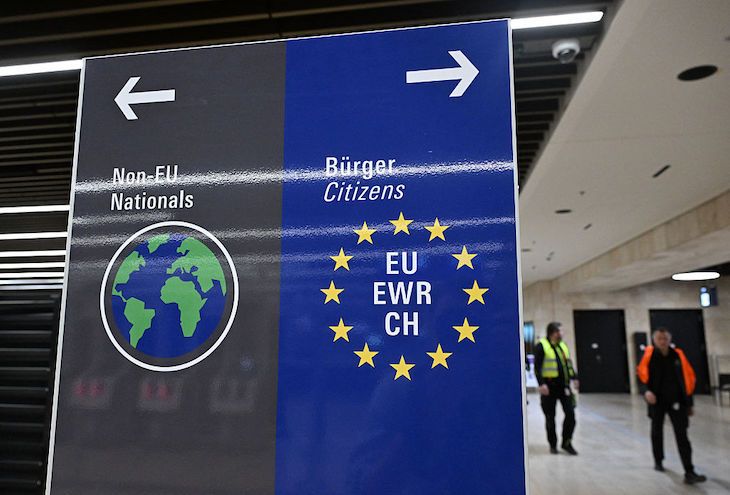
In October, my wife, daughter, and I flew to Bratislava for a short break. The Slovak border guard asked me how long we planned to stay in Slovakia. “Five days”, I replied.
“That’s okay; it’s just that you only have eight days left on your Schengen visa. You’ve been in France since August.”
A system that loses track of who has left the continent, and wrongly flags countless people as illegal overstayers, degrades real security
This was news to us, considering we’d just flown in from Luton. On 4 August, we took a trip to Disneyland Paris on Eurostar and returned via Lille to St Pancras on 8 August. But according to the EU’s Entry/Exit System (EES), that never happened. Perhaps they thought we manned a dinghy to Dover?
The taxi ride from the airport to our hotel was filled with worrying questions. What happened at Lille? Were we in danger of overstaying? Were we trapped in the Magic Kingdom and then inexplicably materialised in the entry queue at M. R. Štefánik Airport?
It was all terrifyingly absurd, and punctuated by the fact that we planned a trip to Sweden for Christmas. If we hadn’t travelled to Slovakia, we would have flown to Gothenburg blissfully unaware that we risked being locked up by a team of huscarls named Sven.
We contacted the French and Slovak border police for clarification. So far, there has been no response from the French (le sigh), but the Slovaks confirmed that they have no record of my wife and me leaving France, and that they diligently recorded our exit from Slovakia. Peculiarly, my daughter, who is five years old, is listed as OK to travel on the EES.
The EES states the following about us: “Your remaining authorised stay cannot currently be calculated due to temporary incomplete data in the Entry/Exit System.”

We are Schrödinger’s overstayers.
And we’re not alone. It’s estimated that thousands of holidaymakers are affected by these errors, including author Jojo Moyes, who was threatened with a two-year travel ban and a €10,000 (£8,000) fine because of an EES error. Paula Pugh, who took a trip to Italy to celebrate her husband’s 60th birthday, was taken by police officers and put on the next flight back to Blighty because of another error. This is the tyranny of a “computer says no” culture, where reality and common sense are subordinated to digital screens, and the law-abiding risk breaking the law through structural incompetence.
The EU sells biometric surveillance on the promise that it makes borders more secure. Yet a system that loses track of who has left the continent, and wrongly flags countless people as illegal overstayers, degrades real security.
Worse, there is an asymmetry of accountability: states demand your most sensitive biometric data under threat of refusal of entry, yet take zero responsibility when their own contractors’ software corrupts your record. The EU is suing IBM, Atos and Leonardo, over delays in the delivery of this €212 million (£180 million) Kafkasoftware.
The Government knows what is happening, but so far has only provided this tepid reply: “We are aware of reports of inaccuracies in some EES records affecting British nationals, including incomplete records and the registration of some individuals who are exempt from EES. We are raising these issues as part of our engagement with the European Commission.”
“Affecting” is a word doing some heavy lifting in that statement; the reality is that people are facing criminal prosecution and large fines because of glitches. This is the egg-splattered face of European digital resilience.
The impact on tourism is obvious from our experience, and perhaps serious action will be taken once quarterly earnings are reported, or more public figures are put in chains. For now, our Christmas trip to Sweden is on hold – unless we decide to send our five-year-old ahead alone, since she is the only one the computer trusts.






Comments