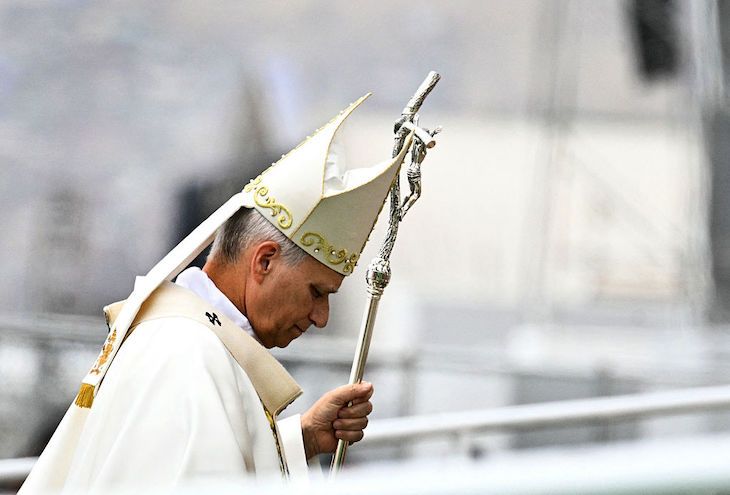
Last week, as Pope Leo XIV’s 12-day apostolic visit to South America reached its midway point, Argentina’s La Nacion noticed something.
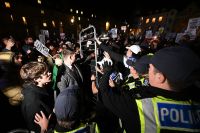
The newspaper observed: ‘On his journey to the Monument to the Spaniards, where he celebrated a well-attended Mass; outside the apostolic nunciature [a Holy See diplomatic mission] where he spent every night; and during the vigil for the youth in Palermo – the slogan “Freedom for the traditional Mass” or “We young people want the traditional Mass” was present during the Pope’s travels through the country, on banners and flags demanding it.’
Young people, in Argentina and elsewhere, want the traditional Mass because it gives them what the world cannot: the mystery of faith
If you are a non-Catholic scratching your head at this point, be reassured that most Catholics are doing the same. We are about to enter that most obscure – some might say obscurant – of worlds, the Latin Mass Discourse.
By ‘the Latin Mass’ we mean the Roman rite as it was celebrated for roughly a millennium, through a succession of incremental reforms, with a universal Roman Missal mandated by the 1570 Council of Trent, from which the sacrifice acquired its other name, the Tridentine Mass. Evolution gave way to revolution in the 1960s – because of course – and under the auspices of Vatican II, though far exceeding what that sage council had envisioned, the liturgy was upended.
The Mass was no longer in Latin but in the vernacular. The priest turned his back on the liturgical east – the direction of God – and now faced the people instead. The prayers were shortened and simplified; Psalm 43 (‘Judge me, O God’) and the opening verses of John’s Gospel (‘In the beginning was the word’) were ditched altogether. Timeless Gregorian chants gave way to more recent (and sometimes Protestant) hymns and contemporary worship music born of the 1960s folk revival. The altar rails at which the faithful had knelt to receive Holy Communion, on the tongue, were ripped out and Catholics queued, standing, to have the Body of Christ deposited into their hands.
Despite these disorienting changes, this expression of the Mass, known as the novus ordo or new order, was and remains canonically valid as the ordinary form of the Roman rite. It is the Mass celebrated by John Paul II, the Mass which led Saint Carlo Acutis to Heaven, and the Mass which sustained the faith of millions under the yoke of communism. But among a small, committed minority of Catholics there was a thirsting for the Mass as it had been. John Paul II afforded some leeway but it wasn’t until 2007, under Benedict XVI, that the Tridentine Mass was opened back up to the people, with the German traditionalist remarking: ‘What earlier generations held as sacred, remains sacred and great for us too, and it cannot be all of a sudden entirely forbidden or even considered harmful.’
The new rules changed nothing about the Mass attended weekly or daily by Catholics; indeed, most of the faithful were unaware of Benedict’s letter, Summorum Pontificum. It did not require priests to celebrate or laity to attend the Tridentine Mass. All it meant was that, where they so wished, clerics could publicly say the old Mass without having to seek permission from their bishop. In the years that followed, interest in the Tridentine Mass slowly grew, older Catholics revisiting the Eucharistic celebration as it had been in their formative days while younger cohorts got their first taste of an ancient liturgy which had been boxed up and stored away in the attic in the 1960s.
The traditional revival troubled Church progressives and in 2021 Pope Francis issued an apostolic letter, Traditionis Custodes, which revoked the permissions given by Benedict and required priests wishing to celebrate the Tridentine Mass to ask for permission from their bishop. It was a devastating moment for traditional-minded Catholics who saw the Mass which nourished their faith snatched away by bishops fearful of schism and perhaps resentful of what looked like a backlash against their lifetimes’ work of shepherding the Church.
Some had hoped that Pope Leo, seen as more temperate than Francis, might ease his predecessor’s restrictions, particularly after the excommunication of the traditionalist Society of Saint Pius X for consecrating bishops against the orders of the Holy See. Given the Society’s highly dubious claim to be the true custodians of the Tridentine Mass, it seemed wise for the Vatican to stop the schismatics pocketing the Church’s timeless liturgy on their way out the door. Which brings us back to that banner.
Yesterday, as the Holy Father fielded media questions on his return flight to Rome, he gave what sounded like a definitive answer to a journalist and, by extension, the young Catholics hoisting that ever-present banner in Argentina. Asked if he intended to make the terms of Traditionis Custodes more flexible, he said:
‘No, not right now. Traditionis Custodes was a decision of Pope Francis and we will continue to follow that. Traditionis Custodes includes possibilities of dispensation or of allowing the Tridentine Mass or the vetus ordus Mass to be celebrated and so, again, for the unity of the Church, the vast majority of Catholics around the world, we celebrate the rite of Vatican II, of Paul VI, and we will continue to do that and there is an avenue available for those who wish to apply for the dispensation.’
Where they rebelled against tradition, Gen-Z Catholics yearn for more of it. Where they pursued relevance, the young long for reverence
While Leo’s remarks appear to shut down that possibility, seasoned Vaticanologists would note the pontiff’s wording, from the preface of ‘not right now’ to the distancing formulation ‘a decision of Pope Francis’. Even so, traditionalists cannot semantics their way out of this one. The Pope has spoken and, until he or a successor says otherwise, his word is law.
However, in today’s Church, the hierarchy enjoys much less deference than in past generations. This reflects societal changes but also the half-life of the clerical sexual abuse scandal, with episcopal authority diminished in the eyes of the faithful by the morally disordered judgements of some bishops when confronted by evil. So while the Holy Father has spoken, others will continue to speak, too, and those voices will be saying what those banners in Argentina said: ‘We young people want the traditional Mass.’
For Catholic progressives, typically baby boomers and older Gen-Xers, it is frustrating to find themselves in the position that all victorious revolutionaries eventually do, that of the status quo against which a new generation inevitably rises. Where they rebelled against tradition, Gen-Z Catholics yearn for more of it. Where they pursued relevance, the young long for reverence.
Few among them reject the novus ordo, fewer still Vatican II. It is simply that in the ancient usage they have found the missing pieces of their spiritual puzzle. In a noisy and insistent age, when the constant buzz and ping of technology pushes another profane dopamine hit, the Latin Mass offers a sanctuary of sacred silence; against the disorienting barrage of modernity, relativism, and ideology, a shield of eternality, doctrine, and fidelity; amid lurid temptations to worship the self, a humbling invitation to worship the divine. Young people, in Argentina and elsewhere, want the traditional Mass because it gives them what the world cannot: the mystery of faith.
Demographics are not destiny, at least not in an institution like the Catholic Church, but they matter. The baby boomers are growing older, clerical and lay alike, and their failure to transmit the faith to the generation or two that came after them means the Church is heading for a cliff edge in the parish houses and the pews. Many churches will close; parishes will merge; diocese will be subsumed into others; deacons and laypersons will have to take on more responsibilities; and Mass will become a scarcer sacrifice, with daily celebrations no longer sustainable in some places.
At which point the Church will find itself dependent on traditional youth, by then well on their way to middle age, and their more orthodox instincts will inevitably reshape Catholicism. The 2025 US National Study of Catholic Priests found that, while more than 70 per cent of those ordained before 1975 identified as ‘progressive’, the situation had turned 180 degrees by 2010: more than 70 per cent of priests ordained since then describe themselves as ‘conservative’. Only 11 per cent who took Holy Orders before 1980 considered access to the traditional Mass a priority, a figure which sits at 39 per cent among post-2000 priests. The Priestly Fraternity of Saint Peter, a traditional order in communion with Rome but which celebrates only the Latin Mass, is seeing record numbers of ordinations. Only a quarter of young Catholics attends weekly Mass, but this figure soars to 98 per cent among those who attend the Latin Mass. An almighty tide is gathering.
Pope Leo is wisely seeking to guard the unity of the faithful but as the faithful changes so too will the contours of unity. Among those presenting in the pews every Sunday, volunteering their time to run parish groups, and filling the collection plate, will be a greater proportion appealing for both the living expression of the Mass, the novus ordo, and the enduring expression, the Latin rite, to be made available. Saint Augustine said: ‘For you I am a bishop, but with you I am a Christian.’ The distinction forms the hierarchical backbone of the Church but the commonality is where true unity lies. The bishops of tomorrow, guided by the Holy Spirit, will be with the faithful in understanding respect for tradition and the traditional Mass as a communion between what was, what is, and what always will be.


Comments