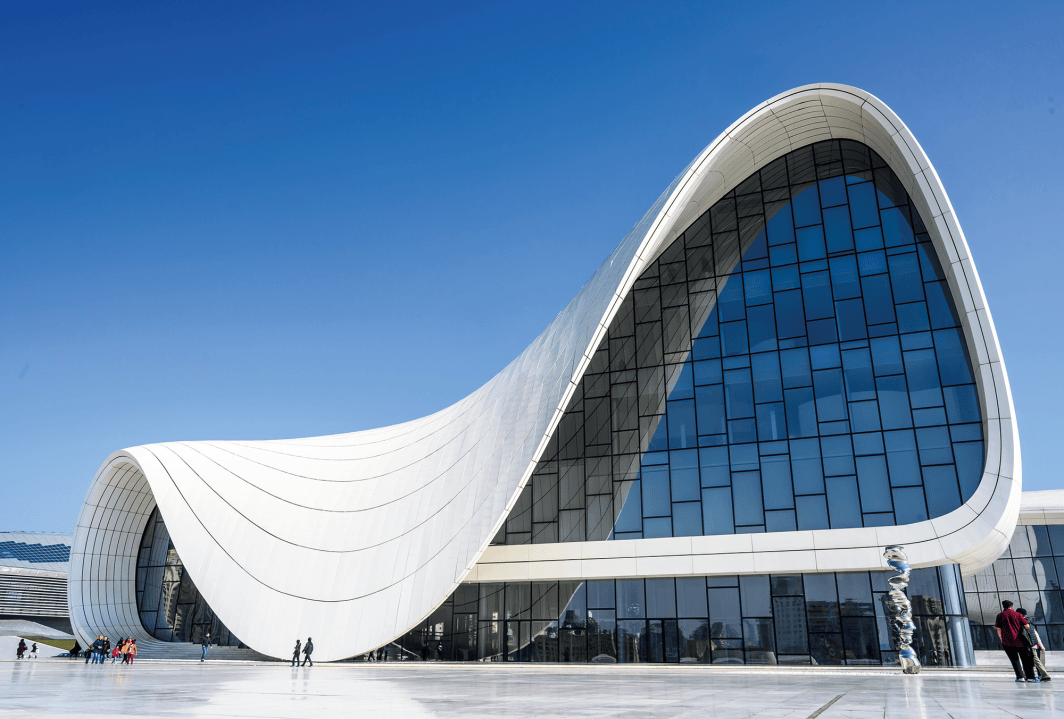
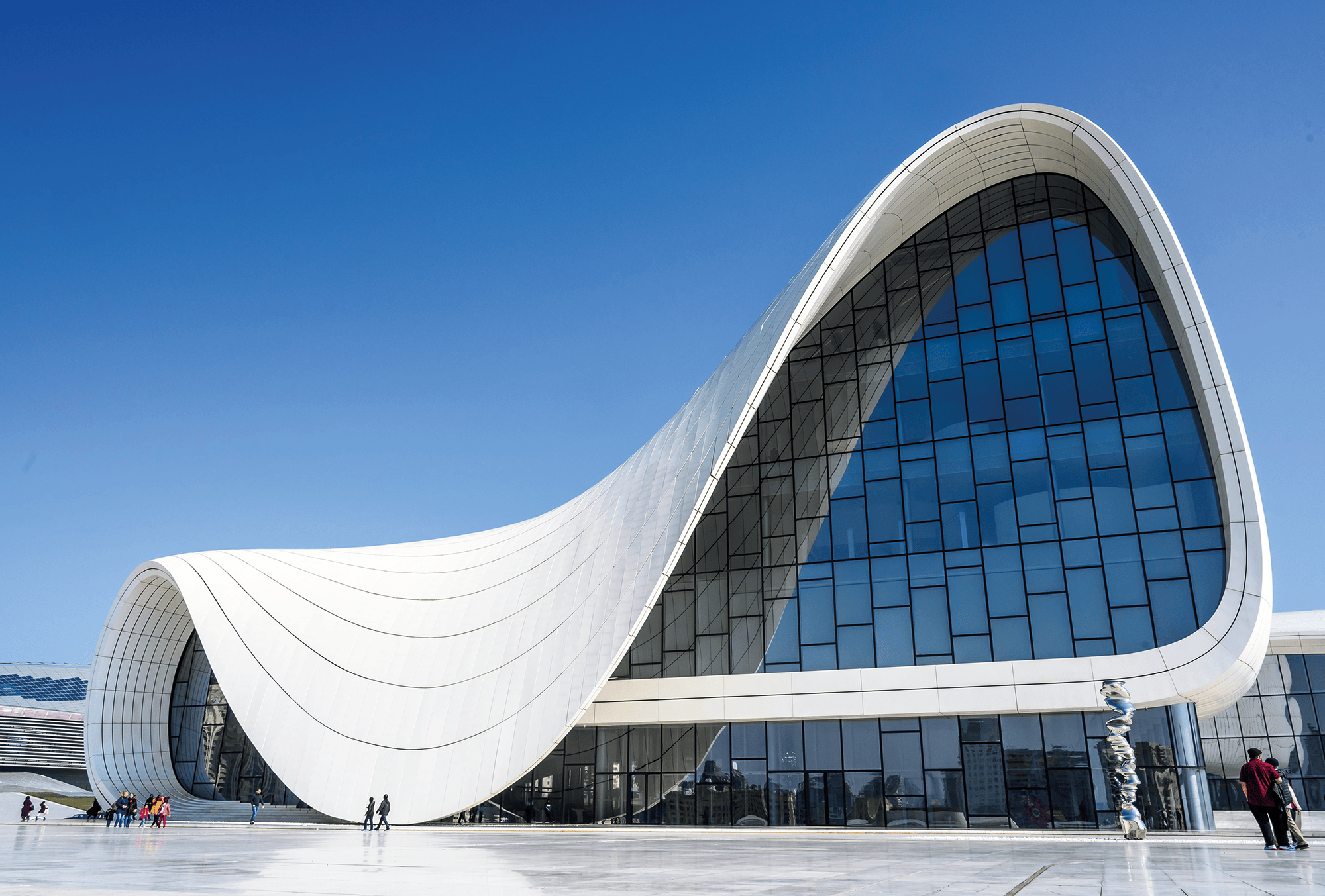
Stock photographs of the Heydar Aliyev Center suggest this voluptuous 21st-century Caucasian behemoth – part museum, part concert hall, part conference centre, part dynastic monument – rises, like the Great Pyramid of Giza, from a seemingly isolated and sun-bright setting. Opened in 2012 and flanked by multi-lane roads and parades of Soviet-era, and po-mo, office and apartment blocks, it does no such thing. Nor is the weather necessarily clement in Baku, capital of Azerbaijan, a country presided over by the less than sensitive dictatorship of the Aliyev dynasty since 1993, two years after its divorce from the USSR. The city and the Heydar Aliyev Center are whipped by fierce Caspian winds.
Inside this animated building, shaped as if with those winds by Zaha Hadid – a stellar and controversial architect who died ten years ago – visitors are met with a beguiling vortex of spaces, folding seamlessly one into the other, free of columns or any other form of visible support. The effect is mesmeric, the architecture itself the undisputed star of this curatorial Jamboree Bag of art, crafts, Soviet-era presidential limousines and KGB uniforms.
Zaha Hadid was criticised – as if she were the only architect working in questionably governed countries
In 2014, London’s Design Museum acclaimed the Heydar Aliyev Center its ‘Design of the Year’. Amnesty International, Human Rights Watch and Art for Democracy were among those who condemned the award. Deyan Sudjic, the museum’s director, responded by saying that the building had been judged purely for its architecture. Hadid believed that regimes come and go while architecture endures. Who knows, she wondered, whether Khufu, who commissioned the Great Pyramid, was benevolent or cruel?
Zaha Hadid attracted a great deal of criticism – as if she were the only architect working in questionably governed countries. In September 2015, she walked out of the BBC Today studio when Sarah Montague, the presenter, inferred that construction on her Al Wakrah Stadium in Qatar, for the 2022 Fifa World Cup, had caused numerous deaths. The accusation was false; the BBC issued an apology. This fake news was aired in an interview meant to celebrate Hadid being the first woman in her own right to be awarded the Royal Gold Medal for Architecture.
The Heydar Aliyev Center mattered so much to Hadid because here, she felt, was a fully resolved example of a form of design she had been evolving since she set up her practice in London in 1979: a floating, folding landscape architecture of continuous curves. When she was still at a Catholic school run by nuns in Baghdad, her father had taken her to see the Mesopotamian marshes. Hadid recalled gazing at a shape-shifting landscape of sea, water courses, sand, reeds and dunes, of man-made patterns playing against nature’s winds and tides, a visual experience that stayed with her.

Born in Baghdad in 1950, Hadid was raised in the city’s oil-rich golden years. Formed in 1950, the Iraqi Development Board invited Walter Gropius, Alvar Aalto, Le Corbusier, Josep Lluis Sert, Gio Ponti and Oscar Niemeyer to work in Baghdad. Frank Lloyd Wright designed an opera house for an island in the Tigris as part of an ambitious new cultural quarter. While few designs by these big names were built, the intention had been to modernise the country. The military regime of Abdul-Karim Qasim that usurped the monarchy in a 1958 coup sponsored a progressive egalitarianism. ‘I was bought up,’ Hadid recalled, ‘in a world where we believed in modern architecture, design, politics, philosophy, women’s education. I remember going to Moscow for the first time when there was still a belief in sputniks, outer space, reaching for the stars. It was crazy when you even found sputniks on the toilet paper, and, of course, a lot of things were wrong, but that idea of progress I knew from childhood was really exciting.’
Hadid studied mathematics at the American University of Beirut, moving to London in 1972 where she flourished as a student at the Architectural Association school. Encouraged by charismatic tutors, notably Rem Koolhaas, who was also to become a major international architect, Hadid drew and painted visually stunning evocations of a future architecture. Revelling in the lightning-strike diagonal lines of Russian constructivists and suprematists, she was also captivated by drawings made in 1932 by Mies van der Rohe for a proposed lakeside villa in Berlin. While very different from those that were to become her own – buildings that appeared to be sculpted by desert winds, djinns and digital dreamscapes – those of the Bauhaus architect had imagined a house spread like fingers through the landscape, opening out in geometric planes as if exploring its setting.
Hadid’s winning ‘glass necklace’ design for the Cardiff Bay Opera House competition in 1994 should have brought her acclaim in her adopted country. Small minded boyo politicians, however, alongside peevish critics and the Millennium Commission – holder of the project’s purse strings – did for her. Despite the professional underpinning of Arup – the structural engineers who made Sydney Opera House possible – her Cardiff Bay architectural aria was said to be unbuildable. As a woman, an Iraqi and an untamed spirit, Hadid felt she had been doomed from the start. ‘I think it was Zaha’s triumph,’ said Norman Foster at the time of her death in March 2016, ‘to go beyond the beautiful graphic visions of her sculptural approach to architecture into reality that so upset some of her critics.’
And yet in 1993, working closely with her long-term architectural partner Patrik Schumacher, she had completed her first building, a fire station for the Vitra furniture factory at Weil am Rhein. The Germans loved her. Her dynamic Phaeno Science Center (2005), Wolfsburg, and ingenious BMW Central Building (2005), Leipzig, where cars on assembly lines weave through company offices, raised her into the architectural firmament.
‘I don’t design nice buildings – I don’t like them. I like architecture to have some raw, vital, earthy quality’
Even then, the biscuity British remained suspicious. ‘I can be my own worst enemy,’ she said. ‘As a woman, I’m expected to want everything to be nice, and to be nice myself… I don’t design nice buildings – I don’t like them. I like architecture to have some raw, vital, earthy quality… Some winters ago, I flew from New York to Chicago in the snow; at sunset, the landscape and cityscapes became no colours other than starkly contrasted black and white, while the rivers and lakes were blood red. Amazing. You wouldn’t call that a nice landscape, but it had the quality of light and life I would love to get into our buildings.’
Over time, her ideas drawn at first by hand were transformed through a 400-strong team of gifted architects and 3D computer-modelling into ambitious, inventive, sometimes almost Baroque buildings of many types, scales, curves and settings worldwide. ‘One of the things I feel confident in saying we can do,’ she said, ‘is to bring some excitement, and challenges, to people’s lives. We want them to be able to embrace the unexpected.’
Her practice, ZHA, led by Patrik Schumacher, thrives. Asking, as many in the profession have done, if architecture needs such a spirited and original diva as Zaha Hadid ten years on from her death at the age of 65 is like questioning the parts played on the architectural stage by Borromini, Guarini or Gaudi. They might not be to your personal taste, yet how they have made architecture across the centuries sing.





Comments